Wednesday, 9 May 2018

Tony Bellew wasn’t the only one to claim victory against David Haye in their rematch

Father Time and denial had defeated the Hayemaker before he even entered the ring; Haye and the rest of us just failed to accept it

I’ve always been a fan of David Haye. Since he was a cruiserweight, his timing, speed and explosive punch power were undeniable, even for anyone who didn’t like him. Under the tutelage of Adam Booth, his ring craftsmanship was impressive. He’d stalk his opponents, quickly finding his range while remaining elusive. That was before sensing an inevitable opening in which he’d relentlessly exploit. Once Haye had smelled blood, a brutal stoppage of his opponent was typically a fait accompli. It’s therefore little wonder that Haye has oozed confidence throughout his career.

His heart was sometimes questioned but that’s largely because he rarely had to dig deep. Prior to his defeat to Wladimir Klitschko, his only taste of defeat was against Carl Thompson. Hubris got the better of him as he punched himself out; leaving himself gassed after his unsuccessful early onslaught. Nonetheless, after the Thompson defeat, it was back to regularly scheduled programming and Haye’s punch power continued to deliver the W to his resume.

When Haye started landing bombs, who could withstand his punch power at cruiserweight (well, Carl Thompson aside)? And at heavyweight, it was broadly the same story.

Haye started to campaign at heavyweight in 2008, three years shy of his 31st birthday when he had always been resolute would be the deadline at which he’d retire. That was a sensible decision and at face value, achieving his goal of heavyweight titles within that time seemed fairly viable.

He defeated Nikolai Valuev to earn the WBA heavyweight title the following year. Losing his title to Wladimir Klitschko in 2011, Haye subsequently stuck to his word and retired. But after the fracas in Munich with Dereck Chisora, in 2012 he came out of retirement to fight Del Boy again, only this time in the ring.

Even after reneging on his claim of retirement, the Chisora fight could have been an ideal close to his career. Stopping a durable Chisora could have been the final W on his record. Alas, as so many fighters fail to do, Haye instead dared to evade the inescapable Father Time.

Returning to the ring in 2016, Haye fought two unknown fighters, who were roundly considered tomato cans, for a total of three rounds. His power was still there but power is typically the last attribute to fade from a heavyweight’s arsenal. And against such lacklustre opposition, timing and speed was never going to be called upon.

Nevertheless, Haye allowed those fights to bolster his denial that he was the same fighter before his hiatus. I was in denial as I wrote in encouragement of Haye remaining in the sport as he showed what he had left. Yet, I was in denial of the very facts that I had articulated in the very same article -

While Haye had a decisive KO win over de Mori, it was after 2 minutes and 11 seconds of the first round. That’s 131 seconds from which we were able to gauge how much ring rust Haye may have accumulated in the last three-and-and-a-half years. What we do know is that Haye hasn’t lost any of his punch power and explosiveness, or his ability to finish an opponent once he smells blood. Conversely, there were glimpses of Haye’s timing and accuracy being slightly off but nothing that wouldn’t be expected from such a lengthy lay-off. There also wasn’t any opportunity to assess Haye’s punch resistance, or, due to the brevity of the bout, his stamina.

Father Time had called but Haye, and the rest of us, were ignoring him. Furthermore, the constant injuries, no signs of the Haye of old being present, and Haye’s inactivity, should have made it a giveaway.

When the Bellew fight was made, Haye was generally expected to blast the Liverpudlian out. At least that’s what most, including me, expected. Again in hindsight, I asserted what Haye and others, myself included, acknowledged but failed to give sufficient credence to -

Haye began the fight clearly looking for that big shot but with some untidy and reckless work that reflected clear ring rust. There wasn’t anything clinical about his boxing in the first round that I scored in favour of Bellew. Haye experienced more success in subsequent rounds within the first half of the fight and I scored it accordingly. Although he wasn’t eclipsing Bellew how many expected and the Liverpudlian wasn’t fazed by him either. Bellew took some solid shots from Haye but soaked them up and came back with some of his own.

I still stand by the fact that Bellew beat what was effectively a one-legged Haye (who probably entered the ring already injured). He also beat a faded fighter who in his prime would have smoked Bellew within a few rounds, the latter being something we should all have acknowledged. Father Time laid it out for us to see but we didn’t want to accept it and primarily, neither did Haye.
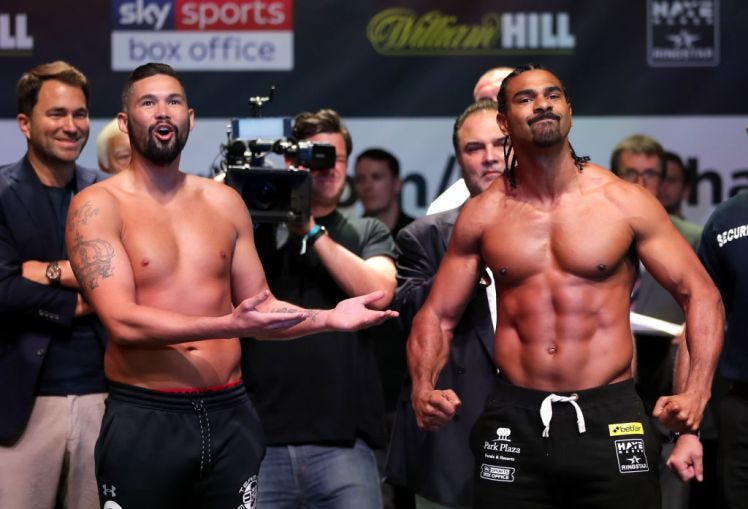

When the rematch with Bellew was called, it was postponed because of injury. Father Time must have been facepalming at the extent to which he was being ignored by Haye. Still, the result of the first fight was being put down to injury and exclusively so. A fully fit Haye was going to do what he would have done a decade prior, or so Haye and many fans and pundits believed. Although we failed to recognise that despite the chiseled physique being back, the fighter it once belonged to was no longer there.

Boxing YouTuber UltraTechSports, who as an aside has one of the best video intros on the internet, posted a video after Haye’s public workout and suggested that Haye looked injured. Haye’s distribution of weight was off and he wasn’t able to push off from his back foot which would undoubtedly hinder his biggest attribute of punch power. If Haye’s timing and speed had already gone, without his power, it was the final call from Father Time that Haye could no longer ignore.

Paulie Malignaggi, working as a pundit for Sky, made a similar observation from the first round. We weren’t seeing the Haye of old and UltraTechSports was bang on. Haye’s shots lacked their once signature power. Once that became apparent, Haye could no longer remain in denial and the once formidable fighter was now unravelling before our eyes.

Haye now needs to retire, a conclusion he should have come to years ago. Even if he were to continue fighting, it’s unlikely he’d find himself back in the mix as a contender for titles and the heavyweight landscape arguably has more depth than it did when he was at his peak.

Prior to the fight, he said that anything short of a spectacular defeat of Bellew would result in his retirement but in a post-fight interview, he didn’t seem so forthcoming with a retirement announcement. Maybe hearing Bellew and Eddie Hearn telling us “I told you so” in every iFL TV interview will give him the nudge he clearly needs.

With Hayemaker Ringstar Promotions, Haye can remain active in the sport without having to enter the ring again. He’s made a lot of money and despite a patchy record at heavyweight, has a legacy of being a former heavyweight and unified cruiserweight champion. He’s achieved much in the sport but I don’t want to see him in the ring again. Regardless of the result, he has no business being back in the ring either and that should be the message from everyone around him. I suspect those were sentiments from Adam Booth after Haye beat Chisora but to Haye’s detriment, it was clearly a message that he didn’t feel he needed to heed.

As for Bellew, I’ve always said that I’ve got a lot of time for him. He seems like a genuine guy and while I maintain he’s not an elite fighter, he’s a solidly good one who doesn’t lack heart. Bellew beat Haye and we shouldn’t take that away from him. However, Bellew wasn’t the only one getting the W at the O2 Arena; Father Time and denial were also there to claim their respective victories from David Haye.
SHARE:

Sunday, 18 February 2018

Chris Eubank Jr needs to rebuild and go back to basics

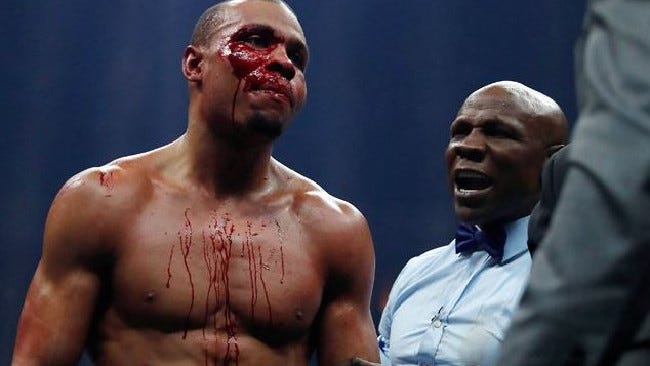
Contrary to what Team Eubank had managed to convince many pundits, boxing fans and even the bookies, Chris Eubank Jr lost a unanimous points decision to George Groves. The Brighton man was outclassed by Groves from the first bell and it quickly became apparent that nothing Eubank and his father had prophesied in the fight was going to happen.

When Eubank started his professional career, I was taken in by the hype based on his supreme conditioning and great engine. But his loss to Billy Joe Saunders was the turning point when I realised I’d been hoodwinked like so many others. I started looking at Eubank’s handpicked opponents, typically void of decent head movement and therefore perfect for replicating his “instafamous” training methods (because no matter how many times you hit the punching machine, it’ll never hit you back), and his apparent lack of punch power. What exactly had he done in the ring to confirm he was the real deal? He talked the talk but he didn’t walk the walk.

Consequently, I tipped Groves getting the W in their fight. I could see Groves using his boxing brain to fight at range, controlling the fight with disciplined and effective use of the jab all night. And that’s exactly what happened. Eubank was unable to close the distance and his messy and ineffectual work (exacerbated by a bad cut beneath his right eye) was the only thing he showcased.

Groves, however, was just too good, too big and too strong for Eubank and he worked to a game plan whereas Eubank seemingly didn’t even have one. If anything, I thought the scorecards were too close based on the extent to which Eubank was schooled by the Hammersmith man.

How could I be so sure? Surely Eubank’s high workrate and athleticism had to count for something? Was this not destined to be the opportunity he needed to showcase it?

It could have been. But when you can’t land a shot, and you’ve claimed you don’t need a trainer to steer you away from what was often an amateurish performance, you’re very quickly going to find yourself in a dilly of a pickle. Alas, that’s the situation Team Eubank had engineered for their man.

Coming up short for the second time in his career that he’s actually stepped up in class, Eubank, and his father, don’t need to eat a slice of humble pie; they need to eat the entire thing. Until the first bell, they’d convinced so many of his prowess and so compelling was their narrative that many believed the hype. Yet Eubank’s talk was writing cheques his body couldn’t cash.

In defeat, Eubank appeared delusional in calling for a rematch and audaciously calling out IBF super middleweight champion, Caleb Truax. There was no realisation that right now, challenging for world titles isn’t what he needs or deserves. Rather Eubank needs to go back to basics in every aspect of his team and career.

Team Eubank are still claiming Eubank’s performance wasn’t reflective of what he’s capable of. How many more opportunities does Eubank need to show us he’s the real deal? Unfortunately, for Team Eubank, Groves, like Saunders before him, has derailed the Eubank hype train until further notice.

Eubank proclaiming himself as some kind of Clubber Lang (of Rocky III fame) wrecking machine who doesn’t really need a trainer is ludicrous and the biggest learning point he should take in defeat. Eubank is a phenomenal athlete and at domestic and fringe world level, that can sometimes be enough. Although to operate without any depth in actual boxing skills at world level is ridiculous and declining to enlist the services of a trainer to address that is beyond arrogant. Should Eubank be able to talk himself back into undeserved contention for a world level fight off the back of his defeat to Groves, he’ll be left wanting again with the status quo.

Ronnie Davies, Eubank’s trainer seemingly in name only, is effectively a sideman in the corner. That isn’t Davies’ fault, that’s the position he’s been relegated to by Eubank and his father. Davies needs to call it day with Team Eubank. He doesn’t command the respect of Eubank and that ship has long sailed.

Eubank needs to seek someone who’ll actually train him and almost reteach him to incorporate boxing basics into his style. He needs someone who he’ll listen to and respect and with whom he’s able to establish a rapport where they’re a trusted voice in the corner. The question is, is it too late to undo Eubank’s arrogance and establish the required balance in his team? His corner was an absolute shambles. Has he not realised this himself?

Much has been made of the distraction that Eubank Snr presents to his son’s career and his team. Eubank Snr knows how to sell a fight with his controversy but perhaps Eubank Jr too has been taken in by his father’s promotional fanfare. After his latest defeat, Eubank Jr may have finally been given the nudge to distance his career from his father and if he wants to progress his career, that may well be an unexpected move in his rebuilding. After all, the ‘warrior’s code’ clearly wasn’t enough on this occasion and Eubank Jr might want to enlist some orthodox advice going forward.

Naseem Hamed, part of the ITV Box Office punditry team, went as far as saying Eubank should call it a day and didn’t mince his words in lambasting Eubank’s performance. Hamed alone made the PPV worthwhile, dropping more truth bombs on Eubank than a Funkmaster Flex show. I don’t think Eubank need throw in the towel on his career but he needs a rebuild of his team and a reality check of just how good he currently is.

Eubank arguably also needs to move back down to middleweight. Groves is a big, strong super middleweight and without a rehydration clause, he would have entered the ring as a light heavyweight. In contrast, Eubank is a blown up middleweight who’s just too small. Already not being a big puncher, he lacks the power and size for the 168lbs division. It was apparent when he fought Groves and it’d be the same against any legitimate super middleweight at world level. They say speed kills in the ring but not if you can’t land a shot and can get man handled from the outset.

Eubank is a decent fighter, just not the fighter he claims to be. If he wants to become the boxer he says he is, he needs a new team and to adopt a dose of humility to balance out his spades of hubris. His defeat to Groves, and the accompanying deflated ego, may just be the wake up call he needs to effect that.
SHARE:

Sunday, 27 August 2017

What did we learn from Mayweather vs McGregor? Not much

In what was billed as one of the biggest sporting events in history, Floyd Mayweather vs Conor McGregor has come and gone. It’s undoubtedly broken PPV records and generated a level of hype beyond that seen in either boxing or MMA thanks to all the casual interest. All involved with the event are also walking away with epic paydays. Indeed, as a friend put it, McGregor is walking away from his debut with a record of 0–1 yet with more cash than many fighters see in their entire careers. And Mayweather, who took the lion’s share of the revenue, of course walks away with his 50th W on his record complemented by 0 losses.


The fight played out largely as expected. That is of course if you weren’t a McGregor fanboy, or sections of the MMA media, whose skewed analysis and narrative were without doubt the most irksome aspect of the fight’s build up (that’s not referring to actual MMA fans who unlike the aforementioned actually took a measured and knowledgeable approach and analysis to the fight).

Most anticipated Mayweather would take a few rounds to shake off any ring rust, gauge McGregor’s game plan and establish his range. Consequently, he’d become more elusive to McGregor’s offensive, adopt a strategy of attrition and start landing shots at will to close the show. Despite McGregor being stopped in round 10, Mayweather could arguably have put those combinations together from round 6, when McGregor was now clearly fatigued, and with the same conclusion.

For his part, McGregor didn’t present himself as Mayweather fodder en route to a pay day. He came to another man’s sport and fought under Queensbury rules. He showed a solid chin and above all a self-belief that was second to none in contrast to Mayweather’s previous opponents. He really felt he could cause an upset and convinced many people of it too. Despite being immovable from a likely victory for Mayweather, I admittedly found McGregor’s self-belief and master salesmanship incredibly convincing. Nevertheless, he was fighting a pound for pound great in a sport that he had no professional experience in.

It would be remiss to dismiss his pedigree and success as a fighter, let alone to not expect some of that to transfer to his preparations for Mayweather. But this is boxing and like any sport there are levels. And a novice to the sport, just as a boxer would be in MMA, simply isn’t on the level of a pound for pound former champion, even in retirement. So what did we actually learn from this fight? The answer is not much that we didn’t already know.

Both fighters’ compelling promotion prevented logic prevailing for the deluded factions of the McGregor supporters who felt this was a 50–50 fight or worse still that Mayweather would fall victim to McGregor’s left hand. What they failed to appreciate was that the fight was on Mayweather’s turf of boxing. Aside from an unorthodox style that would require a few rounds to read, there wasn’t anything McGregor could bring to the fight that Mayweather either hadn’t already experienced or didn’t know how to neutralise.

To think otherwise was what caused the ire of so many of the boxing fraternity. They felt their sport wasn’t being respected by MMA fans insofar as the belief that a novice would be able to do what 49 others, who had dedicated their lives and careers to the sport, were unable to achieve.

As a result, many viewed this fight as boxing vs MMA, a notion as inequitable as sprinting vs long distance running or rugby vs football. Simply because the respective disciplines may present some commonality, that doesn’t make such direct comparisons viable. I’m sure McGregor knew this yet dared to dream for which he should be commended. Alas, many others did not.

The internet will be a better place without the fanboys whose comments, void of objectivity and full of ignorance, have littered comment sections and social media since this fight was announced. Unfortunately, still not convinced that their man was conclusively defeated, some still remain delusional.

The same goes for sections of the media. As boxing journalist Steve Bunce commented of the MMA press, some reports would suggest that McGregor’s training had transformed him “from raw novice boxer to some type of creation that is part Stephen Hawking and part Clubber Lang.” If anything, the subsequent result will perhaps in future inject some reality into such sentiments.

The dust has settled and both fighters are even richer than they already were. McGregor may not have achieved the unthinkable, in what was a lofty yet admirable aspiration. Although he has earned the respect of a boxing fraternity that has long held a chip on its shoulder with the success of MMA as a fellow combat sport.

McGregor was noble and gracious in defeat and showed respect to the sport that provided the landscape for his loss. His profile has also risen in the mainstream without an adverse effect on his stock within the UFC. Mayweather, who had less to gain besides the pay day, also leaves with his legacy unscathed and a 50th, yet meaningless (given the opposition), W on his record.

As for the spectators, they were provided with an event full of fanfare and an uneventful fight that could have been worse. And were they hoodwinked? Probably not. The outcome was there for everyone to realise from the outset. It just depends on what they chose to see.
SHARE:

Sunday, 16 July 2017

Let’s accept Mayweather vs McGregor for what it is

When Floyd Mayweather vs Conor McGregor was announced, my first reaction was it was a mismatch; one that disproportionately favoured Mayweather but would have an entertaining build up and generate a lot of money. That isn’t to throw any shade at McGregor but he’s taking part in a sport that he’s never competed in against a fighter considered a pound for pound great. If those odds aren’t stacked against him, I don’t know what is.

Nevertheless, the fight presents some intrigue, less so around the result which is roundly expected to convincingly go Mayweather’s way, but in what it represents in potential commercial success and an analysis of the overall event.

Firstly, this fight needs to be accepted for what it is in a commercial endeavour rather than a sporting one. Indeed, aside from trying to generate further hype and anticipation, I expect the delay in negotiations was more about how they could generate the most income and deciding what each fighter’s revenue streams would be. Both Mayweather and McGregor have a well publicised penchant for money and as I previously predicted, post-retirement Mayweather’s lack of fight income means he has little to offset his gambling debts, apparent poor business acumen and financial management. That’s also now compounded by an IRS bill.

The fighters may argue otherwise but there’s little legacy to fight for here. A Mayweather victory means he beat a 0-0 fighter from another sport. This fight is about money first and bragging rights second.
McGregor in Bantersaurus Rex mode
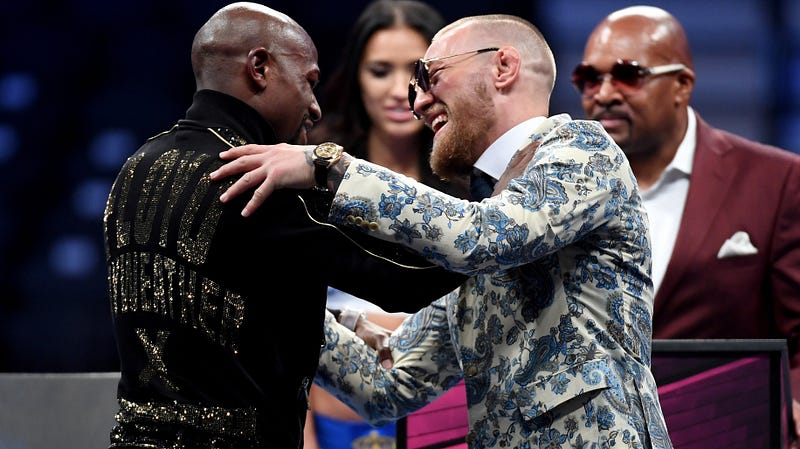
Consequently, entertainment and generating interest is high on the agenda. The first presser was entertaining with Mayweather probably edging McGregor in the banter stakes but the subsequent presser in Toronto was a 10-8 round to McGregor who put in a bant-tastic display that echoed Muhammed Ali in his prime. As a fellow fight fan put it, McGregor had more zingers than KFC. However, after Toronto, New York and London were mediocre to say the least.

New York and London represented a pantomime akin to that expected from WWE but one that was crass and desperate. After Toronto, the world tour had run out of steam. It was gassed like a fighter in the championship rounds that had neglected their cardio in training.

I’d go as far suggesting the Toronto presser will remain the main event and high point but what of the fight itself? I can only see a Mayweather victory and all the evidence points towards it.

Combat sports aficionado and multi discipline participant, David Dennis, shared some of his thoughts on the fight and agreed that all roads lead to a Mayweather victory. A wide UD points decision where McGregor is toyed with for 12 rounds, made to repeatedly miss in a defensive masterclass from Mayweather, or a TKO, probably with McGregor walking onto a shot similar to the check hook that saw Hatton hit the canvas when he fought Mayweather, were both scenarios we envisaged. Furthermore, McGregor could even see himself disqualified if his muscle memory reverts to type as he forgets that he’s now operating under Queensberry rules rather than MMA where his fists are the only permitted tools.

Mayweather’s fragile hands probably won’t allow for any meaningful power punches and as the bigger man, McGregor may be able to use his size and grappling experience to rough Mayweather up on the inside. But the chances are Mayweather’s too smart to allow him to get close enough to do that. Anything can happen in boxing and if McGregor lands a big left, Mayweather could be in trouble. Although the likelihood of that is slim, albeit not impossible. As David put it, “Floyd really is as good as everyone hates to believe he is” and he gave McGregor a 2% chance of victory.

David added further insight into the commercial value of the fight with PPV buys perhaps being eroded by boxing purists who have shown much vitriol toward the fight, more than I previously expected. Oscar de la Hoya, promoting Canelo vs GGG as a genuinely epic fight only a matter of weeks later, has been very vocal against Mayweather vs McGregor (which will undoubtedly eat into his own PPV buys). Many of the traditional boxing press, who already felt Mayweather’s braggadocio was unwelcome in the sport, are similarly against it.

Boxing has admittedly had a chip on its shoulder when it comes to MMA, primarily UFC with its commercial success. For many within the boxing community, this is a fight that is not only boxing vs UFC but also one that they will turn their backs on as a brash Irishman attempts to hijack their sport.

That leaves the casuals, the intrigued and McGregor fanboys to make up the bulk of PPVs buys. Yet in McGregor especially, boxing and UFC’s premier salesmen and self promoters will certainly maximise those numbers to an extent beyond much else seen in either sport.

McGregor does provide some intrigue insofar as he presents Mayweather with a type of opponent that he’s never faced. Certainly more outlandish, a better self promoter, more braggadocious, void of fear of Mayweather and with a self-belief that he really can win, McGregor makes for a great rival. It’s just as well because that translates into promotional hype to sell the fight. It just doesn’t translate into fighting ability in a sport that McGregor’s never competed within.

Both fighters presumably realise this fight is a spectacle but one that will make gargantuan amounts of money. As spectators, we too need to realise and accept that. That means enjoying the inevitable entertainment that we’re likely to get, albeit outside of the ring, and appreciating the fight for what it is.
SHARE:

Wednesday, 3 May 2017

Anthony Joshua has answered the questions about just how good he is

My prediction for Anthony Joshua vs Wladimir Klitschko came fairly late compared to most fights. The fight simply raised so many questions upon which it was difficult to make an informed choice as to who would win. My biggest question was just how good Anthony Joshua actually is. Although after last night’s heavyweight barnstormer, we now know that he’s the real deal.

As the fight neared, my doubts for a Joshua victory incrementally grew. I wasn’t buying the smoke and mirrors narrative that Eddie Hearn and Sky generated because it was based on Joshua defeating fighters like Charles Martin. That wasn’t a slight against Joshua but merely a fact that Joshua hadn’t fought anyone upon which to gauge how good he was.

In contrast, Klitschko looked more focused than ever and as an experienced fighter who didn’t need the money as an intrinsic motivator, he clearly believed he could win having seen a chink in Joshua’s arsenal that he could exploit. Consequently, I hesitantly went with a Klitschko victory by stoppage in the mid to late rounds but to his credit, and in more ways than one, Joshua proved me wrong.

The tactics and developments of the fight largely played out how I anticipated. I expected both fighters to be fairly gun shy in the opening rounds before Joshua would try to steamroll Klitschko; relying on his power to stop the Ukrainian but getting gassed in the process. And in the fifth round that’s exactly what happened with Joshua unloading a barrage of his signature bombs that put Klitschko on the canvas.

Klitschko, who’s always been perceived as chinny from earlier in this career, managed to get up and showed he could indeed take Joshua’s power. He returned to put a spent Joshua on his backside in the sixth with a stunning knockdown. An exhausted Joshua, exacerbated by him coming in at a career heaviest to presumably bolster his power for a stoppage, was taking a shellacking and experience was now trumping youth.

I thought it was now over for Joshua as the fight continued to play out largely as I had predicted. He was now in uncharted waters, being on the receiving end of such punishment and unable to answer back with anything meaningful, and I expected the referee to stop the fight or for Klitschko to take matters into his own hands. He looked punch drunk after the knockdown. His corner must have been concerned and I wouldn’t have been surprised if Eddie Hearn soiled himself as his cash cow was on the verge of defeat.

Though somehow Joshua managed to survive. If we didn’t know if he had heart and survival instincts before, there was no doubt based on the sixth round. But this was also the round where Klitschko’s experience perhaps lost the fight for him. Where a greener fighter would have probably emptied the tank having smelt blood and gambled on seizing a brutal stoppage, Klitschko didn’t succumb to the temptation to take a risk in such a high stakes fight. Yet had he, he may have seen the W.

Klitschko continued to play the long game in subsequent rounds but neither fighter disappointed. For a 41 year old who hadn’t been in the ring since November 2015, Klitschko showed no signs of ring rust or age. Similarly, any doubts over Joshua’s ability at this level were banished. We always knew Joshua could dish out punishment but now we knew he could withstand it too.

In the 11th, Joshua, maybe sensing urgency, showed that he’d carried his power throughout the fight despite what were a gruelling previous ten rounds for both fighters. To have power is one thing, but to maintain it in a fight like this shows true mettle that Joshua has never had to prove. Coming out from the bell, he looked to take Klitschko out and was seemingly willing to empty the tank yet again to achieve it. It was a gamble worth taking and after Klitschko met the canvas twice, a further onslaught saw the referee stopping the fight. Youth and power had trumped experience and delivered Joshua to a deserved victory.

What was probably the biggest surprise was that the fight was truly a humdinger of a bout. Klitschko has been responsible for many a borefest that has characterised heavyweight boxing as a division void of the glamour and hype of yesteryear while Joshua has been largely in routine fights that excited only the casuals and frustrated the boxing fraternity. Both fighters were therefore unlikely players in a thrilling act that has restored the excitement that should be inherent to heavyweight boxing as the pinnacle of the hurt business.

We cannot doubt the heart, power, chin and resilience of either fighter and there is absolutely no shame in Klitschko’s defeat. Indeed, for yesterday’s performance, I rate him more now than I did for the bulk of his career.

Similarly, Joshua has answered the question of how good he is. He survived a tear up with a future hall of famer who wasn’t past it either and came out victorious in a manner that I didn’t foresee.

Joshua is still being built as a fighter and would have learned an abundance in this fight (and arguably implemented some of that within the second half). Against explosive and predatory fighters like Deontay Wilder or David Haye, Joshua wouldn’t have been granted the respite Klitschko gave him by not pursuing the knockout in the sixth round and upon smelling blood, both would have pounced with the ferociousness of a savage lion upon its prey.

Wilder and Haye will have been watching realising that while Joshua is dangerous, he is vulnerable with a less-than-granite chin and can be hurt and even put down. Tyson Fury too, who Joshua called out post-fight, would present an awkwardness that would test Joshua as it did Klitschko. Nevertheless, Joshua isn’t just a heavy puncher, we now know he’s also a fighter who’s willing and able to go in the trenches and come out fighting.

The fight will be fuel for the Joshua hype train driven by Sky and Matchroom and boarded by those who’ll continue to make irksome and sycophantic comparisons to Muhammed Ali and other legends. Though right now, Joshua is at the top of the heavyweight tree and deservedly so. A rematch clause was included in the contract but at 41 and after a tough fight, will Klitschko want it?

Before the fight many questions were asked. Subsequently, many answers have been provided. We saw two unlikely warriors banish the doubts that have characterised their respective careers thus far and instead putting on a performance that will contribute to their legacies as great fighters.
SHARE:

Sunday, 23 April 2017

In a fight of unknown quantities, Anthony Joshua’s level is the biggest question mark in his fight against Wladimir Klitschko

Anthony Joshua is the favourite in his fight against Wladimir Klitschko. Many of his casual fans, who probably don’t know who Wladimir Klitschko is, can’t fathom a scenario where he doesn’t share a ring with a fighter that’s already lost before the first bell. And while Joshua can only fight who’s put in front of him, the level at which he’s been assessed to operate at has been largely based on his mostly mediocre opposition.

Yet despite Joshua’s status as favourite, when it comes to his fight with Klitschko, we’re looking at a fight of unknown quantities. Is this fight too soon for Joshua? Can Joshua get past Klitschko’s jab? Can Klitschko’s chin, which has been exposed earlier in his career, withstand Joshua’s power? Was Klitschko’s loss to Fury just a bad night at the office for the Ukrainian or can we assume Father Time has called upon him? Has his hiatus from the ring since November 2015 resulted in ring rust? The questions are aplenty. But amidst them all, the biggest unknown is just how good is Joshua and is he as good as we’ve been led to believe?

While I think Joshua is a solidly good boxer, who can become an elite fighter, my immediate answer to the latter would be no. Joshua’s good but he’s not as good as we’ve been led to believe. That’s because his promoter Eddie Hearn, the Sky hype machine and the casuals have heaped so much hype upon him that we need to rein in any perception of the level he’s currently operating and restore some realism to what we’ve seen in his 18 fights.

Eddie Hearn has built Joshua’s career with incredible timing. Every opponent placed in front of Joshua has been been carefully considered to heavily dilute any risk while making Joshua look better than he arguably is and this fight is no different. Team Joshua’s thinking behind fighting Klitschko now is that he’s peaked, no longer represents a threat and is therefore ripe for as a perfectly timed 19th KO for Joshua. Meanwhile, Klitschko’s record and reign at the top means should Joshua get the W, he can legitimise all the hype around him without having to encounter a risk that is commensurate with the reward.

Though what if Hearn et al have taken in their own hype around Joshua, so much so that they’re unable to gauge the level he’s operating at? What if after 18 fights and 18 KOs, they’ve started to believe their own carefully constructed narrative that Joshua is invincible, compounded with a misguided risk assessment of Klitschko? If Klitschko turns up and isn’t the fighter that was made to look lacklustre by Tyson Fury, that isn’t the narrative Team Joshua will be anticipating. It’s also a narrative that would be the sternest test Joshua has had to date and a venture into uncharted waters where we don't know whether we’ll see Joshua sink or swim.

There’s no doubt that Joshua has explosive power and he puts his shots together with an ease that would suggest a more robust resume than he actually has. His hand speed is impressive as is his movement and ability to cut off the ring. Although his poor head movement, questionable chin and stamina seem to have been completely disregarded in assessing how he’ll fare against an opponent with a supreme jab, power and above all an attribute that Joshua doesn’t have in experience.


With 64 wins (and four losses), Klitschko has experience in abundance. He won’t be fazed by Joshua and if he wins this fight, it’ll be his experience trumping Joshua’s youth. Experience will be what mitigates any ring rust and experience will have mentally steered him back from his defeat against Fury. Experience is the ace that Joshua just doesn't have and it could be to his detriment.

Joshua doesn’t seem to have his usual air of confidence which could be telling of his lack of experience. In The Gloves are Off, which was hardly a barnstormer, Joshua seemed poised but his demeanour suggested he’s not as confident as usual. Perhaps he was merely showing Klitschko a level of respect his previous opponents didn’t warrant but in the media workout too, there were signs that his confidence may have been affected by the task ahead. Joshua can be heard to be asking several and constant questions of Rob McCracken. That’s a good sign of a fighter who is always seeking to learn and improve rather than assume the hubris many elite fighters adopt. Conversely, it could also be interpreted as having an air of needing reassurance in a fight where he’s less assured of the outcome.

I’ve long been critical of Klitschko’s ‘jab and grab’ style insofar as providing entertainment value but its effectiveness can’t be denied. With Joshua’s poor head movement (which I expect McCracken has sought to address), he could be a walking target for Klitschko’s jab and there’s also the question mark over how his chin will hold up against Klitschko’s shots. There’s also been uncertainty around whether and how Joshua will survive when he gets hit cleanly because he’s not used to it based on his gun shy opponents thus far. That isn’t just physically but mentally. Joshua is used to turning up and blasting his opponents out but should his fight with Klitschko deviate from that, there’s no real precedent for how he’ll deal with it.

Klitschko has the experience and patience, and a willingness to adopt a safety first approach en route to victory, that it’s unlikely he’ll go looking for a KO. If Joshua can’t neutralise Klitschko’s jab, I expect Klitschko would happily give us another jab and grab borefest performance for 12 rounds while navigating himself to a points win. There’s little chance of a tear up in this fight and that suits Klitschko. Whereas Joshua has come to be known as a knockout artist. But what happens if the knock out doesn’t come? Depending on the Klitschko that turns up, Joshua could be encountering a scenario unlike any he’s experienced in his professional career and no one knows how he’ll deal with it let alone if he’s able to.

A Joshua victory would be an amazing and deserved achievement. If Klitschko comes out on his a-game in the process, it would also answer a lot of the questions around just how good Joshua is. The casuals might not realise it but there are levels in boxing. And based on his fights to date, we just don’t know where Joshua’s level is. In a fight with so many unknowns, Joshua is taking a gamble in this being the fight where he seeks to provide those answers. Nonetheless, there’s a chance that he and his team don’t realise just how much of a risk they’re actually taking; especially if they’ve unknowingly taken in their own hype.
SHARE:

Sunday, 5 March 2017

What should we make of Bellew’s defeat of Haye?

I cannot recall when my prediction for a fight was more wrong than it was for David Haye vs Tony Bellew (bizarrely, my partner who has no interest in boxing correctly predicted the result during fight week so perhaps I should have listened to her). I’ve got a lot of time for Bellew; he’s got moxy and heart in abundance, a decent skill set (better than many give him credit for) and he can punch and take a shot. He’s a solidly good fighter in my opinion, but not an elite one. Hence I didn’t think he could do anything to neutralise what Haye would bring with speed, explosiveness, accuracy and a natural weight advantage.


Overall, I stand by my assessment of both fighters and prior to the fight I was confident of a quick KO of Bellew within 3 rounds. Though that prediction was far from realised and at no point in the fight did it look like it would be either. Furthermore, in retrospect, perhaps my assessment of Haye was based on the Haye of yesteryear; not the fighter who had an almost 4 year layoff with consequent ring rust, injuries and (excluding Bellew) has only fought substandard opposition since his return to the sport.

I conceded that Haye’s previous two fights showed us little of how good he still was because they presented such limited challenges in his opponents. And at the back of my mind that was a small question mark over Haye. Nevertheless, I thought it was just a matter of time before he caught Bellew with a big shot, smelt blood and went in for a trademark clinical finish. Yet from the outset, the ending I envisaged became increasingly elusive.

Haye began the fight clearly looking for that big shot but with some untidy and reckless work that reflected clear ring rust. There wasn’t anything clinical about his boxing in the first round that I scored in favour of Bellew. Haye experienced more success in subsequent rounds within the first half of the fight and I scored it accordingly. Although he wasn’t eclipsing Bellew how many expected and the Liverpudlian wasn’t fazed by him either. Bellew took some solid shots from Haye but soaked them up and came back with some of his own. So much so that while Haye was still the favourite for me at this point, I thought a knockdown (where he’d get up to come back and win with a stoppage) might have been forthcoming.

Then, in round six, and ahead on my scorecard, Haye succumbed to an Achilles injury (that was rumoured to be the reason why he made a trip to Munich during fight week) which was probably exacerbated by a poor choice of boxing boots lacking adequate support. At that point, it was clear that the fight was Bellew’s for the taking. In the eleventh round, Haye’s corner did the right thing and Shane McGuigan threw in the towel knowing that not only was his fighter unable to compete until the final bell but that he was unable to win.

We shouldn’t detract from Bellew’s win but unlike many of the casuals and the media, we should be measured in how it’s discussed. Yes, Bellew took Haye’s biggest shots in the first half of the fight and came back with his own. Yes, he wasn’t afraid to trade with an explosive puncher a weight above his own weight class. And yes, he was the victor. For that, we must commend him. Nonetheless, after round 6, Bellew was fighting a man effectively fighting on one leg and therefore unable to unload anything meaningful. While Bellew fought well, he alone didn’t beat Haye; Haye’s injury played its part too.

Bellew and Haye were magnanimous warriors in victory and defeat respectively and it shows why boxing is one of the greatest sports in the world. Boxing is the hurt business but in few sports would you get such vitriolic needle in the build up juxtaposed to such an extent with the sporting behaviour and mutual respect shown by Bellew and Haye. Boxing might be branded a barbaric sport by its detractors. But seeing Bellew help Haye (a man who had made beyond spiteful and offensive utterances to his opponent in the build up) to his corner, while eschewing his team’s efforts to celebrate, showed the level of class Bellew possesses. He isn’t everyone’s cup of tea but the man is a certified gent without a doubt.

Similarly, unlike Haye’s defeat against Wladimir Klitschko, there was no citing of his injury. He rightly gave Bellew unreserved respect and kudos.

So what now for both fighters? Three fights since the return from his layoff and we’re yet to see the Haye we once knew. Has that been purely due to the level of opposition and in his latest fight his injury? Putting the injury aside, the first six rounds against Bellew were his opportunity to show us otherwise and had we seen it, Haye would have likely won the fight. At 36, Haye is running out of time to prove that he can regain his position on the top tier of the heavyweight tree. Has Father Time caught up with Haye or has he just been unlucky? If it’s the former, it could be time to call it a day, safe in the knowledge that he has a legacy as a former unified cruiserweight champion and a former heavyweight champion.

Haye called for a rematch but apparently his team were lukewarm toward the inclusion of a rematch clause in the contract. However, it remains an option for Bellew who before the fight said that he would give Haye a rematch. Bellew has more options in being able to return to cruiserweight to defend his WBC belt or challenge for a heavyweight title as mooted by Eddie Hearn. He could even walk away from the sport having achieved more than he expected and presumably being financially secure.

Eddie Hearn too has shown himself to have played yet another masterstroke as a highly adept promoter with impeccable timing for his fights. He’s also surely full of glee that David Haye seemingly no longer presents any obstacle to the Sky hype machine peddling the story of Anthony Joshua as the world’s greatest heavyweight.

It’s opined by many that Bellew was Eddie Hearn’s fodder for Haye to not only gauge how good the latter was before a potential fight with Joshua but also to stall a fight with the current IBF champion should he get past Klitschko. If the old Haye is still there, he beats Joshua everyday of the week but based on the first half of his fight with Bellew, it’s a much more evenly matched fight.

Bellew deserves the utmost respect in victory and for his post fight conduct towards Haye. But let’s not make more of his win than we should given the circumstances. Haye and his team now need to ask themselves if the loss was a case of bad luck or the tap of Father Time upon Haye’s shoulder. It remains to be seen what the answer is but it’s a question that needs to be answered as Haye assesses his next move in (or out) of the sport.
SHARE:

Monday, 6 February 2017

Chris Eubank Jr talks the talk but we’re still yet to see him walk the walk

Chris Eubank Jr is the IBO Super Middleweight champion of the world. To casual boxing fans, that might carry some kudos. However, to most within the boxing fraternity, it’s considered a lightly regarded belt and one that is broadly unrecognised as being on the fringe of the four main governing bodies (WBC, WBA, IBF and WBO).

Further diminishing the credibility of his newly bestowed title was Eubank Jr’s opponent Renold Quinlan, an 11-1 fighter who most (including me) hadn’t heard of prior to this fight. Needless to say, many boxing fans are finding it difficult to accept this fight as Eubank Jr’s ticket to being considered a marquee fighter. Conversely, Eubank Jr, and his father Chris Eubank Snr, claim that he is not only ready but deserving of the big fights. Perhaps he is ready (if not deserving) but we’re yet to see it for ourselves.

When Eubank Jr turned professional, I considered him hugely promising. He wasn’t (and still isn’t) trading off his father’s name for success and like the elder Eubank, has showmanship and a formidable chin. Jr has also shown impressive hand speed upon which his father has predicated the loftily perceived claims that his son is already a pound for pound great who would defeat Gennady Golovkin and Andre Ward. It’s utterances like this that make it difficult to take Team Eubank seriously but again, perhaps they know something that they’ve just not shown us.

This is the issue with Chris Eubank Jr. He talks the talk but he’s yet to walk the walk. At the time of writing, his only defeat is to current WBO Middleweight champion Billy Joe Saunders. Saunders also represents the sternest test on Eubank Jr’s resume and a test that he didn’t come through in a 2014 split decision. Therefore on what basis does he consider himself at elite level?

I was wrong in predicting a Eubank Jr win against Saunders and it’s rumoured (though I’ve never heard it used, let alone mentioned, as an excuse by Team Eubank) that he was ill prior to the fight. Nevertheless, the remainder of Eubank Jr’s fights have broadly been against fighters of domestic level. For a fighter billed as being ready for the big leagues, you’d expect him to despatch them more deftly than he does which suggests that while his hand speed is impressive, his power is not.

It took 10 rounds for Eubank Jr to get a stoppage against Renold Quinlan and seven rounds to do the same against Gary O'Sullivan. Eubank Jr certainly isn’t a knock out artist but when we see him loading up his signature spiteful uppercuts, I previously expected them to do more damage then they evidently do. I wouldn’t go as far as calling him a powder puff puncher but perhaps he doesn’t possess the firepower Team Eubank would like us to think he does.

Eubank Jr also gets hit far too much for my liking. Yes, he clearly has a good chin but if he thinks he can take the amount of shots he took against Renold Quinlan against Golovkin, I imagine he’d be in for a rude awakening if they ever meet in the ring.

One thing we can’t question is Eubank Jr’s conditioning. Regularly posting videos of his training on social media, you can see the intensity and it’s undoubtedly impressive. Although, this is boxing, the hurt business, not a Zumba class. Furthermore, pads and heavy bags don’t hit back. And if Eubank Jr’s training isn’t translating into similarly impressive performances in the ring, his Snapchat videos don’t count for anything other than telling us he goes hard in the paint. Other than recognising the intense training he undergoes, I’m not making anything of his videos other than braggadocio and raising his social media profile.

Every fighter needs to have confidence and Eubank Jr has buckets of it. But many feel it’s misplaced hubris that he exudes. Suggesting his trainer Ronnie Davies is more of a cornerman who occasionally gives advice, presents a flawed fighter-trainer relationship; one that lacks discipline and respect on Jr’s part and doesn’t bode well for his fulfilling of the promise we have been sold by Eubank Snr of his son becoming one of the greats.

A Saunders rematch, Golovkin and James DeGale are all fighters that Team Eubank claim they want in their next opponents. The former two are fights that they are generally considered to have been scuppered with Eubank Snr’s negotiations and DeGale wants nothing to do with Eubank Jr due to the existing bitterness between the pair. Contrary to what Eubank Jr may feel, his IBO belt also fails to tempt any of those fighters as it isn’t a belt they regard with high esteem. Team Eubank have a bad reputation for unreasonable demands in negotiations and they may have found that they’ve blackballed themselves out of the very fights they claim to want.

The Eubank Jr show is an intriguing one and I won’t go as far as claiming he isn’t the everything Team Eubank say he is. After all, he’s shown the attributes to suggest that this could be case. He just hasn’t shown it to us in the ring. Putting his lightly regarded belt aside, he needs to step up in opposition ASAP and show that he deserves to be in the mix with elite fighters based on his performance. Thus far, none of his opponents, or indeed his performances, have presented an opportunity for this to be showcased.

Maybe my first impressions of Eubank Jr were correct and he is the real deal. However, I’ll continue to reserve judgement until he proves otherwise.
SHARE:

Sunday, 15 January 2017

Khan doesn’t want it with Brook

At the beginning of 2014, I wrote about five all-British fights that I wanted to see. They didn’t all happen in 2014 but, with the exception of one, all have occurred at the time of writing. That one fight is Kell Brook vs Amir Khan.

Since that post, Khan has fought four times with three wins and one loss. That loss was a KO at the hands of Canelo, a fight that he was roundly predicted to lose. Most boxing fans foresaw his chin wouldn’t be able to withstand Canelo’s power (not to mention the jump in weight to a catchweight of 155lbs being too much for him). As far as modern boxers go, Khan’s frequency in the ring is probably just below average (if not too infrequent for those of us that hark back to the golden eras of the sport where fighters were much more active) but it’s been punctuated by some admirable charity work.

In contrast, Brook has fought six times in the same period. During that time he wrested the IBF welterweight belt from Shawn Porter, beating the American as the away fighter. Subsequently, he defended it against less impressive opponents than those faced by Khan. Though his most recent fight was against Gennady Golovkin, a fight he lost by TKO following his corner retiring him due to a broken eye socket.

In similar circumstances to Canelo vs Khan, Brook went up in weight to fight at middleweight but even in defeat, his stock rose and there was no shame in losing his ‘0’. Not to detract from Golovkin’s victory and ferocious punch power but Brook ended the fight on his feet (unlike Khan who fought a less spiteful puncher in Canelo yet ended up on the canvas). Furthermore, had Brook not sustained the injury that led to the fight being stopped, he showed that he was not only able to withstand Golovkin’s punch power but also trouble him with his own firepower, athleticism and pugilism. In fact I can’t recall when another fighter put it on Golovkin like Brook did in the second round of their fight.

Both fighters are therefore coming off losses and looking for big money fights which would make Brook vs Khan a no-brainer. Alas, more than ever, it seems that Khan just doesn’t want it with Brook.

Brook and his promoter Eddie Hearn have chased this fight for so many years that it’s become borderline embarrassing in how much they want the fight. Initially, Khan claimed that the fight didn’t make commercial sense as Brook was largely unknown outside of boxing circles, didn’t have any high profile names on his resume and didn’t have a belt. And he was right. Despite my desire to see this fight, taking it a few years earlier would have likely seen it generate much less revenue than it could do today. Yet despite his valid opposition then, Khan and his team clearly didn’t want the fight. They continue to claim that Brook isn’t a problem for them and that they’d be the a-side to the fight but on both counts I would beg to differ.

Brook has since addressed Khan’s concerns regarding the commercial viability of the fight. He’s now IBF champion, has increased his stock on both sides of the Atlantic and despite a defeat, troubled GGG and took his best shots in a way that no middleweight has done. Conversely, Khan hasn’t been particularly active and has failed to deliver a performance that’ll erase memories of his chin getting lit up like a christmas tree (as a friend once so eloquently put it).

Khan is a bigger name in America where he’s had more of a presence and is now based but I still see him as the b-side to the fight. And since this fight was first mooted, I’ve seen Brook as the favourite. Indeed, and as Khan is very aware of hence his reluctance, I can see a defeat against Brook ending his career.

Canelo vs Khan was accurately billed Power vs Speed, a nod to what each fighter was bringing to the table in their respective skill set. On that basis, Brook vs Khan should be billed ‘power and accuracy vs speed and a suspect chin’. I’ve said repeatedly that Khan can’t hold a shot and the KOs he has experienced, or wars like his fight against Marcos Maidana (where he showed himself to have heart and balls in abundance), will not only have damaged his confidence but also affected his already fragile punch resistance. His trademark poor discipline in refraining from a temptation to trade also does him few favours. His chin isn’t built for brawling and big punchers like Brook will tear him a new one if he tries to initiate a tear up.

The sticking point in resumed negotiations between the two camps are reportedly the split (Khan still feels he’s the a-side and should take the lion’s share while Brook is content to take a 50-50 split). Again, Khan is presenting a stumbling block through his misguided hubris as he brings less to the table by the day. He’s also insisted that the fight take place at welterweight; a clear disadvantage to Brook who’s disadvantaged at the weight and would perform more effectively at the light middleweight limit of 154lbs.

With all of Khan’s rhetoric prior to the Canelo fight of being able to perform better at a higher weight class, why not take the fight at 154lbs? Because he’s clutching at straws to duck the fight or give himself an advantage if it does happen.

I don’t want Brook to fight at welterweight and would rather see him relinquish his IBF welterweight belt and move up in weight. He’s weight drained at welterweight and looked the best we’ve seen him at 160lbs when he fought Golovkin. But his own stubbornness is preventing him from making the move. He’s the a-side in the fight and if Khan really wanted it, he’d move up for the fight and the consequent pay day and opportunity to prove himself. He should also be grateful that Brook isn’t pushing for more of a 50-50 split (which is probably fair given Khan’s profile).

Fight fans want to see the fight and Brook wants it too. It’s only Khan who doesn’t. Whether he’s delusional in his demands as he tries to cash out of boxing, or just ducking Brook to avoid the risk of what could be the end of his career, time is running out for this fight to happen.
SHARE:

Sunday, 11 December 2016

Boxing needs the casuals but not their undue influence on the sport

In what to most boxing fans was a routine defence of his IBF belt, Anthony Joshua stopped Eric Molina in round 3 of their fight. In contrast to the absolute barnstormer that preceded it in Dereck Whyte vs Dillian Whyte, Joshua vs Molina was one sided and somewhat embarrassing as the so-called main event. The Manchester Arena was likely mostly populated with Joshua fans who otherwise take little interest in boxing and besides Joshua, may not even follow other boxers. Nevertheless, they buy tickets, PPVs and therefore make boxing a more marketable sport.

As a boxing fan, I recognise the need for said fans to make boxing a commercially viable sport. But this group of casual fans (typically known as the ‘casuals’ within boxing circles) are responsible for fights like Joshua vs Molina not receiving the disdain it should do. It’s yet another hollow defence by Joshua against a fighter who didn’t represent a credible challenge (amidst the already slim pickings of credible heavyweight fighters that could be deemed as world class).

A deal to fight Wladimir Klitschko, a former champion until he lost his belts to Tyson Fury in 2015, seemed to be on the verge of being signed for Joshua. Based on Klitschko’s performance against Fury, it’s clear that Joshua’s team were banking on Father Time having called on Klitschko. Indeed, he represented less of a risk than he would have prior to taking the L at the hands of Fury. Nonetheless, Klitschko was still a live opponent and respected name in boxing circles.

The story of that fight wasn’t written before either fighter had stepped in the ring and Joshua and his team knew that. Conversely, possibly with exception of his fight against Dillian Whyte, every one of Joshua’s opponents to date have been against handpicked fighters that were selected to pad Joshua’s record and protect his ‘0’. Hence the fight with Molina continuing that trend.

I’ve gone on record as saying that I think Joshua is a good prospect. Although the more he fights lacklustre opponents, the less likely he is of fulfilling that and the more likely he is of being exposed when he finally meets a bonafide contender.

Returning to Joshua’s actual fights, why hasn’t he received the opprobrium that was eventually met by his fellow Team GB boxing gold medal alumnus, Audley Harrison? By this point in his career, Harrison was getting booed out of the arena after every fight while Joshua seems to have staved off any criticism. Harrison too fought opponents that presented no risk but Joshua, to his credit, gets his opponents out quicker and in more impressive fashion than the borefests that Harrison’s fights descended into. Joshua also has the hype machine of Sky Sports and promoter Eddie Hearn behind him that could convince the casuals that a fight against a wet paper bag was a potential banana skin for Joshua en route to unification fights.

Herein lies the problems with the casuals. They provide demand and acceptance for fights that shouldn’t be accepted and aren’t good for the sport. They will happily part with their cash to pay for a Joshua PPV that actual boxing fans will scorn because we know how poor a match-up it is. Yet without their support, the sport of boxing arguably wouldn’t be as commercially healthy as it is now.

Boxing is flying high. Eddie Hearn has taken it as close as it’s been to the levels it experienced when it was a regular feature of Saturday night terrestrial television and boxers were household names. The heavyweight champions of the world were recognisable and transcended boxing even with sections of the public that didn’t like the sport. Despite David Haye’s popularity, not since Lennox Lewis has a heavyweight champion been so recognisable outside of the sport as Anthony Joshua is today. That is no bad thing for Joshua or the sport and we have to attribute it at least in part to the casuals.

There’s no doubt that there are some annoying casuals. With their sycophantic yearning of Eddie Hearn to retweet and repost their photos of their tickets for Matchroom Boxing events or photos of their televisions showing they’ve ordered the PPV, they’re an irksome nuisance on my timeline. On the other hand, some casuals are just casual fans who while not having more than a superficial interest in the sport, want to enjoy a night of boxing without having to pledge their allegiance as hardcore fans. And we shouldn’t lambaste them for it either.

I’m undoubtedly a casual fan to some sports where I just don’t have the same level of interest as I do in boxing and other sports that I actively follow. I’m happy to be a casual in other sports in that regard and I don’t claim my interest to be anything beyond that.

The casuals aren’t going anywhere as long as there are promoters and broadcasters that realise that boxing is a business and not just a sport. The casuals are what make boxing a viable business and they’re needed unless we want boxing to become a fringe sport. When you look at the job that Dana White has done with UFC, you realise that many of their fans are really fans of the atmosphere generated by their events and of big name marque fighters rather than being a concentration of hardcore MMA fans.

Even watching McGregor’s recent WWE-esque theatrics at the presser for UFC 205 shows that McGregor, clearly an astute businessman, realises how to maximise his audience and fanbase to include MMA casuals. And while I don’t want boxing to descend into that, it’s the direction it’s going in with fighters like Dereck Chisora already looking to up the ante on UFC.

Promoters need to acknowledge that while the casuals form part of boxing’s fanbase, there is no credibility without the hardcores. Not catering to core fans will cause the sport to relinquish its credibility as fans become disillusioned. The casuals often can’t see past the mesomorphic build and effortless KOs (because of the lack of quality opposition) of a Joshua or the snapchat videos of high workrate working the bag (which tells us little as the heavy bag can’t hit back) of a Eubank Jr. And that attraction has little validity upon which to determine who the stars of the sport should be let alone how they should be perceived.

We need the casuals in boxing and we should make them welcome without allowing their presence to influence what isn’t right for the sport. Boxing is a business. But after all, it’s still the hurt business.
SHARE:

Sunday, 5 June 2016

Muhammad Ali wasn't just the greatest boxer, he was one of the greatest period

There’s been an outpouring of tributes following Muhammad Ali’s passing. As a sporting icon and a figure from popular culture, this isn’t uncommon. Yet Ali was a boxer, an athlete from a sport that has been equally celebrated and lambasted for its gladiatorial nature. A sport that is unashamedly the hurt business and ignorantly deemed an arena where the fighters are too stupid to realise that they endure pain for our enjoyment. A sport that has seen its biggest stars elevated to the dizzy heights of success only to unceremoniously be brought crashing down when they’re superfluous to requirements and no longer a cash cow for the money men of the sport (who’ve never laced up a pair of gloves let alone thrown a punch themselves). Yes, he was a boxer, but the above didn’t apply to him; he was special. He transcended boxing, sport and even popular culture. He was the greatest but without the hyperbole that such labels often attract. Therefore it’s little wonder his death has been met with a response that is befitting of a legend.

As a boxing fan there’s a lot that could be said of Ali’s ability in the ring but little that hasn’t already been said by others. Indeed, when encouraged by fellow fight fan and Muhammad Ali admirer @davidcdennis to pen this post, this was my concern. Ali’s footwork, hand speed, movement and athleticism remain second to none. His heart, mettle and conditioning in soaking up punches from an incredibly ferocious puncher in George Foreman (who most modern fighters would have ducked in fear of his punching power for the duration of their careers) to claim the W against all odds, spoke volumes of his character in the ring. Moreover, it served as a reflection of his tenacity as a man outside of it. Despite me regularly and repeatedly revisiting Ali’s fights online or reading fight reports as if he fought at the previous weekend rather than decades ago, his boxing prowess isn’t what he stands out for either. Instead, it’s what he represented which is what his legacy is undoubtedly driven by. It’s also why he’s honoured by so many who may never have even seen any of his fights.

Ali represented the struggle of the black diaspora but also Muslims at a time when both minority groups struggled to achieve respect and acceptance in America (arguably they still do). Although this wasn’t from a position of pity for Ali didn’t need anyone’s sympathy. Even as Parkinson's amplified the juxtaposition between Ali in his later years with the demeanour we once saw of a young, outspoken, athletic man, he always rejected any pathos others may have tried to inject into his story.

Ali was the architect of swagger, slick oration, charisma and sublime intelligence that wasn’t seen in a black boxer let alone a sportsman period. And certainly not on the platform that he occupied. No interviewer could bamboozle him if they tried and he could articulate his argument with a flair and authority that would leave his audience in awe even if not in agreement. In an era where the boxing writing and broadcasting community was dominated by white, middle class men, many of whom would have looked down on a black, southern fighter, Ali turned the equilibrium of their interaction on its head. He was the smartest and most eloquent in any room and during interviews not only did he know it but he exuded it. Though there was something that tempered his confidence in not crossing the fine line into the realm of unpleasant arrogance.
As an instant black icon, Ali gave the diaspora pride and credibility. He was one of the prominent voices of black, Muslim and social consciousness in an era where it meant so much and was so needed. He knew he was a handsome black man and made sure to share it. In doing so, he unashamedly celebrated the black image. This was at a time when subconscious self-loathing was widespread amongst black people as a result of enduring racism and the shadow of slavery and latterly segregation. Ali ignored the memo of the day that being black was to be dirty and inferior and replaced it with his own narrative that black was beautiful; a narrative that has been central to the ongoing healing of the black diaspora. Ali undoubtedly inspired a generation of youth and countered the racism that was rife during his peak via his very being.

The integrity of Ali was unparalleled. He refused to evade conscription during the Vietnam war but even more vociferously refused to go to war. As a Muslim, he cited he was a conscientious objector which was rejected. Nonetheless, he represented a reminder of Islam as a compassionate religion and he continued to do so throughout his life. Again, Ali’s identity was in contention with his time but he was unapologetic for it. Similarly, against a backdrop of inequality and prejudice in America, Ali’s logic in support of his opposition was “I ain’t got no quarrel with those Vietcong.” And he was right as they didn't have a quarrel with a black, Muslim man either; he could find that without leaving America. While some saw it as unpatriotic at the time, history has judged his opposition more favourably. His actions, which cost him three years of his career with inactivity when his boxing licence was revoked, showed the principled stance that was lost on so many Americans at the time. As a social commentator, Ali was also equally earnest and forthright which compounded his influence in his generation and beyond.

Subsequent to his boxing career, Ali’s humanitarian work and compassion came to the fore. Despite being a quality that might appear to create a dichotomy with boxing, the latter was even apparent during his career and Ali rarely had real venom for his opponents. But more fool those those who thought that would detract from his performance in a fight. There was a contrast between the persona of the brash boxer and the compassionate humanitarian, qualities that weren't mutually exclusive for Ali.

Muhammad Ali might be remembered as the greatest ever boxer. But his true legacy is of being one of the greatest period.
SHARE:

Sunday, 10 April 2016

What's next for Anthony Joshua?

Anthony Joshua is the new IBF heavyweight champion of the world. In what was a promotional masterstroke by Joshua’s promoter, Eddie Hearn, Joshua was navigated to being a world title challenger at 15 - 0 and became world champion with an impressive record of 16 wins and 0 losses, each win by way of deft KO.

Joshua defeated American Charles Martin with a second round stoppage. Martin became IBF champion when he fought Vyacheslav Glazkov for the vacant belt (which the IBF stripped Tyson Fury of as he had agreed a rematch with Wladimir Klitschko rather than facing his mandatory) and Glazkov was unable to continue due to a knee injury in the third round. Not a KO, not a points decision where Martin dominated Glazkov for 12 rounds, but an injury. With no disrespect to Martin, he was effectively gifted the belt in underwhelming circumstances. And while we knew very little about him, what we did know suggested he would be no different in level to Joshua’s previous opponents rather than someone who was a bona fide champion on world level.


As soon as Joshua claimed the W and the title from Martin, the casuals (whose presence I welcome within the sport), and even some hardcore boxing fans, were out in force on social media. Joshua was giddily proclaimed as the second coming of Muhammad Ali or Mike Tyson in his prime. Meanwhile, little regard was given to Joshua’s opponents to date in supporting their assertions.

The hype around Joshua is nothing new and as a boxing fan I think he’s a beast of a fighter with phenomenal power. He’s also seemingly on course to establish himself as one of the best heavyweight boxers in the world. Nonetheless, I would still maintain that even as champion Joshua is yet to experience an actual test.

This isn’t Joshua’s fault. He can only fight who is put in front of him and he cannot be blamed for the division still suffering from a paucity of fighters at world class level. Furthermore, he’s despatched his opponents in impressive fashion. So with a record of 16 - 0 and as IBF champion, where does Joshua go from here?

As a PPV fighter, there’s no turning back for Joshua in term of levels. He’s world champion and his subsequent fights will need to be with fighters that the public deem worthy of being PPV. The public won’t be accepting of paying £17 to see Joshua KO fighters who never stood a chance or were even capable of putting up a decent fight. And as is the nature of the British public, especially the casuals, it could be the undoing of Joshua’s popularity if his level of opponent isn’t deemed to rise and promptly.

That poses the question of who Joshua’s future opponents could be. Who could satisfy the public’s thirst in fights that Joshua and his team would be willing to take? Indeed, they will have little choice but to consider these options if they want him to be perceived as a credible champion henceforth.

Looking back at Joshua vs Dillian Whyte, Whyte came to fight and honestly believed he could beat Joshua. Had his conditioning and accuracy been improved, he may have done just that in the second round when he rocked Joshua with a left hook but was unable to capitalise on his brief yet effective onslaught. Whyte was in no way intimidated by Joshua and while he met defeat via Joshua’s power, he at no point feared it. Joshua therefore needs opponents that not only maintain that attitude but are also worthy of being considered world level. Herein lies a problem as there aren’t many fighters in the heavyweight division who meet both those stipulations.

With the exception of Whyte (but inclusive of Martin), Joshua’s opponents have been taken in by the hype around Joshua himself. There’s an aura around Joshua and his trademark power, which leaves his opponents overawed, sapped of confidence and mentally having lost before the first bell. For a meaningful test, Joshua needs opponents that turn up to fight with a belief that not only can they win but also a measured respect rather than fear of his power.

Of the current crop of heavyweights at world level, Tyson Fury, Deontay Wilder and David Haye would possess that attitude and make for an even fight. Added to that, they all have the ability to make a match with Joshua a 50-50 fight unlike those on his record to date. Though while Joshua himself may want those fights, his team may want to develop him further and keep him away from anyone that poses a threat to taking the ‘0’ on his record. Indeed, even Joshua with his affable candour, has admitted that he is still learning and will probably appreciate the risk they pose too.

The aforementioned fighters all have at least one fight already scheduled before they’d be free to take on Joshua but they all represent live opponents and cracking fights. Fury would show no respect for Joshua’s power and be uber confident having beaten Wladimir Klitschko. He’s also already called out Joshua and established some needle between the 2 fighters. Wilder too brings his own ferocious power and confidence. And Haye, subject to how good he still is, possesses experience, explosiveness and speed that none of Joshua’s opponents to date have shown. The question is, is Joshua ready for those fights and how long will an impatient and fickle public be willing to allow him until he is?

For now, Joshua is the new IBF champion. He’s achieved the title within 16 fights, via 16 KOs, and he should be lauded for his achievement. Let’s not detract from that as he’s responded to the tests that have been placed before him en route to the title and he cannot be asked to do anything more than that. Although in return for his fasttracked journey to the title, his next steps will need to be bigger and more impressive strides than he has taken thus far. And in contrast to his previous opponents, he’s likely to find that it’s much tougher at the top.
SHARE:

Sunday, 17 January 2016

Haye day or pay day, it’s certainly not time for David Haye to call it a day

After a three-and-a-half year hiatus, David Haye has returned to boxing with a first round KO of Mark de Mori. However, many boxing fans have questioned Haye’s motives for returning to the ring. As a former unified cruiserweight world champion and latterly a WBA heavyweight world champion, Haye had, and has, little to prove or achieve in the sport. His loss to Wladimir Klitschko, in what was a lacklustre effort, was followed by a demolition job of Dereck Chisora that had needle aplenty in the build-up. Subsequently, Haye was scheduled to meet current heavyweight champion Tyson Fury but unfortunately pulled out twice due to injuries. Following the second injury, which required reconstructive shoulder surgery, it was suggested that Haye might not fight again. But as was suspected by many during his lay-off, Haye has made a return to the sport and a timely one at that.

It’s been suggested that Haye’s return is for financial reasons, a claim that hasn’t been supported by anything other than the rumour mill. As a boxer who’s always seemed to have great business acumen and astuteness, not to mention having made huge amounts of money in fights where he fought under his own Hayemaker promotional banner, I’d like to think there isn’t any truth to this. Nonetheless, whatever the reason for his return, Haye is back and ready to make his mark on the heavyweight division yet again.

Haye’s return has come at a time when the heavyweight landscape has freed itself from the shackles of the Klitschko brothers’ domination of the division that it was subject to when Haye stepped away from the sport. Tyson Fury and Deontay Wilder are now champions and Anthony Joshua is being touted by many as the next big name of the division. Fortuitously and favourably for Haye, all three are potential opponents for him either en route or fighting for a world title. And all three are fights that Haye would win – subject to his current form.

While Haye had a decisive KO win over de Mori, it was after 2 minutes and 11 seconds of the first round. That’s 131 seconds from which we were able to gauge how much ring rust Haye may have accumulated in the last three-and-and-a-half years. What we do know is that Haye hasn’t lost any of his punch power and explosiveness, or his ability to finish an opponent once he smells blood. Conversely, there were glimpses of Haye’s timing and accuracy being slightly off but nothing that wouldn’t be expected from such a lengthy lay-off. There also wasn’t any opportunity to assess Haye’s punch resistance, or, due to the brevity of the bout, his stamina.

Haye has also returned with a new physique; he’s bulked up while retaining a chiselled frame but without any discernible loss of his trademark speed. Gone are the days of Haye fighting close to cruiserweight limit and he weighed in at a career-high of 227lbs 5oz. This didn’t seem to affect him negatively at all but it’s unknown how he would have carried that extra weight going into the second half of the fight.

While de Mori was a WBA top ten ranked opponent with a solid record, he represented a litmus test for Haye’s ability to compete rather than an actual test of being able to return to the highest level of the division. Prior to his fight against Haye, I’d never heard of de Mori which is telling of the level at which he’d previously fought at. Overall, there are still unanswered questions about Haye. Nevertheless, based on the little we have seen, there seems to be little to be concerned about regarding the legitimacy of his return.

Returning to Joshua, this seems to be the fight that Haye will want to pursue the quickest and arguably the most winnable fight too. With the hype around Joshua (which is gradually becoming warranted, just not as rapidly as some might suggest), and Haye’s ability to draw a crowd, Haye knows this will probably be the biggest money-spinner too. Haye’s performance against de Mori would have been intended to be quick and conclusive to make a statement akin to Joshua’s victories and put himself in the frame for a domestic PPV clash. Though, despite the rhetoric from Joshua’s team and the casual boxing fans of Joshua’s current ability exceeding that of his actual experience, Haye’s display of punching power will possibly provide a reality check that leads them to hold off from making that fight. Rather, a more sensible approach would be to build Joshua’s experience before putting him in such a dangerous fight that at the time of writing, I don’t think he could win.

As for Wilder and Fury, they’d provide sterner tests having operated at a higher level than Joshua. Fury has said he’d refuse to fight Haye given his two consecutive pull outs from when they were scheduled to fight which is understandable really. I expect that’s nonetheless just bombast from the big man who knows it’d be a huge fight. Haye vs Wilder too would be a great attraction in a UK vs US heavyweight fight that would capture the attention of a global audience. While Haye might have had an advantage over Wilder from when they sparred, three-and-a-half years is a long time in which Haye hasn’t fought anyone and Wilder became a world champion.

It’s certainly a new day in heavyweight boxing and Haye’s return makes it one of rich pickings for him if he’s able to return to his previous form. Although it still remains to be seen if that’s case. Yet from the little we saw again de Mori, there’s increasingly less reason to think otherwise and more reason to believe that Haye will begin his ascent through the rankings en route to a heavyweight title.
SHARE:

Sunday, 29 November 2015

A new day in heavyweight boxing

Tyson Fury is the new WBA, IBF and WBO heavyweight champion. After beating Wladimir Klitschko in a unanimous points decision, Fury beat the odds and the man that most said was unbeatable. While I wanted to see a Fury victory and another British champion, admittedly, I didn’t call it and thought he’d lose on a points decision despite a spirited effort. It was clear that Fury was coming to fight and was probably the most live opponent Klitschko has faced in years. But beyond catching Klitschko with a clean shot (Wladimir Klitschko is notoriously chinny) and getting a stoppage, I struggled to see a Fury win in Germany, the adopted home of the Klitschko brothers. Nor could I see how Fury would get past Klitschko’s jab. Yet Fury, full of self-belief, proved me and most boxing commentators wrong.

At no point in the build-up during the fight did Fury seem fazed by the occasion or in awe of Klitschko. Even with Team Klitschko’s usual tricks that seek to unnerve an opponent and give themselves a psychological edge, Fury remained calm. The palaver over the gloves and the ring canvas couldn’t shake Fury and he remained composed throughout. Even if the result had been different, for Fury, a win was the only conclusion.

Fury was up on my scorecard but a points win for an away fighter in Germany is almost unprecedented. Klitschko initiated a clinch repeatedly and constantly turned his head, the latter for which Fury was deducted a point for hitting in the back of the head. Although at no point was Klitschko penalised. It seemed that it was a typical Klitschko show where the W was theirs even before the first bell as a blind eye was turned against all of Wladimir’s misdemeanours in the ring. As I waited for the scorecards to be read, I expected the following day’s headlines to be of Fury being cheated in Dusseldorf, not of a well-deserved victory. I guess the judges didn’t get Team Klitschko’s memo.

Not to taint Fury’s win, let’s get the negativity out of the way early doors. Firstly, the fight was a borefest. Furthermore, Father Time seemed to have caught up with Klitschko. Though that shouldn’t detract from Fury’s achievement. He’s beaten the man that no one has beaten since 2004. Fury therefore deserves all the kudos that will hopefully now be heaped upon him. And with it, it marks a new day in heavyweight boxing.

Once the most prestigious and coveted prize in sport, the heavyweight boxing championship has become a hollow title that has increasingly failed to capture the attention of those outside of boxing. In the last decade, respective heavyweight champions have largely been unknown outside of boxing circles and even with their lengthy dominance of the division, the Klitschko brothers are largely household names only in Germany and eastern Europe.

The excitement that used to characterise the heavyweight division has been lost and replaced with the boring yet effective ‘jab and grab’ style of the Klitschkos. Their safety first approach has turned even boxing fans off from the division as it’s failed to quench our thirst for knockouts and gladiatorial battle between some of the biggest and strongest athletes in sport. Although with Vitali Klitschko retired and Wladimir Klitschko defeated after an eleven-year span of not seeing an L on his record, it provides the opening for all that we love about heavyweight boxing to return. An end to the closed shop operated by the Klitschkos.

Klitschko has said he’ll exercise the rematch clause in the contract and perhaps he will. As an athlete and a former champion, defeat will be hard to swallow and a rematch provides an opportunity to address that. Not to mention his contract with German broadcaster RTL provides a sizeable revenue stream. However, it was evident from his fight with Fury that Klitschko has peaked and now provides the ideal opportunity to bow out with an honourable defeat and a solid record.

Klitschko should have no shame in defeat and should call it a day rather than fight on with each subsequent fight showing a decline in his speed and movement. But Klitschko is a fighter and an athlete; relinquishing the attitude that comes with that is always hard for any athlete at the peak of their sport. Prior to their fight in The Gloves Are Off, Klitschko remarked that it’s “better to be dead than second”, an attitude that embodies his fighter’s mentality and one that could only be understood by an athlete that has trained with the sole objective of victory. The fighter is still within him but Father Time has already begun to cast his shadow over Klitschko and now is the time to walk away as a former great champion. As one of the most intelligent men in boxing, he also has far more opportunities open to him than many of his peers once he decides to hang up his gloves.

If Klitschko doesn’t exercise the rematch clause, or if he does but faces defeat again against Fury, the heavyweight division is wide open. Brash American Deontay Wilder, the holder of the WBC heavyweight title, has already called out Fury in a fight that would finally reignite American interest in the division. David Haye has already announced his comeback and assuming he still has the speed and explosive punching power he had prior to his three and a half year layoff, he’s certainly in the mix as a title challenger and one that would beat Fury. He’s also got the psychological edge against Wilder after schooling him in sparring. The big ‘if’ is of course how good Haye still is which will be unknown until his comeback fight. Anthony Joshua is probably looking at Fury as a fast-tracked route to a world title and if he proves himself to be the real deal, the heavyweight division could soon be alive again.

Many might not have seen Tyson Fury as the boxer to resuscitate the heavyweight boxing division and it still remains to be seen if he will. Nonetheless, he’s provided the first opportunity to end the Klitschkos’ reign and to usher in a new era of the excitement that boxing fans once relished in heavyweight boxing. Hopefully heavyweight boxing is back and its unlikely saviour Tyson Fury should be applauded for opening the gate that has remained locked for well over a decade.
SHARE:
© iamalaw

This site uses cookies from Google to deliver its services - Click here for information.

Blogger Template Created by pipdig