Saturday, 11 August 2018

Stop asking people when they’re going to have children

Trigger warning: this post discusses miscarriages and infertility

If you’re in a long term relationship or married, but without children, the chances are you’ve been asked “so, when are you having children?” For many couples, it can be par for the course and is usually well intentioned or good natured banter from family and friends. But if having children isn’t on the horizon, or if not having children isn’t for want of trying, having to bat away such questions can be received with a range of emotions from mild annoyance and frustration to pain and distress.

Before I became a dad, it’s a question my wife and I would often hear. Typically said in jest (or perhaps truth in jest from our respective parents), and not a subject that I was worried or anxious about it, it wasn’t something that affected me. Not to mention, no one around us really harped on about it to the extent that it became an annoyance. Though for many couples, it can be a different story.

Feet by green_kermit is licensed under CC BY-NC-ND 2.0
I’m at an age where many of my peers, but certainly not all, now have children. For some of those that don’t, that’s a choice and one that should be respected. Having children isn’t for everyone and for some it just isn’t a feature that they seek to be a part of their lives or their relationship. There shouldn’t be any judgement for that stance whatsoever. For others, it may just not be the right time for them, especially as people are generally having children later in a reflection of contemporary lifestyles. If having children is a decision you’re nearing to but not quite there yet, why should you feel pressured to hasten that decision to satisfy others?

Despite modern society increasingly distancing itself from archaic and arbitrary measures of what constitutes success, there still remains a fixation upon what we’re supposed to do in life and those expectations remain in our most personal spheres. We’re supposed to be in a relationship. And if we’re not, we can expect to be questioned why, and worse still, shamed for it. And if we’re of a certain age where many of our peers may be having children, and within a relationship, then obviously we should be too, right? Wrong.

It’s therefore little wonder that marriage and having children can sometimes be for the wrong reasons, such as an attempted solution to a broken relationship or merely buckling under the pressure of societal expectations. If the question of when children were coming disappeared, a layer of that unwarranted pressure to have children would likely disappear with it.

No one should be made to feel guilty or that they’re an anomaly for a decision that’s theirs to take in not having children. Yet many will be made to feel just that. Furthermore, the decision and commitment to have a child isn’t one that should be taken lightly. So shouldn’t we laud those who don’t conform and decline to have children if it isn’t an experience they desire?

For others, not having children may not be a choice they’ve made. Conception and pregnancy are not an exact science and for many who don’t have children, that hasn’t been for want of trying. Conception for some couples can take years of trying, sometimes to no avail before alternative routes such as IVF or adoption are explored. And even then, the process is not only not guaranteed but is also lengthy and emotionally draining.

For some couples, experiencing a miscarriage, or even recurrent pregnancy loss, can be a painful reality. Imagine the distress caused in both scenarios, compounded by seeing the babies of family, friends and even strangers as a reminder that parenthood remains elusive. It’s made worse by having to handle the insensitivity of people asking when you’re going to have children; when unbeknownst to them, the recipient of their question wants nothing more than to be a parent.

So how has such an insensitive line of questioning come to be so commonplace? Much of it can be traced back to expectation but it’s also reinforced by the older generation.

Becoming a grandparent is a wish held by many parents with adult children. Indeed, if I gave them the green light, my parents and in-laws would proudly parade my son all day, everyday.

Said parents see their own peers becoming grandparents and many want that for themselves. Although where it goes too far is when social conditioning starts creeping in again and becoming a grandparent becomes something that is supposed to happen. Some even see not becoming a grandparent as a disappointment and will ignorantly articulate this, nonchalant to the fact that there might be a reason why grandchildren haven’t been forthcoming.

It’s a view that’s particularly prevalent in ethnic minority communities where the significance of family makes becoming a grandparent almost a necessary rite of passage and something some will feel entitled to. That deeply misplaced sense of entitlement can be extended to ‘uncles’ and ‘aunties’ in the community, that you might not even know, telling you that it’s about time you had children. It’s well meaning but for someone who knows they perhaps can’t have children or is having trouble conceiving, it’s also incredibly insensitive.

There needs to be more awareness, sensitivity and empathy for those who can’t have children or are having difficulty conceiving or becoming parents. Especially with social media, we need to be mindful of excessively flaunting our parenthood to an audience that will likely include at least someone for whom we’re projecting an experience they’ve been unable to have for themselves. That doesn’t mean refraining from celebrating our own children but simply being a bit more thoughtful in our exchanges and what we share. And above all, not asking when children might be forthcoming unless it’s a conversation they’re happy to have.

We need to remember and respect that having children is a choice some choose not to make. Likewise, difficulty in having children, biologically or otherwise, is a reality for some who would like nothing more than a baby. When and if someone is going to have children can be a sensitive subject and more people need to be mindful of that.
SHARE:

Sunday, 19 November 2017

Money can’t buy happiness

I’ve always been fairly prudent with money and recognised its value accordingly. However, through circumstances beyond my choosing or control, I found myself taking out a number of loans in my late teens. While my peers used money from part time jobs for clothes and going out, I was instead supporting my family and now servicing the debt that came with the loans I now had to pay off.

At the same time, my struggle with depression meant I was fully acquainted with the dark cloud that hung over me. I thought the albatross of debt had caused me to feel this way and figured money might be the solution to banishing the immovable cloud that had long plagued me.

Eventually, I came towards the end of the loan and decided to pay it off early. I’d yearned for this day and was sure that I would feel better once I was debt-free. I vividly remember walking into a branch and announcing to the member of staff at the desk that I would like to pay off the balance of my loan. After years of repayments that I resented, this was going to be the beginning of life after debt and I would start feeling better immediately as money was about to solve my problems. Alas, I was wrong.
By Howard Lake and licensed under CC BY-SA 2.0
I walked out of the branch, free of debt, expecting that ominous cloud to have receded as soon as I crossed the threshold of the bank. But it had it hadn’t budged, and it wouldn’t for many subsequent years. I felt helpless and empty. I’d pinned all my hopes of feeling better on paying off my loans but it didn’t change things whatsoever. If anything, it made it worse because I was all out of ideas as to how I would ever address my depression. And I had now succumbed to the belief that I wouldn’t ever be rid of it.

Money couldn’t address my depression, and in effect buy me happiness, and I was ignorant and naive to think it could. Yet in an ever-materialistic society, we’ve been conditioned to believe to the contrary.

When many of us think of happiness, it’s generally linked to an image of materialism. Money and opulent lifestyles produce a narrative for what many of us perceive as a life of happiness. If only we were able to fund that lifestyle, without any constraints, surely our happiness would be secured and guaranteed, right?

We’ve become accustomed to our perception of happiness as a superficial concept. And as a result, we can’t see past or realise our folly in money being a weak, inadequate and hugely misleading gauge by which we measure it.

We can’t pretend that there isn’t a joy and contentment that’s derived from money. Being able to maintain a lifestyle that affords us the freedom to do what we enjoy, and to purchase whatever we desire, without feeling the need to monitor what we’re spending, is undoubtedly what most of us aspire to achieve. And it’s certainly a life I wouldn’t reject.

Although, what happens when we become jaded with what money can provide? When we need to make more and bigger purchases to replenish our levels of happiness? Or when we encounter desires that money can play no role in facilitating, yet run so much deeper than material cravings?

Good health? Companionship? Self-fulfilment? Money can’t buy any of them. It’s at this point that we realise money is a vehicle that will only get us so far in our pursuit of happiness. And like getting on the wrong bus or train, that you were nevertheless sure would get you closer to your destination, it often terminates at a location that makes it even more apparent how far you are from actual happiness.

Bob Marley’s last words to his son Ziggy were “money can’t buy life”. Money wasn’t something Bob Marley was lacking to say the least but he realised that it didn’t buy happiness. Although never more could it have been apparent to him, his family and friends as he died, a rich man who could buy much but couldn’t buy life.

In my lowest periods of depression, no amount of money or material possessions would have been able to shift that dark cloud. Money was a worthless commodity and a currency that wasn’t accepted in exchange for anything that would aid my mental and emotional health improving. Sadly, it’s typically at moments like this when we realise how ineffectual money can be in facilitating our happiness; when we’re already at rock bottom in our distance from achieving it.

It’s difficult to distance ourselves from the notion that money can bring us happiness when we’re bombarded by images that support that. Social media perfectly filters the lives of celebrities appearing ‘happy’ in all that they show us. So we attempt to project our own ‘happiness’ with similarly curated moments that have the same aim of showcasing our materialistic prowess. Because there’s no doubt of someone’s happiness when they’ve taken a selfie of themselves outside of a designer store.

We’ve sadly based happiness on carefully selected snippets from the lives of people we don’t know and assumed that if we had their money, we’d match their assumed happiness too. We don’t know what happens after they put their phones down and aren’t “doing it for the ‘gram”. Are they depressed? Are they experiencing personal problems that make what we see insignificant and shallow in contrast?

Not only are we linking money to a perception of happiness that’s based on someone else’s life, but we don’t even know if they’re actually happy. It begs the question how we’ve been able to make such a strong link between two entities without tangible and credible evidence to support this assumed connection.

How many people underpin their pursuit of happiness by money? Aggressively seeking a partner who’s rich? Or a job with good pay that they hate but feel will validate their self-worth? The assumed feeling of happiness that those decisions result in is typically short-lived as the denial associated with them can rarely remain repressed forever.

Good mental and physical health for ourselves and those around us, self-acceptance and connections to people that matter to us. None can be purchased with money yet all provide happiness to an extent that is unmatched by anything acquired in a store. We need to start redefining what happiness means to us and how we go about achieving it.

Our own path to happiness will always be subjective. Nonetheless, we’ve been made to believe that it’s driven by materialism as capitalism has permeated even how we define good mental health. Hence the narrative of happiness being linked to money. If we consider our own definition of happiness with honesty and introspection, we’ll realise that money isn’t a key to attaining it. It undoubtedly affords us tangible representations that certainly bring us satisfaction and joy. But in the truest sense, money can’t buy us a version of happiness that really matters.
SHARE:

Wednesday, 8 November 2017

The glorification of being busy


While some of us might not like to admit it, we usually prefer to be busy than bored. When we’re bored or idling, we lack stimulation and yearn the feeling of being productive that lends itself to our self-esteem. It’s why many people struggle with depression during unemployment, without having other activities to channel their time and energy into. Being busy staves off boredom and contributes to our feeling of self-worth as rightly or wrongly we feel we have something to show for our time.

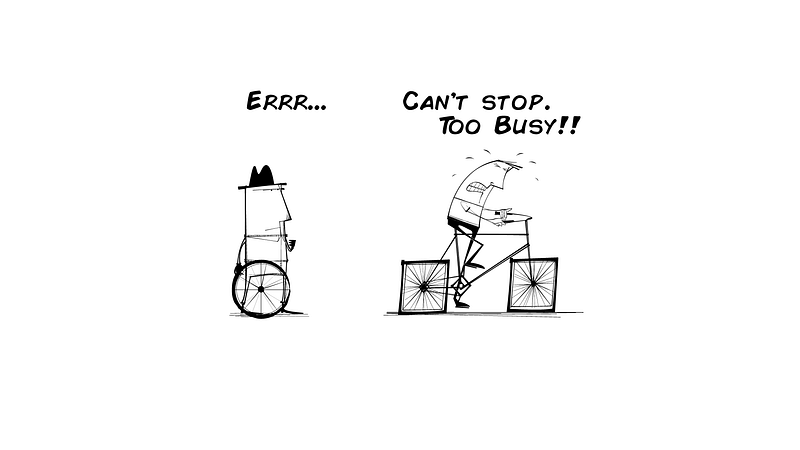
Being occupied therefore isn’t a bad thing and it’s necessary for good mental health. But the notion of being busy has changed. It’s become glorified as a measure of success or Stakhanovite-esque ideals and efforts that have skewed our perspective on what really matters. Being busy has come to falsely represent who works harder, whose job is more challenging and more important and ultimately who arbitrarily and meaninglessly gets bragging rights for the aforementioned.

By Alan O’Rourke and licensed under CC BY 2.0
Indeed, we all want to acknowledge our efforts to ourselves, and for others to do the same, as it returns to the validation we all crave from being productive. After a productive and long day at work, I might feel tired but I feel good for what I’ve achieved and that shouldn’t be a feeling we deny.Though that isn’t where said feeling stops in today’s society.

Working a long day is increasingly celebrated as a barometer for how hard we’ve worked yet it’s a Pyrrhic victory if the opportunity cost was any measure of success in our personal lives and our mental health. Many ‘successful’ people have regretted how they worked relentlessly for years, devoting themselves wholeheartedly to their work, only to later realise that they’d done so at the expense of what really mattered. Failing to spend time with family and friends that were no longer around, not pursuing personal passions or finding companionship, even in the platonic sense, had evaded them as years of a tunnel-vision approach to work passed them in the blink of an eye. At which point, they couldn’t make good on what they’d already lost in those years.

A friend and former colleague commented how they felt bad for not continuing to work into the night, on what was a day off, where they’d nevertheless already worked tirelessly for the day since the morning. We’ve now been wired to assume that we shouldn’t give ourselves a break and to do so is to be lazy. Even with the context of clearly putting in work, we don’t warrant ourselves worthy of breathing space because to pause has become synonymous with being indolent. If you consider that ideal in its crudest sense, we’ve basically been programmed to work and remain busy until burnout.

Naturally, there’s something to be said for one’s commitment to a task and we all find ourselves constantly tipping the scales of work-life balance in favour of work to meet work commitments (which doesn’t make it right either). However, we’ve now become conditioned to assume that if we aren’t busy with work, we’re slacking and should consequently feel guilty. It’s a ludicrous idea, and damaging to our mental health, that we actively deny ourselves any modicum of respite. I too have constantly been guilty of the same mindset where regardless of how long my day has been or how much I’ve managed to get achieve, I feel like I’ve let myself down by not doing more.

And it isn’t just a work where we succumb to that mindset. I’ve lamented that in the past I never really valued my time to an extent that I now do my utmost to make good on that attitude. As a consequence, rarely will I allow myself down time to just ‘be’; instead filling any free time I have in trying to reclaim those lost years. I maintain that I’m making good use of my time, particularly in the context of what I see as my previous errors. Nonetheless, there’s something to be said for allowing time to simply not be busy and providing our minds with an opportunity to unwind.

We all need to afford ourselves the mental capacity to manage our thoughts effectively and that’s only possible with an interruption in regularly scheduled programming. Although being in a constant state of preoccupation without any pause won’t facilitate that. So why are we denying such a crucial and easily attainable effort to achieve it?

The balance is there to be struck but society is causing us to fail miserably at achieving it. How often is being ‘busy’ used as an excuse for spending time with family and friends? Or a label for how fabulously ambitious one’s life is in contrast to their peers? Hard work and ambition shouldn’t be played down. On the contrary, they should be valued and celebrated but in the context of giving ourselves occasional and necessary respite. Otherwise, what are our endeavours for if we cannot enjoy them for ourselves and with others that matter?

When I die, I don’t want anyone attending my funeral who was too busy to make the effort to see me when I was alive. If your job was more important and too preoccupying then, don’t be taking the day off or finding an available evening to mourn me when we could have shared an evening together when I was actually here. Yet this is the stance we’ve adopted and it’s damaging our mental health, our perspective and our connections to people that matter.

Being idle is not the solution or the suggestion to counter the glorification of being busy. We need to achieve a balance and recalibrate our gauge on self-worth so that being busy isn’t erroneously interpreted as a contributory measure in allowing self-validation, or in receiving validation from others. It’s necessary to give ourselves respite; not only for ourselves but also for those around us.

Being busy has become a hollow trophy that society has designed to distract us from what really matters. We need to focus on ourselves, those around us and the things that matter to us rather than chasing a preoccupation that has become a distraction and a mistaken badge of honour for so many.
SHARE:

Sunday, 1 October 2017

Mums rightly come first during pregnancy but let’s not forget about dads-to-be

No matter how much empathy one can offer, being pregnant is an experience that no man can fully understand. Pregnancy presents both an onus and a privilege for the mum-to-be in carrying a child. Indeed, when you consider the favourable aspects of pregnancy, there’s much of the experience to be celebrated such as the bond you’re able to establish with your unborn child and the fundamental role you play in their life before they’re even born. However, for most women, pregnancy can also present challenges as they approach the birth of the baby.

During pregnancy, your body changing means you aren’t yourself. Simple tasks such as bending down or quickening your pace become frustratingly impossible. Not to mention the effect changes in your body may have on your mental health and self esteem (particularly if you’re struggling to mentally link it to the pregnancy). There’s also the discomfort, irritableness, mood swings and anxiety, the latter being an obvious experience for most first time parents.


As much as society rightly celebrates pregnancy, for mums-to-be it isn’t always easy. Consequently, pregnant women typically receive the kudos, compassion and support they deserve for undertaking such an important role. Yet what about dads-to-be? Sure, our bodies aren’t changing therefore we aren’t experiencing the by-products of that either. Conversely, the regard for the role of men as impending parents, and their wellbeing, is given little if any weighting. Mums rightly come first during pregnancy but we shouldn’t be forgetting about the role and wellbeing of dads-to-be too.

Society has a tendency to diminish the role of fathers. Even during pregnancy, the message from society is that fathers are secondary to the mother. I’d be inclined to agree that during pregnancy a woman’s wellbeing and needs are greater than that of a man’s but that doesn’t mean they should be ignored. Although sadly that’s the message that’s being disseminated to those about to embark on fatherhood.

In the UK, women can take up to a year of statutory maternity leave; a generous allowance compared to countries like the US where the lack of universal healthcare provision clearly indicates how they regard motherhood. For the stress pregnancy places on a woman’s body, it’s only fair and provides an invaluable opportunity to bond with your baby before returning to work. It’s also hugely important for a woman’s mental health in allowing her to mentally recalibrate from the emotional experience of pregnancy, childbirth and becoming a parent. Alas, that’s in shocking contrast to the paltry two weeks of paternity leave available. Two weeks. It is possible to share parental leave but as the default, the perception of a mother’s value greatly outweighs that of a father.

What’s not realised is that the same mental recalibration and regard for mental health is necessary for fathers too yet it isn’t given any credibility.

Mentally, emotionally and physically, pregnancy can take its toll on a woman. Physically, that isn’t the case for man. Though mentally and emotionally pregnancy presents its own demands for dads-to-be. The anxiety that comes with being a first time dad especially is expected. Just as for mothers, it presents a huge shift from the status quo as you embark on parenthood. Will you be a good enough dad? Will you know what to do with the baby? Will you be able to manage the imminent change to your lives?

Then there’s managing the manifestation of your partner’s emotions. The mood swings and irritability are par for the course during pregnancy and the dad-to-be is likely to be a prime target whenever it’s articulated. Nevertheless, that too can be an emotionally draining experience in itself as you take it on the chin and put said utterances down to hormones, not allowing it to affect how supportive you need to be.

There’s also a frustrating helplessness in knowing that while your partner is experiencing the physical demands of pregnancy and childbirth, all you can do is offer support and encouragement. That support is undoubtedly valuable and appreciated but it’s hardly a substitute for being able to give birth yourself.

It’s only right that men step up their game during pregnancy and provide all the support that their partners should be able to expect. The wellbeing of mums-to-be needs to come first but amidst that stance, we’ve neglected to consider and support the wellbeing of fathers too. Instead, men are told in jest or otherwise that we don’t get a say in voicing any anxieties or frustrations because we aren’t carrying the child. All that does is lessen the role of being a father.

In some ways, perhaps men of yesteryear have caused this. Previously, men probably had less to be anxious about during pregnancy in a time when gender roles were much more rigid and the mental and emotional health of mothers was dismissed as a non-entity. Tending to the emotional needs of their partners wasn’t the consideration it is today and men themselves were more detached from the journey of pregnancy.

In contrast, men today are much more involved in attending antenatal appointments and classes, providing massages on tap, cooking whatever their partner’s cravings demand and generally doing anything their partner wants or needs. Not to mention picking up the slack on anything the mum-to-be is no longer able to do with the same ease as their pre-pregnant self. It might be to varying levels but modern men are much more involved than men of previous generations which is undoubtedly a positive.

That involvement requires the wellbeing of both parents to be acknowledged. Society has progressed for that to be the the case for women but it’s still not the reality for men.

Good mental health for both parents makes for better parents. If the wellbeing of mothers isn’t in tandem with the wellbeing of fathers, it continues to diminish the role of the latter in a disturbing message that has managed to permeate society throughout successive generations. If dads-to-be are supporting the wellbeing of mums, it begs the question who’s making sure they’re ok too?

We shouldn’t pretend that men have the same experience during pregnancy as women do. It’s a reality that the overall needs and changes that a pregnant woman is subject to will outweigh those of a man. But when it comes to mental and emotional health, there are bound to be some parallels. We might not be able to carry a baby but we do carry the emotions that come with becoming a parent. If we want to see mothers and fathers as equal entities within parenthood, we need to have the same regard and attitudes in ensuring that the wellbeing of both parents is supported to achieve that.
SHARE:

Sunday, 7 May 2017

Light beyond the clouds

Depression. It isn’t just an occasional feeling of unhappiness that typically passes within a few days of its onset. Indeed, sometimes feeling low is a normal and expected feature of our emotions. On the the contrary, depression can be a debilitating, sustained feeling of dejection and despondency that permeates every aspect of your life and try as you might, you just can’t shake it. Millions of people can attest to this and I am one of those people.

I can’t put a finger on when I first started to suffer from depression. Initially, I accepted this feeling as a part of me so I didn’t attempt to address it. I didn’t even label or acknowledge it as depression. It was a feeling that I became so familiar with that trying to address it seemed as futile as changing who I was.
I find it near impossible to articulate how depression feels. There’s an emptiness and darkness that is omnipresent to your life. I would often liken it to a dementor or a dark, ominous cloud that refused to go away and would spoil anything remotely pleasant. Regardless of how hard I might try to ignore it, that dark cloud would remain to remind me that my depression hadn’t gone anywhere and could become heavier and darker whenever it chose to.
There was no escape from that cloud. I would wake up and it would consume my absolute first thoughts in reminding me of how I was supposed to feel. Depression wouldn't even give me any respite in my initial waking moments.

It was akin to opening your front door and stepping out into darkened skies every single day. My depression was telling me I should accept and get used to it because that would be my experience indefinitely. All day, everyday. Depression was conditioning me to not even expect otherwise and after a while, I didn't. It had killed my hope of ever escaping that dark cloud so why bother trying?

The lows of depression are so low that they can consume you and put you on a path of self-destruction. And no matter how well-intentioned, no one can understand how you’re feeling. In the depths of depression, there isn’t any hope or glimmer of light to draw solace from. It’s a sickening, crushing feeling that can cause you to lose any sound perspective and rationale that are instead replaced by helplessness, self-loathing and destructive and skewed introspection.

During my low points, I would generate the most feeble and often spurious arguments to convince myself that I was nothing. I hated myself and felt I was a loser. Although this was in contrast to the faux veneer of confidence that I would otherwise usually portray. My deceptive demeanour continued to provide a shield to anyone getting as much as a glimpse of how I was really feeling on the inside. And for the most part, I was pretty good at maintaining the act. That meant no days off work, no expressing of my emotions, no public breakdowns, no confiding in anyone and no seeking of professional or peer support regardless of how awful I felt.

I would routinely get angry at myself for feeling this way. The rage I directed squarely at myself was driven by my feeling of inadequacy and the belief that I was worthless. I would try to direct my rage into exercise and so many of my workouts would be fuelled by me trying to combat depression. Every mile ran or every weight lifted was a counterpunch to my depression. Sometimes it worked and, albeit temporarily, I would feel indestructible and impervious to depression at that moment. I was on the front foot and it was a contrast to how I’d normally feel.

Yet sometimes my depression was too powerful for me and my endorphins seemed to have no effect whatsoever. I remember running a long distance race that I had built up in my head as a showdown of me vs depression. I ran the race in a good time and felt physically strong but emotionally, I felt empty. Absolutely empty. My depression was telling me that my resistance was futile.

My self-esteem was at rock bottom and I was eroding what was left of it that my depression hadn’t already destroyed. This was based on a distorted image of myself that I was projecting in my own head, and to others on days where I felt particularly dismissive towards my own self worth. If someone enquired about what I did, I would sometimes boldly tell them that I was a loser. They saw it as self-deprecation or banter while I felt I was just being honest and it was my way of not being in denial about how I saw myself.

Rationally, realistically and relatively that wasn’t the case and had anyone realised that it was my depression talking, they would have probably been bamboozled and unable to see what I had to be depressed about. Alas, depression is often void of logic and rationale. The logical side of me knew there wasn’t anything to support my feelings. But that didn’t stop the way that I felt and there was no way logic could permeate the overwhelming feeling of despair that I was plagued with. I was alone with my thoughts and emotions in an incredibly dark place that only I could see.

Where my depression gave me a shellacking in telling me I was nothing, anxiety (often found in tow with depression) drove my obsession with feeling inferior. I was garbage and I repeatedly reminded myself of it. My depression and anxiety would tag team me in somehow generating non-existent reasons to support this idea and I’d assume random strangers were superior to me based on absolutely nothing.

I remember once seeing a nondescript commuter on the train in a fairly modest pinstripe suit. Immediately, my mind told me he was in a better job than me (because pinstripe suits confirm one’s status as being in a good job, right?), had a better life than me and was a better person than me. Within seconds, I’d built a whole back story around this commuter's life with the sole aim of supporting the narrative that I was a lesser individual in contrast to him. That was despite me having no idea of his life other than us being on the same train.

My depression was now spiralling out of control yet I avoided pretty much everything that might have put me on a path to recovery sooner.

I wouldn’t entertain any possible solution to my depression. I wasn’t hiding my emotions or my depression out of shame but out of a refusal to accept the vulnerability of the weakness I believed it presented in me. Avoiding the acceptance of that vulnerability probably did me even more damage and was probably supported by my then perspective on mental health.

Coming from a community where mental health concerns can ignorantly equate to being “sick in di head” and being of a working class background where depression is often seen as something one should “just snap out of” to get on with life, on some level I probably didn’t want to address my feelings openly or internally. So I didn’t. Instead, I accepted them. I decided that feeling this way was how I was supposed to feel. I had to accept the internal and emotional darkness, no matter how much it affected every facet of my life. With punishing consequences to my mental health, I decided to continue on that basis.

As a man, there was probably another obstacle I was placing in addressing my depression in avoiding a label of being weak and unmasculine. It’s a problem that males face increasingly as the gender roles we’re subject to in society still disseminate a message that we shouldn’t talk about our feelings let alone have any feelings that might suggest any weakness. Suicide is the biggest cause of death of men under 45 in the UK and 75% of UK suicides are male. Yet when it comes to mental health, men are keeping the lid on a pressure cooker of emotions with no outlet as the pressure only builds.

My anxiety too was worsening. I was now experiencing panic attacks and breakdowns (which I obviously kept to myself). As a result, it was becoming increasingly difficult to hide how I was really feeling. Perhaps that was down to some measure of my vulnerability coming to the fore. Conversely, perhaps my depression had just reached a point where my struggle to permanently conceal it was becoming untenable. On reflection, it was probably both.

The turning point for me in acknowledging that there was a problem came from my partner. She knew something was wrong but because I did my utmost to hide it, she had no idea what. She couldn’t empathise with me and similarly, I wasn’t able to fully detail what I was experiencing either as it had become a default emotional state for me. Nevertheless, she knew something wasn’t right and try as I might, it couldn’t be denied. Finally, after years of my depression being my secret, someone else knew and I gradually started articulating to her how I’d been feeling for all those years.

It might seem a trivial detail but this was major. I had finally admitted to myself (and now someone else) that I had a problem and had embarked on the path to addressing it.

Having told my partner how I was feeling, I unwittingly moved closer to trying to address the problem and had shed a layer of obstruction to at least some notion of recovery. Where I had once told myself I would never confide in anyone about how I felt, let alone seek help, I began to see the latter as less of an issue. It’s also where I warmed to the idea of counselling.

The albatross of my secret of suffering from depression had been lifted off of my shoulders. Seeking help became something I was open to and I spoke to men's mental health charity, CALM, who suggested counselling and our conversation was another layer removed.

With a surprising lack of trepidation and disregard for any stigma, I eventually started counselling. I wasn’t expecting it to be a panacea that would lead to me constantly feeling happy and rid me completely of any depression and anxiety and if I’m honest, I still don’t. There has to be some realism when it comes to addressing depression as unhappiness and occasional sadness are features of life. It also means that any successful recovery from depression doesn’t suddenly mean a utopian life of perpetual happiness. What it does mean is being able to deal with feeling low in a manner that doesn’t spiral into anything more than that and if it does, having coping mechanisms to manage it. 

As I was increasingly experiencing deeper depression and anxiety, I felt I had nothing to lose with counselling. I went into it with an open mind and was probably so emotionally drained from my depression that any resistance I might once have had was diminished.

I opted to seek counselling privately rather than through my doctor. Despite my relaxed perspective on it, I was wary of how it would be viewed on my medical records. I say that with some reluctance as in some way my attitude probably exacerbates the very stigma I was afraid of. I just didn’t feel comfortable going to a doctor with this and still maintain distrust for how a doctor might advise me to deal with depression.

Whether or not it’s an unfounded view, I felt a doctor might possibly pass it off nonchalantly, putting it down to “feeling blue”, suggesting “it’ll soon pass” or even suggest medication before exploring what was right for me. My expectations show how much work there is for even doctors in understanding how they may be perceived by a patient with mental health concerns.

Counselling was a completely new experience for me, especially as a very private person. However, I soon became comfortable with it. I’d talk about how I felt in whatever detail I offered and my counsellor would listen. He’d unobtrusively ask intermittent questions or make an observation that might gradually signpost our conversation towards some clarity. As only my counsellor knew how I felt, I wasn’t exactly straying from my usual private self either. Furthermore, I felt I was finally being proactive in fighting my depression.

It’s difficult to explain the undoubted effectiveness of counselling but it provided an environment that was free from judgement and a forum where I could safely articulate my feelings. Not to mention, it’s helped me explore some of the possible roots of my depression and anxiety. I still don’t know exactly what caused me to feel this way and depression is far from logical insofar as it doesn’t need a reason to be present.

Counselling hasn’t resulted in an epiphany where one day I realised I was free of depression. Nonetheless, I attribute counselling to the incremental but significant progress I have made in addressing my depression and my anxiety. When I look back, especially to some of the emotional lows I’ve had, the contrast in my mental health is startling.

The stigma surrounding mental health issues arguably and subconsciously affected my willingness to consider counselling sooner. There isn’t a stigma around going to see a doctor for a physical concern and it should be no different for mental health. Seeking support for mental health has nevertheless remained taboo with no validity and to the detriment of those who would benefit from that very support.

I lost years to depression. Years in being impeded from experiencing progress in so many areas of my life where depression made me stagnant. Years of not feeling good enough and inferior to everyone around me. I was suffocated by the dark cloud and it held me captive from experiencing the light that it had hidden from me for so long.

My life was effectively on hold thanks to depression. I wondered if one day I'd be free of the emotional and mental prison that unbeknownst to everyone I was trapped within (although there was no actual feeling of optimism in my thoughts). In retrospect, that was an obvious dichotomy with how I was feeling but in spite of that I told myself to be ready for that day should it ever be realised.
The Deep by Sarah Ingram (www.sarahingram.co.uk)
While our environment and circumstances can appear one way, depression is potent enough to make them feel drastically different. It’s a distorted reality but one that no one can see but you. Consequently, I’ve come to accept that amidst my experience, I’ve benefited in some way from my depression and anxiety.

Depression and anxiety has given me a perspective of the human condition that without it, I wouldn’t have. My heightened awareness of this is almost the gift that came with the curse of depression. Similar to a sixth sense, I can now see and empathise with depression and anxiety in others in a way that many are unable to appreciate. Moreover, if depression and anxiety is making someone feel inadequate or weak, I instinctively understand not to voice or project anything said depression and anxiety will feed on.

That doesn't mean concealing your own successes for fear of triggering or exacerbating someone’s depression or their anxiety, it just means having some sensitivity and empathy in what you might project. It should be a given but if someone is depressed about their finances, they probably don’t want to hear about your new Rolex. Depression and anxiety have a way of making you realise that even more vividly because that empathy is much more likely to be instinctively forthcoming.

I don’t know where my depression came from but to no avail I’ve spent years trying to reason with myself what the source might have been and why depression chose me. What I do know, but didn't always realise, is that depression didn't prey on me because I’m weak. Depression has taken me to such lows that to be able to write this today tells me I’m far from weak. I still need to remind myself of that but it's a reminder that my experience with depression undoubtedly refutes.

As a fan of combat sports, I look at some of the fighters who’ve been victim to depression, fighters I’ve supported and followed in awe of their prowess in combat yet depression has been able to metaphorically send them to the canvas. Ricky Hatton, Tyson Fury, Oscar de la Hoya to name a few suffered from depression and there are plenty from other sports.

Hatton especially has spoken of his experience with depression and being suicidal with a candidness that helps to fight the stigma around men speaking about their mental health. As a working class man too, his message resonates with me and hopefully others. Having followed his career, there's nothing weak about ‘Hitman’ Hatton whatsoever and more men need to follow his example as we fight the stigma.

My depression didn’t subside overnight and addressing it was, and remains, a work in progress; one that perhaps may never be wholly complete. What I now experience, I refer to as ‘residual depression’. The cloud might sometimes continue to be present in the background, just not directly over my head or engulfing me, and I’m better able to expedite its retreat.

I struggled on how to conclude writing this but realised that's because there can’t be a static state of happiness as a conclusion to my experience. That’s ok. Therefore I’m ok. Mental health can’t be viewed with rose-tinted glasses because that isn’t reflective of life and for most of us, our emotional well-being can’t be expected to plateau regardless of that being in a good or bad state.

Good mental health is about managing our emotional well-being and addressing the stigma of mental health conditions plays a significant factor in that. Depression, and other mental health conditions, can’t remain a taboo conversation or be perceived as weakness. It needs to be in the open so that more people suffering from depression realise they too can experience light beyond the clouds.
SHARE:

Thursday, 27 October 2016

Slavery may have ended but its shadow remains over the black diaspora

When former British Prime Minister David Cameron visited Jamaica, he made the clearest statement that his government had little empathy for the black diaspora when considering the aftermath of slavery -
“That the Caribbean has emerged from the long shadow it cast is testament to the resilience and spirit of its people. I acknowledge that these wounds run very deep indeed. But I do hope that, as friends who have gone through so much together since those darkest of times, we can move on from this painful legacy and continue to build for the future.”
These weren’t surprising utterances from Cameron and they suggest much about him and those who share his stance. Although, with less unempathetic rhetoric, there are some (including some black people) who feel any dialogue around the subject of slavery is now redundant and that it should be consigned to history to avoid dwelling on a loathsome past.
While I don’t agree with this, I can see the rationale behind such an approach when considering how latching onto the past could further stymie the progress of black people. Nevertheless, while slavery has ended, its shadow remains like an unshakeable albatross. Many lamentable features of the black narrative can be traced back to our darkest period in history and over a century later, the existence of slavery has a lot to answer for.

The black diaspora is undoubtedly facing challenges and experiencing a rate of progress that is not commensurate with other communities. When I consider postwar emigration of non-black communities, later arrivals have generally experienced more prosperity than blacks who were one of the earliest groups of immigrants to Europe and North America subsequent to World War 2. The reasons for that are plentiful enough that it’d require a separate post. Needless to say, they cannot be wholly attributed to black people either but rather the institutionalised social attitudes we’re subject to.

These attitudes (and their manifestations in respective governments and legislation) are hangovers from slavery; a time when black people were marginalised and robbed of any notion of equality or progression while systematically being dehumanised. Yes, the tangible barriers to our progress, such as access to education and our freedom, have been lifted. But in practice, the vestiges of the prejudice, racial bias and a desire to preserve our inferior position in a centuries-old racial and social hierarchy that was once legal, can still be seen in modern views towards the black community.

For real change to be effected, wider society needs to unlearn centuries of institutionalised prejudice towards blacks that was par for the course during slavery and during the years that followed. Not doing so obviously preserves the position of blacks as beneath everyone else; a position that existed for centuries. Can we therefore really expect said unlearning to have occurred in less time than those ideals were actually entrenched?

Racial and cultural bias of standardised tests provide a further hurdle for our access to high quality education and the opportunities it can afford. And one only needs to look to America to see the influence of the slave owners’ ideals that black lives don’t matter having successfully permeated law enforcement. Slavery might have been abolished and equal rights legislation may have been passed, but it’s not so easy to abolish ideas that have been inherent in successive generations.

Conversely, the black diaspora is responsible for many of its own shortcomings. Though while not seeking to diminish this charge, these failings can be traced back to slavery in illustrating just how far its impact has spread since it was abolished.

Look at other immigrant groups and you’ll often notice they’re playing the long game. They’re happy to live in less than modest and often overcrowded accommodation for years while saving money for a better property and better opportunities for their future and that of their families. The long term thinking amongst these communities is what expedites their rapid social mobility. Meanwhile, black communities fail to experience the same trajectory or least with the same swiftness. Why? A warped mindset of short term thinking that has been engendered since slavery. It’s seemingly become inherent and frustratingly difficult to eradicate but it’s a flawed approach that we desperately need to address.

For the black slave, there was no need for long term thinking. Your life was a disposable commodity in the hands of a slave owner who viewed it as such. Alas, for many black people, the same mindset has seemingly continued.

It’s easy to say slavery has no bearing on this being the case today. But consider the nonchalance towards black lives held by the slave owner. In principle, is it much different to the nonchalance shown towards black lives now? The only difference is today, the ‘slave’ almost buys into those sentiments more than the ‘slave owner’ themselves to the extent that the slave owner needn’t push their agenda any longer as the slave will do that for him.

Similarly, governments have replaced slave owners with the undue power and influence some of the black community perceive them to have in being responsible for the direction of their lives. This is instead of acknowledging that there is more they can do for themselves that governments cannot interfere with. In turn, this has created a blame culture against legislatures and society. Sections of the diaspora are still unmotivated past the post slavery mentality when our fate was at the whim of the slave owner. Perhaps we were slaves for so long that we don’t know how to be free and how to grasp our freedom? Instead, we credit our failures to the nearest entity we can identify in the form of a slave owner rather than taking responsibility for the freedom that we now actually have.

The collective mental health of the black diaspora is arguably the most significant legacy of slavery. Centuries of being dehumanised and perceiving ourselves as inferior has permeated the black psyche. Our self esteem is incredibly damaged as we continue to perpetuate the notion of being secondary and almost actively allowing ourselves to be marginalised because for so long it was the status quo.

We struggle to value ourselves with our true worth because we have been programmed not to do so and others have been programmed to foist that notion onto us. Subconsciously, many black people equate being black to being negative to the extent that there’s a demand for skin bleaching products in a number of regions.

Vybz Kartel, once one of bashment’s biggest stars, launched his own range of ‘skin brightening’ products and presumably in pursuit of a caucasian look (which most opine went badly wrong), Lil’ Kim has transformed herself from a pin-up when she released her debut album Hardcore to a light-skinned barbie doll that didn’t meet quality control at the factory. And Beyonce, arguably one of the biggest celebrities period, has long been accused of appearing lighter. Are we literally trying to wash away our blackness? It shows how much undoing of centuries of damage to our self esteem is still required.
Psychologically, slavery has damaged the black psyche to so great an extent that we’re yet to wholly escape the conditioning it has seared into our identity. And we’ve failed to acknowledge and accordingly address the impact this has on us today.

It’s important to emphasise that slavery, a system that was abolished over a century ago, cannot be deemed a comprehensive excuse for any failings of a black person or indeed the wider black community. Yet it must be acknowledged as offering an explanation for the shadow of slavery continuing to pervade the black people today.

Other communities have seen persecution via colonialism and periods of brutality such as the experience of the Jewish Diaspora during the Holocaust. Though no group has seen such sustained physical abuse, psychological abuse and dehumanising as the black diaspora experienced throughout slavery and later periods of history. Furthermore, no group continues to be hindered by their experiences to the extent that can be seen in black communities worldwide.

Like a hat that has been worn for so long that even when removed it’s still felt to be on, the shackles once worn by black slaves during slavery may have been removed yet psychologically and socially they continue to be felt. After a while, the sensation of wearing the hat completely wears off but somehow the same can’t be said for slavery and the residual conditioning it has had on black people that can be traced back hundreds of years. However, we can’t overly lament or pontificate about it any longer unless we’re willing to take a meaningful approach to addressing it. Because if we don’t, no one else will and we’ll have wasted the freedom that black slaves would have once deemed unimaginable.
SHARE:

Sunday, 25 September 2016

The value of time

Time. It’s a commodity that we take for granted when it appears to be in abundance yet frantically despair when we realise it’s slipping through our fingers with no redress. And for all its value, once it’s gone, it’s gone. Sadly, many of us only realise this when it is indeed too late and we’re ruing over lost opportunities or experiences that we chose not to embrace.

We reflect on our naivety, how green we once were and often how plain ignorant our younger selves now appear in hindsight. But despite this inevitable regret, many people never really appreciate the value of time. Rather than making good on time lapsed, we soon consign our regret to a place of nonchalance; forsaking the chance to reflect and shape our subsequent approach to how we appraise the commodity of time.
I’m someone who is filled with regret at how I once valued time. In my youth, I arguably placed time on a pedestal to the extent that I wasn’t willing to take risks or explore new opportunities because I felt it might have represented a waste of time; time that I couldn’t get back. I was right. However, there is no reward without risk and rightly or wrongly, every risk we turn down represents a lost experience. I valued time but I didn’t appreciate the nature of how it escapes all of us.

That caution developed into complacency. I thought I was preserving time but I was allowing it to pass while I made little or poor use of it. Furthermore, my mindset had now turned to one where my stance remained due to an inability to act otherwise as a result of circumstance and anxiety.

Steve Harvey spoke of a similar experience of those who fritter their time away in their youth, just to try and play catch up once they’ve realised their mistake. I didn’t exactly waste my time out of overt recklessness. Nonetheless I was reckless in how I considered time and it had exactly the same result.

I lost years to this period of my life and who knows what else. Though this gave me the jolt I needed to view time in the way it should be. I realised I needed to make good on my folly and, almost predator-like, I did just that. If I had an interest in something, I was pursuing it. If an opportunity presented itself, I was seizing it. Good, bad or indifferent, I realised that every experience in life contributed to our being. And in ways we might not imagine or appreciate at the time but might actually serve us in the future. I had been denying myself this with my failure to see the worth of my time.

I’ve maintained said approach and it’s served me and my mental health well as I feel more confident that I’m making good use of a commodity that I can’t get back once it’s gone. Alas, I can’t make good on everything; ‘tis the nature of time. But wherever possible, I’m salvaging from the wreck of my earlier failure.

In doing so, I’ve also learned to value my time as mine. Not in a selfish way of not wanting to share my time and efforts with others but in perceiving my time and the journey I take via the path it represents, to be mine.

Years ago, I bumped into a friend in my old neighbourhood who I’d not seen for a while. We got to talking and it was around the period when I started to realise how my value of time hadn’t exactly been prudent. I was lamenting at what I hadn’t done based on what was ‘expected’ by society; not what I hadn’t done to my own detriment due to what was good for me. My friend responded with a deeply apt rebuttal and said “life’s not a race”. That’s stuck with me since and I pay little regard to what I should have done based on society’s expectations or what others are doing and instead focus on myself and those important to me.

We can’t care about using the lives of others as a gauge for where we should be in our own lives because our allocation of time is ours, not theirs. Although so many people are caught up in doing just that. They don’t see the worth in their time because they measure it against someone else's or society’s. And when they do realise their error, it’s often too late as they’ve used their time to create a life that isn’t necessarily for them and with little or no recourse. People chase the job, house, marital status, children, superficial notions of success and anything else they assume they’re ‘supposed’ to have based on a futile comparison. All the while they’re failing to appreciate their time as their own. Why chase a life that isn’t yours just to later realise you’re out of time to get to your own destination?

Our perception of time goes beyond recognising the worth of our own time but that of others too. So many of us have an inability to understand the finite nature of time, either in a discrete sense within a given period or as life itself. We make demands on others, totally indifferent to the impact it will have on their own time, and fail to see or appreciate this through our own blinkered perception.

How many times have we taken up the time of someone as we see their time as akin to ours? We see their x hours in the same regard as what we have prioritised for the same period. It’s the selfish nature of the human condition that even with a commodity as valuable and finite as time, we find ourselves unable to recognise the value of someone else’s time with their perception rather than our own.

Conversely, we need to learn to share our time. Spending excessively long days at a job to only neglect our partners, friends and families clearly doesn’t signal a true valuation of time. Nevertheless, it’s a common story for many as society has realigned our priorities to prevent us from recognising where our priorities should lie. We need to need to find the sensibility and balance to see our time for ourselves while apportioning it accordingly for others around us. This requires an altruistic approach that seems sparse when considered in tandem with the notion of our time.

Like good health, we appraise time with nonchalance when it is plentiful and desperately when it becomes scarce or reflects regret of past actions or lack of. Yet both commodities are rarely given the status we give wealth and material and tangible possessions that can come and go - with the proviso that we have the time and health to afford us the chance to do so. Clearly we need to reappraise the commodities in life that we should view as valuable with more esteem than those that we can always make good on should we mess up. Unfortunately, time isn’t so forgiving and once it’s gone, it’s gone.
SHARE:

Sunday, 5 June 2016

Alicia Keys’ and the no makeup movement

Alicia Keys’ recent essay on Lenny provides a narrative that is surely familiar to most women. It articulates the struggle and pressures of being a woman in feeling the need to meet accepted and expected images of beauty that conform to traditional notions of being a woman. In a brave move that should be praised, Keys’ decision to shun this in rejecting the need to constantly wear makeup equally opposes and challenges the social anxieties it presents for many women. Indeed, her attempt to spread a #NoMakeup movement is arguably inspiring many women but it’s the tip of the iceberg when considering the notions of beauty and femininity that women have long been subject to.


As a man, much of the the experience outlined by Alicia Keys, and shared with many women, is admittedly alien to me. Although as an aside, men are increasingly subject to further social pressures in body image and perceptions of masculinity. This is prompting many men to take dangerous steps to meet these perceptions which are rapidly damaging men’s mental and physical health at perilous levels. Sadly, as a relatively new phenomenon, these aren’t widely recognised. Nevertheless, for women this is something that has existed as far back as patriarchal stereotypes can be traced throughout history.

Personally, I like to look good as much as the next person does. But the driver for that stems from my personal contentment and less so from the perception of others. During the winter months, I often grow my hair into a sometimes untamed but periodically shaped afro and shave less frequently than usual. There are occasions that I probably look at least a tad unkempt but on the whole, I don’t care and broadly speaking I’m not judged for it. It’s something I embrace with a nonchalance that is born out of incremental improvements to my own self-esteem and mental health whereby I feel more comfortable with myself, my actions and my appearance than I might once have been. Though for women, this represents a challenge that involves undoing centuries of expected conformity in one's appearance and indeed traditional notions of femininity which are increasingly foisted in the face of women.


Social media has provided a further and damaging projection of what many women feel they need to meet with Instagram posts displaying what is brushed off as casual and effortless perfection of women. Subjects such as the Kardashians are photographed leaving the gym, looking as if they’re yet to break a sweat with not a hair out of place. Because that’s exactly how we all look after a workout, right? Then there are the voyeuristic photos (often posted under the guise of something that seems more principled than the superficial notion of merely getting your attention) that get posted to an audience of young women who naively seek to attain an image that’s manufactured by those who devote their lives to maintaining a plastic, paparazzi-ready facade.

Makeup, hair, clothes, shoes and conforming to expectations of ideal body image present a rigmarole that women have to contend with on a daily basis. And rarely does society suggest it’s acceptable to dispense with any of the aforementioned. For younger women and girls especially, the message is damaging - if you don’t look like this, you’re slacking as a woman. It comes from the media but also wider society and even some men who fail to accept women with a natural demeanour that ignores the above. Similarly and lamentably, and in a further example of gender roles being dangerously reinforced, some women will admit to feeling naked or exposed without wearing makeup as it provides a shield that they literally feel unable to leave home without.

In a brilliantly honest but hilarious social critique of the expectations of beauty placed upon women, one of YouTuber Jenna Marbles’ early videos highlights the extent to which women go in their daily routines. It’s frighteningly accurate for many women and her satirical commentary provides the subconscious narrative for what many women feel compelled to do on a daily basis. Nonetheless, there isn’t anything wrong with wearing makeup. But there is a troubling issue with the extent to which it becomes a decision based on social conditioning and pressures and less about a personal choice, not to mention the effect it has on female mental health.

I’m in no way criticising women who wear makeup or makeup per se. It can enhance, accentuate or refine features and conceal what might personally be deemed a minor imperfection. And most importantly, it can provide a source of confidence that should never be rejected. No different to how I might get a haircut or have a shave when attending an event, makeup can be part of the effort women make to feel good about themselves. After all, we should all do what makes us comfortable and supports our self-esteem and no one should feel the need to apologise for doing so. However, that shouldn't be confused with attempting to meet a gauge of beauty that isn’t our own.

As a celebrity, Alicia Keys is able to use her status as a vehicle for the #NoMakeup movement but her essay also shows the emotional growth she’s undergone to arrive at a point where she is able to embrace her new stance. Furthermore, let’s not pretend that even without makeup, Alicia Keys hardly falls short of the accepted notion of beauty. It’s just a more natural, and some might say less refined, version of what we’re accustomed to seeing. It’s also worth noting that Alicia Keys is an artist who has a huge talent that doesn’t require compensation based on her looks and therefore has further attributes upon which to pin her own self-confidence. Although this shouldn’t detract from the stance that she and many other women have taken in rejecting these social pressures.

It’s questionable if women have been so long subject to these expectations that the status quo can never be overturned. A natural look can be met with raised (and sometimes unnaturally shaped) eyebrows as if to suggest “didn’t you get the memo? We don’t do that as women” which is a sad reality. Many women even experience discomfort in showing themselves without makeup to their partner, family or friends let alone to strangers.

I’m sure #NoMakeup will get some welcome traction on social media. It’ll also likely result in many #NoMakeup selfies celebrating the rejection of having to constantly wear makeup out of obligation rather than choice which is the crux of the argument. More significantly, hopefully it can provide the seed for the wider debate on the social conditioning woman are subject to and the damaging impact it has on successive generations of females.
SHARE:

Saturday, 27 February 2016

Marriage and relationships aren’t for everyone so why do we shame people into thinking otherwise?

For many singletons attending events and family functions such as weddings, there’s often a line of questioning that can be expected from enquiring relatives and friends:

“So… are you seeing anyone?”

“When are you getting married then?!”

“No girlfriend/boyfriend?”

If the answer is negative, it can frequently be met with pity as if to suggest that one’s life is clearly lacking without a partner. It’s followed up with somewhat patronising assurances of “you’ll find someone soon” or offers of “you know, I should introduce you to…” with that telling look of concern at your pathetic single life combined with enthusiasm at the prospect of being able to play matchmaker.

Such questioning can be innocent small talk, genuine (but misguided) concern or merely crass prying. But it remains unnecessary, intrusive and even presumptuous of one’s sexual orientation depending on how the question is framed. And for some, it can be a question that is anticipated with some trepidation; something no one should feel due to their relationship status. Yet it stems from the assumption and expectation within society that we should all want to be in a relationship and for many, aspire to get married.

Firstly, being in a relationship or being married is not an achievement under any circumstances whatsoever. It’s primarily a choice and a circumstance. There isn’t anything about being in a relationship that makes someone better than the next person or makes any aspect of a single person’s life inferior in contrast. And it’s ridiculous that such views still prevail. Not to mention, it’s a huge affront toward those that are single and an archaic attitude within contemporary society. If anything, those who choose to remain single, or not actively pursue a relationship, should be lauded for not conforming to society’s expectations.

Being single or not pursuing a long term relationship is an increasing and more than acceptable choice for some. It needn’t mean said individuals have anything wrong with them, cannot coexist in a relationship or cannot attract anyone. And in the case of heterosexual relationships, it doesn’t mean they’re homosexual either and vice versa. It can be a personal choice for a discrete or indefinite period of time, a reflection of someone’s preference for their own company, a decision to simply not actively pursue a relationship or anything else. As Mexican artist Idalia Candelas captured in a series of black and white illustrations of single women, single life needn’t mean sadness and forced loneliness either. There isn’t anything wrong with being single but society has suggested otherwise.


Consequently, society is ‘single shaming’; effectively applying stigma to those who choose to be single, or indeed those who just happen to be, because they don’t conform to tradition and more conservative behaviour. It’s an outdated, offensive and moronic perspective and no different to ‘slut shaming’. Instead, perceived promiscuity is merely replaced with a perception of what society deems a dystopian relationship status, rather than the Victorian values approach many still subscribe to.

Within many cultures and communities, marriage remains a measure of success for the couple and their families, hence the pantomime that so many weddings become. Being of sound character, accomplished (defined by one’s own gauge) and happy in one’s self can sometimes be deemed insignificant to being married or en route to it. Although with that line of thinking being so socially inherent, it can have a negative impact on one’s mental health for those that don’t conform to or desire such ideals. Nevertheless, a growing number of people are eschewing such notions or pursuits of a relationship and instead seeking happiness by their own definition.

Ironically, the impact of shaming people for being single merely creates forced and sham relationships where people feel obliged to pursue what society has deemed necessary for their completeness. Similarly, for those in a irreparable relationship, it’s fostered a fear of leaving a situation that just isn’t working. While separation or divorce is never an ideal scenario for a couple, it’s certainly more appropriate than remaining in a toxic or destructive relationship. Though many couples cling onto this rather than face the unwarranted stigma of being single or having been in a relationship that didn’t work.

It needs to be remembered that marriage is a social construct. It’s somewhat of an artifice that has traditionally benefited men in representing control and ‘ownership’ of women while providing mutual companionship, stability and avoiding the stigma of both parties being single themselves. However, despite it being important to realise that both men and women are subject to single shaming, women arguably have the raw deal when it comes to being subject to the stigma of being single.

Kate Bolick’s Spinster, an examination of the growing number of women choosing to remain unmarried, begins with ‘Whom to marry and when will it happen - these two questions define every woman's existence, regardless of where she was raised or what religion she does or doesn’t practice’. And for many women, even in the twenty-first century and amidst successive generations of progression for women's rights, this is sadly true. It may be subconscious for some women but it’s nonetheless a byproduct of the social construct that is marriage that begins even before marriageable age.

Many teenage girls clamour for boyfriends so as not to be left out from their friends. And those that don’t have boyfriends are often left feeling inadequate unless they have a strong enough indifference to the pursuit of relationships amongst their peers. Fast forward to their 20s and this inclination is intensified with many women worryingly feeling their lives are incomplete without a partner. Furthermore, by then, men too have joined in the obsession in seeking ‘completeness’ as if being single cannot fulfil that by society’s expectations.

Marriage and relationships are not indicators of being whole and society needs to refute the ludicrous and deep-rooted myth that one isn’t complete without it. While they can provide companionship, and for some, desirable units within which to start a family, marriage and relationships (and indeed said families) just aren’t for everyone and there isn’t anything wrong with that. Therefore we need to stop shaming single people for thinking just that.
SHARE:

Tuesday, 22 December 2015

The vulnerability of relationships


Without exception, my friends and family consider my partner to be a great person. And albeit biased, I’d wholeheartedly agree. I’m frequently told what a marvellous person she is and given constant compliments on her excellent character. All of the above is irrefutable. However, what about the side of her that others rarely, if ever, see as it’s contained within our relationship? The increasingly loud and relentless person in an argument who fails to see logic when it doesn’t support her perspective? Or her infuriatingly stubborn streak (even to her own detriment)? Not to mention the unrelenting ‘reminders’ to do something I’ve already been asked, even while I’m in the middle of doing something else? I can imagine many men and women are nodding their heads while reading this as they recognise the aforementioned in their own relationships.

I still maintain my partner’s an amazing person but it’s fair to say that her ‘less desirable’ traits are less likely to rear their head outside of our relationship. And the same is undoubtedly applicable to me. This doesn’t make either of us duplicitous or disingenuous and this experience is almost certainly reflected in every relationship and close friendship. Not to mention, just as the more frustrating aspects of one’s personality are reserved for their relationship, the same could be said for the best qualities of one’s character such as the uncompromising altruism that is kept for those closest to us.

Relationships are where polarised behaviours can not only be expected but also accepted; arguably due to the inherent vulnerability of relationships. They represent a safe place for our emotions and character, good, bad and indifferent, to be free; a place where any judgement we're subject to should be neutered by underlying affection and respect.

Vulnerability is what enables a couple to go from yelling at each other, both fuelled by indignant anger, to reconciliation with reciprocated and sincere contrition. It's what gives us the space to get frustrated and show it, rather than keep it contained as we might have to with others, but also to make amends while not constrained by bravado or one-upmanship. It allows us to our lose inhibitions to be frivolous, show and articulate our fears and innermost thoughts and have unfiltered honesty within the sanctuary or our relationship. It's the essence of what makes good and genuine relationships such incredibly honest spheres.

To be vulnerable is a feature of the human condition. Hence it being present in any relationship. Without vulnerability, we lack the capacity for fear and apprehension. We lack the capacity to motivate ourselves toward a greater good for ourselves and those around us through connection and compassion. While vulnerability has become synonymous with exposure or weakness, on reflection, it is at the very core of human existence and by no means an attribute that we should seek to erode or ignore.

Brené Brown’s brilliant TED Talk articulated the struggle of vulnerability. Yet within a relationship, that struggle is countered by the security that is provided via our connections with each other. Anxieties are alleviated with reassurances, loneliness with companionship and judgement and criticism with acceptance. Within the sphere of relationships, opposing emotions are juxtaposed and balanced, thus diminishing our vulnerability. The intrinsic nature of vulnerability within relationships means it isn’t going anywhere and on the whole, this is a good thing. Indeed, for a partner or friend to facilitate the emotional refuge of a relationship that doesn’t allow vulnerability to be a crushing albatross but rather a feature that can be accepted and managed, is testament to a great partner or friend.

As spheres of intimacy, relationships will always have the scope for one’s fragility that vulnerability threatens to expose. Although a good relationship will ensure that doesn’t become the case in providing the requisite sanctuary. But what happens when that fragility is abused and taken advantage of with vulnerability becoming a means to facilitate that very abuse?

Vulnerability presents the landscape for relationships to encompass companionship and empathy. Though the vulnerability of others can be exploited by those who feel unable to embrace their own vulnerability and rather use it as a tool to protect their own insecurities and selfishly advance only their own desires. Mental, emotional and sometimes physical abuse, bullying, control and diminishing of individuality and any modicum of independence outside of a relationship, can just as easily be facilitated via vulnerability. Just as the safety and support afforded by a healthy relationship can be too.

For some, their own weakness compels them to pounce upon the vulnerability of a partner for their own gains. Just as they wouldn’t take such an approach with others (in the knowledge that their efforts would be feeble and consequently crushed), they reserve their form of abuse for the only sphere that they feel confident in experiencing success as they prey on the vulnerability of others.

He or she who is subject to such treatment is sadly pinned down by their own vulnerability and numbed, leaving them emotionally paralysed as their own fragility is taken advantage of. With the presence of vulnerability, it’s therefore little wonder that relationships are forums for the best and worst of the human condition with either being heightened through closeness and connection.

Our struggle with vulnerability is part of our emotional experience. And within relationships, that struggle is intensified. It’s a place for the best and the worst that we have to offer in the knowledge that we escape judgement and reproach to an extent that we could not hope for outside of its parameters. At face value, this presents anxieties that rationally, we might not want to encounter. But the possibility of that vulnerability being the basis of something greater continues to lead us to relationships in the hope that just that will be achieved.
SHARE:

Sunday, 26 April 2015

The measure of success

One of my closest friends was recently promoted to a senior position at his job. I can certainly attest to his stakhanovite work ethic and commitment that propelled him to his new post. Nevertheless, he recalled how not working in a white collar industry, which may have been deemed a natural progression following his undergraduate degree, wasn’t always perceived with universal favour by those around him. Nonetheless, working within his field he found himself in an industry where he was able to apply himself and help and motivate others around him. Furthermore, enjoying a job he’s also good at, he eventually realised he’d found his niche and he holds no regard for the views of those who felt his choice of employment didn’t conform to their ideal of a successful career. Not to mention, his career ascent has undoubtedly justified his decision and refuted that of others. It’s a testament to his conviction in his own pursuit of happiness that hasn’t been side-tracked by the views of others.

For most, that disregard of society’s validation of their success does not come easy. On the contrary, they spend their lives chasing it and it characterises their decisions and their life’s direction. Often, that has consequences of suppressed unhappiness and discontent for many as they seek acceptance and endorsement based on society’s principles rather than their own. However, given our perception of our achievements should be subjective, how and why have so many people been driven to gauge this against society’s measure rather than their own?

Similarly to many of my peers, I was the first within my family to attend university. We typically read traditionally academic subjects and our families were undoubtedly proud of us achieving a milestone that hadn’t been achieved in generations before us. That pride inadvertently soon became pressure. And as we neared graduation, we felt our next logical step was a job within a field that seemingly complemented our higher education and what our families and society anticipated. What we didn’t appreciate, and weren’t afforded the perspective of, was what would bring us fulfilment and job satisfaction. The consideration of going into a field where our work would be meaningful and enjoyable was ashamedly secondary to what might be a job that ticked superficial boxes of success. This view of success was typically manifested by the white collar, corporate image which years later I realised in no way guaranteed fulfilment and for some, actual misery.

Sadly, the impact of society’s measure of success upon us is even more prevalent in the most personal aspects of our lives. We feel the need to adhere to society’s modus operandi. And should we not conform to that, we’re left feeling a failure. In a previous post, I wrote about the Asian pursuit of marriage and the feeling of being compelled to find a partner particularly once one has hit a certain age. Of course, this isn’t exclusive to Asians and many cultures and individuals feel that marriage is an indicator of one’s personal success. But marriage isn’t a prerequisite for one to feel complete as an individual and it should be a personal choice. Yet society has managed to infiltrate that choice for many. Years ago at her younger brother’s wedding, my own partner was told by an older family friend that “it didn’t look good” and was “embarrassing” that her brother was now married but she was still unmarried. Clearly her family ‘friend’ is incredibly ignorant but he’s a vessel of society’s judgement that is placed upon us.


I’ve seen peers who have thrown themselves into so-called relationships with the first person that comes along because they’ve hit or are approaching 30 and they feel marriage is the making of a person. Furthermore, they remain in denial of their so-called relationship being contrived and prefiguring failure before it’s even started. Instead, it’s fast tracked to a speedy engagement because it’s what others around them seem to be doing and they feel compelled to follow suit in seeking a hollow notion of cultural achievement. Similarly, women are made to feel that a lack of maternal instinct portrays them as an incomplete woman (although I recently read a selection of brilliant and valid ripostes to that from a number of women in the public eye). It’s a sad and unfair reality that we’re able to be made to feel a failure or incomplete by an objective gauge that’s foisted upon us by society.

The impact of this on mental health is astounding though seemingly ignored. We are effectively determining how we feel about ourselves based on an indicator that isn’t even our own. And the extent to how damaging this is can have reach fatal consequences.

In an age where we are preoccupied with our perception by others, the barometer of success is perpetuated. Social media provides a looking glass through which we are judged not by our own criteria but that of ‘friends’ and ‘followers’ who too are subject to the ideals society has foisted upon them. Social media has provided another tool by which we project the aspirations and lives of others as a vehicle for our own alleged success that often isn’t attained. Internally, we may therefore feel empty and despondent at not fulfilling what we have been wired to accept as the standards we are expected to achieve.

South Korea has one of the highest rates of suicide in the world. It’s a society where personal and family honour is held high. Many suicides in South Korea are therefore often attributed to the respective individuals perceiving themselves as failures and bringing shame upon themselves or their families in the process. The aforementioned are common themes for suicide anywhere. Though as a society, we’ve become so driven by superficial measures of success that in some instances it can drive people to take their own lives.

To feel a failure according to notions set by others surely isn’t right. Alas, it’s become the status quo that has forced many people to struggle with in validating their own lives to themselves let alone society.

So many of us have become conditioned to compare our achievements and happiness by standards dictated by society rather than ourselves. It’s a culture built upon propagating a message that serves to endorse the choices and lives of others with diminishing regard for ourselves. Cultures and societies are built upon these principles but they are crippling the self-esteem and realisation of self-worth amongst so many. Indeed, it’s a sad truth that in many cases, our respective successes are built upon little more than perpetual and damaging lies to ourselves and those around us.

Happiness and success, and the path to which they are sought, should be subjective. But instead they are determined by the expectations of others that are merely projections of what society has deemed valid. It can take great conviction to pursue a course that goes against the status quo of society. Although as my friend can attest, when it is, it’s the measure of success that we should all aim to pursue.
SHARE:
© iamalaw

This site uses cookies from Google to deliver its services - Click here for information.

Blogger Template Created by pipdig