Saturday, 11 August 2018

Stop asking people when they’re going to have children

Trigger warning: this post discusses miscarriages and infertility

If you’re in a long term relationship or married, but without children, the chances are you’ve been asked “so, when are you having children?” For many couples, it can be par for the course and is usually well intentioned or good natured banter from family and friends. But if having children isn’t on the horizon, or if not having children isn’t for want of trying, having to bat away such questions can be received with a range of emotions from mild annoyance and frustration to pain and distress.

Before I became a dad, it’s a question my wife and I would often hear. Typically said in jest (or perhaps truth in jest from our respective parents), and not a subject that I was worried or anxious about it, it wasn’t something that affected me. Not to mention, no one around us really harped on about it to the extent that it became an annoyance. Though for many couples, it can be a different story.
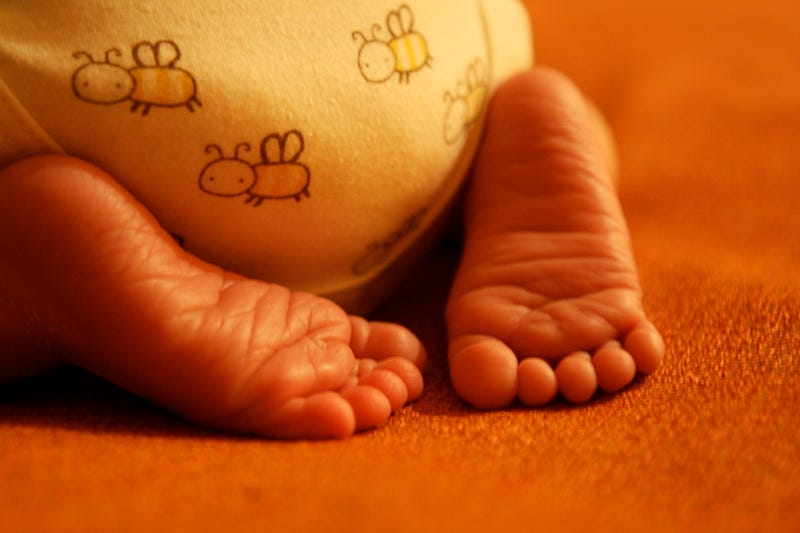
Feet by green_kermit is licensed under CC BY-NC-ND 2.0
I’m at an age where many of my peers, but certainly not all, now have children. For some of those that don’t, that’s a choice and one that should be respected. Having children isn’t for everyone and for some it just isn’t a feature that they seek to be a part of their lives or their relationship. There shouldn’t be any judgement for that stance whatsoever. For others, it may just not be the right time for them, especially as people are generally having children later in a reflection of contemporary lifestyles. If having children is a decision you’re nearing to but not quite there yet, why should you feel pressured to hasten that decision to satisfy others?

Despite modern society increasingly distancing itself from archaic and arbitrary measures of what constitutes success, there still remains a fixation upon what we’re supposed to do in life and those expectations remain in our most personal spheres. We’re supposed to be in a relationship. And if we’re not, we can expect to be questioned why, and worse still, shamed for it. And if we’re of a certain age where many of our peers may be having children, and within a relationship, then obviously we should be too, right? Wrong.

It’s therefore little wonder that marriage and having children can sometimes be for the wrong reasons, such as an attempted solution to a broken relationship or merely buckling under the pressure of societal expectations. If the question of when children were coming disappeared, a layer of that unwarranted pressure to have children would likely disappear with it.

No one should be made to feel guilty or that they’re an anomaly for a decision that’s theirs to take in not having children. Yet many will be made to feel just that. Furthermore, the decision and commitment to have a child isn’t one that should be taken lightly. So shouldn’t we laud those who don’t conform and decline to have children if it isn’t an experience they desire?

For others, not having children may not be a choice they’ve made. Conception and pregnancy are not an exact science and for many who don’t have children, that hasn’t been for want of trying. Conception for some couples can take years of trying, sometimes to no avail before alternative routes such as IVF or adoption are explored. And even then, the process is not only not guaranteed but is also lengthy and emotionally draining.

For some couples, experiencing a miscarriage, or even recurrent pregnancy loss, can be a painful reality. Imagine the distress caused in both scenarios, compounded by seeing the babies of family, friends and even strangers as a reminder that parenthood remains elusive. It’s made worse by having to handle the insensitivity of people asking when you’re going to have children; when unbeknownst to them, the recipient of their question wants nothing more than to be a parent.

So how has such an insensitive line of questioning come to be so commonplace? Much of it can be traced back to expectation but it’s also reinforced by the older generation.

Becoming a grandparent is a wish held by many parents with adult children. Indeed, if I gave them the green light, my parents and in-laws would proudly parade my son all day, everyday.

Said parents see their own peers becoming grandparents and many want that for themselves. Although where it goes too far is when social conditioning starts creeping in again and becoming a grandparent becomes something that is supposed to happen. Some even see not becoming a grandparent as a disappointment and will ignorantly articulate this, nonchalant to the fact that there might be a reason why grandchildren haven’t been forthcoming.

It’s a view that’s particularly prevalent in ethnic minority communities where the significance of family makes becoming a grandparent almost a necessary rite of passage and something some will feel entitled to. That deeply misplaced sense of entitlement can be extended to ‘uncles’ and ‘aunties’ in the community, that you might not even know, telling you that it’s about time you had children. It’s well meaning but for someone who knows they perhaps can’t have children or is having trouble conceiving, it’s also incredibly insensitive.

There needs to be more awareness, sensitivity and empathy for those who can’t have children or are having difficulty conceiving or becoming parents. Especially with social media, we need to be mindful of excessively flaunting our parenthood to an audience that will likely include at least someone for whom we’re projecting an experience they’ve been unable to have for themselves. That doesn’t mean refraining from celebrating our own children but simply being a bit more thoughtful in our exchanges and what we share. And above all, not asking when children might be forthcoming unless it’s a conversation they’re happy to have.

We need to remember and respect that having children is a choice some choose not to make. Likewise, difficulty in having children, biologically or otherwise, is a reality for some who would like nothing more than a baby. When and if someone is going to have children can be a sensitive subject and more people need to be mindful of that.
SHARE:

Sunday, 22 January 2017

Is monogamy simply a social and emotional construct?

While having children is undoubtedly a person choice, anthropologically speaking, procreation is a perceived (and archaically assumed) feature of most relationships between the opposite sex. For those who seek to have children, and those that don’t, a monogamous relationship is usually deemed the most ideal unit from within which to procreate or simply to coexist with a partner. It represents stability, support and, bizarrely, social success of being in a relationship.

However, if we critique this approach, does monogamy really provide the aforementioned or have we been conditioned to believe it does to reinforce the very arguments that are made in its support? Furthermore, as emotional beings, is there an emotional attraction to monogamy that we crave in seeking an exclusive and reciprocated belonging, acceptance and love from a partner who is considered unique in fulfilling said role?

Firstly, I need to make a disclaimer that this isn’t about me expressing a desire or endorsement for polygamy or a proclamation that I am polyamorous (which would go against my own monogamous relationship). Had it been, I would likely have chosen a more personal forum to announce this to my partner. It’s also not something I’m seeking to explore, not to mention a practice I can’t envisage my wife embracing.

Nevertheless, the practice of monogamy has largely remained unquestioned in contemporary society. For even those of us that are more liberal-leaning, monogamy is still broadly considered sacrosanct. Polyamory is becoming more visible and accepted (Laurie Penny wrote an article on her own experience as a polyamorous woman) but there is still a stigma around it. For the conservative brigade, it’s probably just a synonym for liberal promiscuity that we blindly criticise. Why? Because it threatens the status quo of monogamy as the standard for relationships.

Our physical attraction to a partner is typically underpinned by a sexual attraction. And in anthropological terms (for a hetrosexual couple), an underlying desire to procreate. Although, society’s expectations when having children, and the pragmatism surrounding it, downgrades that underlying desire to sex for couples of all sexual orientation. Subsequently, that attraction forms the basis of compatibility for a relationship with personalities and shared values of course typically being granted similar status.

When it comes to a physical attraction, that initial spark is more primitive that we would care to admit. And it calls monogamy into question given its features are secondary, albeit valid, considerations for any relationship.

The stability of a monogamous relationship; having someone to confide in and receive reciprocated comfort, support and affection, makes perfect sense. And attributing that to one person perhaps makes it extra special. Throw in the mix exclusive intimacy and growing emotional attachment and you’ve just placed each other on a status of importance that places your partner above all others. Yet much of this is projected from the relationships of others in setting the standard that we’re told we should seek.

Most weddings feature speeches where the ‘special’ and ‘perfect’ love between the couple is waxed lyrical upon while guests are subject to regaling of how the couple are ‘made for each other’. Well, I’ve been to enough weddings (including those where I’ve known the feelings between the couple are far from mutual) to know that such rehearsed sentiments mean someone’s lying. Rather, they’re soundbites that we’re expected to attain in relationships and if we don’t project them in our own relationships, we risk the stigma-driven judgement of not attaining the social success of relationships.

If we want children, we are erroneously conditioned to feel that a two-parent, cohabiting relationship is better than one where parents may live separately (again, judgement raises its ugly head, particularly in relation to single mothers). Similarly, having two incomes is better than one and provides increased financial stability. And particularly as we age, existing in a unit where we can look after each other makes sense. But are these reasons suffice to drive the social conditioning of monogamy as the ‘right’ standard for relationships? Thinking objectively, and breaking away from my own social conditioning, perhaps not.

Conversely, wouldn’t more than one partner present all of the above but in abundance? Increased financial stability via further incomes, increased support in raising children and further companionship (assuming all of the relationships were able to coexist harmoniously alongside each other) all make a case for those of us sticking with monogamy missing a trick.

There are also the emotional ties that probably provide the strongest anchor to monogamy. As humans, we can be insecure creatures. The notion of sharing a partner, no matter how much of an understanding there might be, would be difficult for many. It’s why infidelity is deemed such a transgression - not just because one has gone against a promise to be monogamous but because their actions represent their willingness to share themselves with another and therefore serve as a trigger of insecurity.

Nonetheless, while not championing infidelity within a monogamous relationship, it comes back to the primal physical attraction that we experience. The attraction isn’t what causes a transgression (though those who experience much more insecurity in their relationship might argue otherwise), instead it’s acting upon it. That default opposition to doing so is based on the social conditioning we’ve been subject to. We’re wired to know that it represents wrongdoing but also empathy of how a partner would feel should that ever-present insecurity be provoked.

If I’m driving a Maybach and I see the Batmobile, I’m going to want to stop and look at it. And I’m probably going to want to drive it too. Nonetheless, getting out and risking not being able to drive my Maybach because I’ve forsaken it for the Batmobile (no matter how temporarily or meaninglessly) is an inherent temptation that is mitigated by the social conditioning that it would be wrong. Similarly to relationships, this makes us human but resistance to acting on an attraction is neutered by our perception and acceptance of monogamy. If we returned to experiencing and accepting those primal instincts, few people would bat an eyelid at getting in both cars.
"I like my Maybach... but it's the Batmobile..."
Monogamy represents stability and within contemporary society, a pragmatic approach to relationships that demonstrates how special a partner is. While I might not seek to adopt a different path, those that do are merely tapping into more primal sentiments that the rest of us have moved away from. Monogamy provides the safety and relationship goals that society has told us we desire and wards off the stigma that we’ve come to fear in not achieving the expectations placed upon us. It’s a social and emotional construct but one that most of us have seemingly brought into in making it the status quo.
SHARE:

Wednesday, 10 August 2016

Why I don’t believe in the importance and sanctity of marriage (and why my wife does)

While it might not be a popular opinion amongst married people especially, I don't believe in the importance and sanctity of marriage. In fact, beyond being a largely administrative and social construct, I struggle to see the value of it beyond a formality of what a couple presumably already have before they decide to tie the knot. At face value, my opinions on marriage probably appear to present a dichotomy with my own relationship. But I can assure you they don't. My marriage is just fine, contributed to by that very stance.


Despite my views on marriage, my wife thinks the opposite. Again, this difference of opinion has no adverse effect on our relationship whatsoever. The crux of what constitutes a balanced and healthy relationship is what we do agree on and the entity of marriage is very much secondary to that. Nonetheless, to give a balanced viewpoint, and in a first on iamalaw, this is a co-written article with my wife arguing why she believes in the importance and sanctity of marriage and why I beg to differ. And just like most things we disagree on, it's appropriate that she has the last word.

Why I don't believe in the importance and sanctity of marriage

What is marriage? It’s a representation of a union between two people to signify their commitment to each other. That might sound like a fairly sterile definition akin to a merger between two companies but essentially, that's what marriage is. When you consider the reciprocated love between a couple, marriage didn't bring that about, it existed long before. Hence marriage simply declaring an existing arrangement rather than creating a new one per se. Indeed, the belief that said emotions will appear or develop consequent to getting married is what many short-lived or flawed marriages can be attributed to.

Marriage doesn't unlock a door to relationship utopia. Anyone claiming it does is a liar or in a situation where they need to convince themselves and everyone else that they’re happy. Sadly, there are a lot of people like that. I’ve even been to a wedding where unbeknownst to the poor groom, I knew the bride loved someone else (not me I should add) and it was written all over her face. Alas, she thought marriage might be able to eradicate those thoughts, not to mention she felt she needed to be married so as to not ‘fall behind’ with her already married peers. It therefore serves to support the notion that in some instances, marriage can merely further the antithesis of what society erroneously claims it establishes as the basis of a bona fide, committed relationship.

When I decided to propose to my now wife, I didn't wake up that day with an epiphany that I was suddenly on the brink of total commitment to her. Nor did I feel I was just shy of such sentiments but needed to be married to facilitate those feelings being at 100%. By definition, I was ‘married’ years before I was married in the legal sense. So what's so sacred about something I already had? 

Our wedding was great and an opportunity to celebrate our relationship with the people that matter to us while publicly formalising our relationship. Along with knowing the significance marriage has for my wife (which while not wholly in agreement with my own views, has no adverse or compromising impact on me), deciding to get married was exactly for those reasons. Nevertheless, a wedding isn't a marriage. And a marriage is something we already had before exchanging vows in front of our friends and family. 

Once I was married (in the legal sense), nothing changed in our interaction or anything whatsoever. We already lived together (which was non-negotiable before marriage for both of us) so what was going to change when we went back home the following day after our wedding? And if anything had changed, or if we had expected or hoped it to, our marriage would’ve delusionally been based on the wrong reasons and our relationship upon a very shaky and flawed foundation.

When the pomp of even modest weddings is considered and juxtaposed with the supposed meaning of marriage, it's hard to argue that there isn't another driver behind the desire of many to get married. Do they really want to celebrate what is already a union with each other or is it an opportunity for the pantomime that many weddings are? Particularly in cultures where the status of being married is bizarrely celebrated as the pinnacle of one's existence and a meaningless measure of success within a society that often laments being single, the value of marriage as an entity surely needs to be questioned. I’ve also noticed that it’s often a case of the bigger the celebration, the more the couple are trying to convince and distract themselves and others that their marriage is a good idea.

We all have free will to determine if we want to establish and remain in a relationship with someone. Being married doesn't keep me with my wife, it's my free will and desire to coexist with her that does. Marriage has nothing to do with it. If a married couple decide to go their separate ways, the acceptance of their marriage having broken down often occurs later than it should have because of the status of being married being clung to, and the unwarranted stigma of being divorced or separated, that can delay the relationship ending. In those situations, marriage can actually constrain one’s free will with consequences that can’t be good for the well-being and mental health of the couple or even any children. 

From my perspective, marriage doesn't even rank at the top of manifestations of commitment between a couple and certainly not above having a child/children together or jointly owning a home. Rather than embody, marriage illustrates that commitment and articulates it in a religious, legal or cultural context. It certainly doesn't facilitate it as it should have already existed in the relationship.

Contrary to what the above might suggest, I’m not anti-marriage. I just don't think it embodies the sanctity of the commitment it’s claimed to epitomise. Some of the most committed relationships and solid couples I’ve seen are unmarried and many of the flawed relationships I’ve seen are within marriages. Marriage doesn't maketh a relationship. It's merely a label society has foisted upon us in trying to demonstrate commitment between two people via a romanticised social construct.

Why I believe in the importance and sanctity of marriage (even though my husband doesn't)

Marriage has always been important to me. I didn't chase getting married like some of my peers but deep down, I probably always wanted to get married and I’ve always believed in the sanctity of it. I’ve never really questioned why but I’ve always seen it like that. When I got married, nothing changed. However, it still remains important to me.

Getting married shows commitment between a couple. There are other ways that commitment can be displayed and I understand that actions like buying a property together or having children show that. But the commitment in those instances are usually secondary factors to actually wanting those things. People don't say “we’re committed to each other so let's buy a house together and have children”. People usually want a house and/or children and their commitment to each other can increase on the basis of that.

With marriage, it's a public celebration of your relationship but one that the couple make for themselves and with each other. It’s not because of any reasons or circumstances that are really about something else like having both names on a mortgage.


Especially as someone who hasn't changed their surname in marriage, I think marriage creates a unit for the couple, and children, that doesn't need to be defined by a shared name. That isn't to say that I think you need to be married to have children. Although personally, being married represents a unit that you can say is yours and that you feel a belonging to.

I can admit that marriage has messed up a lot of people. Within my community especially, people chase it as if they’d be incomplete without it and I’ve seen many people get married for the wrong reasons and to the wrong people in relationships without real love. Even in the current generation, marriage is the done thing; it's not something people would necessarily do or see as important without that cultural influence or push. But the importance I feel marriage has outweighs any of that negativity. 

Marriage brings security as the couple make a conscious decision to declare their commitment to each other. When they have problems within their marriage, they therefore feel like they want to work harder to fix it because they took a step toward that position of being married in the first place. Marriage isn't just a throwaway commitment that a couple are less likely to want to hold onto.

Culturally, a wedding, and especially a daughter's wedding, is a big deal in my community and I feel the same way. Families want to celebrate marriages and that's a valid and happy reason to celebrate. I know that can make for a bit of a show but it's culturally important to us and that's something I can't really explain beyond it being of importance to my identity.

Marriage means something that can't always be put into words and I know it isn't for everyone. It doesn't make a relationship but it represents the union of two people in a way that shows just how important their relationship is to each other. It puts that on display for everyone else to witness and gives something ‘official’ to what a couple admittedly already had together.
SHARE:

Saturday, 27 February 2016

Marriage and relationships aren’t for everyone so why do we shame people into thinking otherwise?

For many singletons attending events and family functions such as weddings, there’s often a line of questioning that can be expected from enquiring relatives and friends:

“So… are you seeing anyone?”

“When are you getting married then?!”

“No girlfriend/boyfriend?”

If the answer is negative, it can frequently be met with pity as if to suggest that one’s life is clearly lacking without a partner. It’s followed up with somewhat patronising assurances of “you’ll find someone soon” or offers of “you know, I should introduce you to…” with that telling look of concern at your pathetic single life combined with enthusiasm at the prospect of being able to play matchmaker.

Such questioning can be innocent small talk, genuine (but misguided) concern or merely crass prying. But it remains unnecessary, intrusive and even presumptuous of one’s sexual orientation depending on how the question is framed. And for some, it can be a question that is anticipated with some trepidation; something no one should feel due to their relationship status. Yet it stems from the assumption and expectation within society that we should all want to be in a relationship and for many, aspire to get married.

Firstly, being in a relationship or being married is not an achievement under any circumstances whatsoever. It’s primarily a choice and a circumstance. There isn’t anything about being in a relationship that makes someone better than the next person or makes any aspect of a single person’s life inferior in contrast. And it’s ridiculous that such views still prevail. Not to mention, it’s a huge affront toward those that are single and an archaic attitude within contemporary society. If anything, those who choose to remain single, or not actively pursue a relationship, should be lauded for not conforming to society’s expectations.

Being single or not pursuing a long term relationship is an increasing and more than acceptable choice for some. It needn’t mean said individuals have anything wrong with them, cannot coexist in a relationship or cannot attract anyone. And in the case of heterosexual relationships, it doesn’t mean they’re homosexual either and vice versa. It can be a personal choice for a discrete or indefinite period of time, a reflection of someone’s preference for their own company, a decision to simply not actively pursue a relationship or anything else. As Mexican artist Idalia Candelas captured in a series of black and white illustrations of single women, single life needn’t mean sadness and forced loneliness either. There isn’t anything wrong with being single but society has suggested otherwise.


Consequently, society is ‘single shaming’; effectively applying stigma to those who choose to be single, or indeed those who just happen to be, because they don’t conform to tradition and more conservative behaviour. It’s an outdated, offensive and moronic perspective and no different to ‘slut shaming’. Instead, perceived promiscuity is merely replaced with a perception of what society deems a dystopian relationship status, rather than the Victorian values approach many still subscribe to.

Within many cultures and communities, marriage remains a measure of success for the couple and their families, hence the pantomime that so many weddings become. Being of sound character, accomplished (defined by one’s own gauge) and happy in one’s self can sometimes be deemed insignificant to being married or en route to it. Although with that line of thinking being so socially inherent, it can have a negative impact on one’s mental health for those that don’t conform to or desire such ideals. Nevertheless, a growing number of people are eschewing such notions or pursuits of a relationship and instead seeking happiness by their own definition.

Ironically, the impact of shaming people for being single merely creates forced and sham relationships where people feel obliged to pursue what society has deemed necessary for their completeness. Similarly, for those in a irreparable relationship, it’s fostered a fear of leaving a situation that just isn’t working. While separation or divorce is never an ideal scenario for a couple, it’s certainly more appropriate than remaining in a toxic or destructive relationship. Though many couples cling onto this rather than face the unwarranted stigma of being single or having been in a relationship that didn’t work.

It needs to be remembered that marriage is a social construct. It’s somewhat of an artifice that has traditionally benefited men in representing control and ‘ownership’ of women while providing mutual companionship, stability and avoiding the stigma of both parties being single themselves. However, despite it being important to realise that both men and women are subject to single shaming, women arguably have the raw deal when it comes to being subject to the stigma of being single.

Kate Bolick’s Spinster, an examination of the growing number of women choosing to remain unmarried, begins with ‘Whom to marry and when will it happen - these two questions define every woman's existence, regardless of where she was raised or what religion she does or doesn’t practice’. And for many women, even in the twenty-first century and amidst successive generations of progression for women's rights, this is sadly true. It may be subconscious for some women but it’s nonetheless a byproduct of the social construct that is marriage that begins even before marriageable age.

Many teenage girls clamour for boyfriends so as not to be left out from their friends. And those that don’t have boyfriends are often left feeling inadequate unless they have a strong enough indifference to the pursuit of relationships amongst their peers. Fast forward to their 20s and this inclination is intensified with many women worryingly feeling their lives are incomplete without a partner. Furthermore, by then, men too have joined in the obsession in seeking ‘completeness’ as if being single cannot fulfil that by society’s expectations.

Marriage and relationships are not indicators of being whole and society needs to refute the ludicrous and deep-rooted myth that one isn’t complete without it. While they can provide companionship, and for some, desirable units within which to start a family, marriage and relationships (and indeed said families) just aren’t for everyone and there isn’t anything wrong with that. Therefore we need to stop shaming single people for thinking just that.
SHARE:

Saturday, 29 August 2015

Should a woman have to change her surname once married?

As a man, there’s little that I anticipate changing in my identity throughout my life. Regardless of my marital status, my title will remain as ‘Mr’ and my surname will remain unchanged (unless I choose to change it by deed poll). Although, for women, both identifiers are typically subject to change for those who subscribe to the tradition of doing so once married.

For some women, not changing their surname once married is unthinkable given their connection, willing or otherwise, to tradition or indeed their respective culture. On the other hand, there are an increasing number of women who retain their maiden name and not doing so is non-negotiable. But the majority of married women do decide to change their surname almost as a matter of course. Moreover, some women even relish changing their surname as a hollow (and foolish) badge of ‘success’ in being married.

The issue of a woman changing her surname is a relevant one for me as my partner falls into the group of women who feel an unease with the social expectation of adopting their partner’s surname once married. And initially, I was in agreement with her. In fact, I probably articulated my opposition to her changing her surname to mine more than she did.


It's tradition within my partner’s culture that when a child is born their middle name is that of their father’s first name. For example, if their father’s name is Joe Bloggs, their full name is X Joe Bloggs. For women though, that changes once they’re married when their middle name (being their father’s first name) is replaced with their husband’s first name. And as with western culture, their surname is also replaced so that it’s shared with their husband. Given the historical context of marriage and gender relations within my partner’s culture, I perceived this as hugely patriarchal.

While some may argue this is reading too much into a tradition, it can be perceived that where a woman (once ‘owned’ and labelled with the name of her father) is married, her ‘ownership’ is transferred from her father to her new husband. She consequently becomes the property of, and is accordingly labelled with the name of, her husband.

Conversely, it has to be recognised that there is an aspect of the tradition reflecting the woman being welcomed into and embraced by her husband’s family by assuming his surname. Although, with my awareness of my partner’s culture and its often still antiquated and misogynistic perception of women, it didn’t sit well with me. Hence I was nonchalant when it came to the idea of her taking my surname once married.

However, my stance eventually had a fairly sharp change. When my partner was questioned by a relative of hers who asked if she’d change her surname when married, her response was a firm “no”. She elaborated on this by explaining that she was “a [her current surname] and not a [my surname]” and her identity was that of a [her surname]. She also returned with her own question of “why should a woman have to change her surname when a man doesn’t?”. On the latter, I agreed with her. Yet on the former, my stance on the matter went from indifference to a burgeoning feeling of rejection toward the idea of a shared identity via my surname. I didn’t perceive it as a rejection of my family per se, but a rejection of the notion of establishing a unit with me that would, by default, share my surname.

As we spoke about this further, she explained that particularly in an interracial relationship, preserving her cultural identify both for herself and within our relationship, was hugely important. To lose her surname, which bears cultural significance for her, would be to relinquish some of that identity and she felt it was important that her surname reflected who she was. And in spite of any resentment I held toward her stance, I had to acknowledge that she made a valid point with regard to her identity; one that as a man I could not fully empathise with. Being a man, my surname, and the reflection of my identity within it, would remain intact in marriage. Furthermore, tradition and society suggests that any assumption of culture and identity in marriage would by default be her assuming mine. While it wasn’t by my design, the status quo was certainly in my favour for who would need to make any cultural compromises.

From my androcentric perspective, I argued that her culture was already visible within our relationship as both of us valued and immersed ourselves in our own and each other’s culture. I also felt that as I had integrated myself into her family to an extent that no claim could be made of me stifling or even diluting her culture within our relationship. But regardless of this, her most personal identifier, her name, wouldn’t reflect that and this was an experience that I would never be able to fully appreciate.

So should women have to change their surnames once married? It’s a tradition within marriage that has broadly endured along with women receiving a diamond engagement ring to signal their impending marriage. The latter isn’t rejected by many women – but it isn’t one that reflects their identity or lack of. The undertones of patriarchy behind women changing their surnames is also undeniable. Society preserves this in many relationships where a woman assuming her husband’s surname is merely a subtle indicator of the subservience and unequal status she may be subject to.

For a woman to change her surname can be a relinquishing of her identity and the trappings of said identity such as her culture or apparent ties to her family and community. Being known as Miss or Ms X, particularly in a professional context, and to suddenly be known as Ms or Mrs Y is also a shift of varying degrees depending on the change in surname. Nor is it a change men are subject to. Despite her rationale, it further explains the indignation of my partner on the matter.

In a modern context, the tradition of a woman taking her husband’s surname as her own needn’t be seen as patriarchal. Rather, it can be seen as the husband welcoming her to his family. Or, as I see it, creating a new entity comprising the couple that share a surname as their shared identity. Many would counter that by saying why not instead take the woman’s surname, a double-barrelled surname comprising both those of the man and woman or even a completely new name? To that, I can only offer the illogicality of tradition as explanation.

Despite my jesting with her, I have returned to my earlier nonchalance on my partner changing her surname. I continue to acknowledge the patriarchal roots of the tradition and how unwittingly or otherwise, these have undoubtedly been used as a vehicle for misogyny throughout the ages. In addition, the relinquishing and dilution of identify in changing one’s surname is one that I can appreciate if not fully empathise with as a man. Where a surname has cultural significance, the loss of identity is even more prevalent when the new surname erodes that. This therefore has further connotations that probably can’t be appreciated when changing a Greene for a Brown or a Clarke for a Jones compared to changing a Yeboah or an Ibrahim for a Williams or an Edwards. As a result, it’s arguably more of an issue for some women than others.

There is an unfairness that must be admitted in the status quo where society has not only expected women to change their surnames but social conditioning has also made it a default position. Though regardless of one’s stance on the matter, there should be a social and cultural debate on the validity and fairness of such an enduring tradition.
SHARE:

Saturday, 27 June 2015

A celebration of marriage or an ostentatious pantomime? - the social dichotomy of weddings

For many, marriage is a social and often cultural rite of passage. While I don’t agree with the pressure that places on an individual as an unwarranted measure of success, I’m certainly not anti-marriage. Nonetheless, my personal views are that there are much bigger commitments a couple can make to each other than a wedding. Having children, jointly buying a property and above all consciously making the decision to coexist in a shared life, all represent bigger commitments to each other than a ceremony. Furthermore, that stance and decision to share a life together should precede any proposal, engagement or indeed wedding. For that reason, a wedding and subsequent marriage is really a formalising of the aforementioned rather than the key to a long and prosperous relationship. And by that token, one could question the sanctity of marriage versus the commitment a couple make to each other regardless of a wedding.

As a result, for anyone that feels a significant difference in their relationship once married, or hopes for one, they’re probably not onto the most secure start in married life. Though many marriage proposals are fuelled by just that. The sentiment that a gesture as romantic as a grand proposal, an ornate ring, an engagement, a lavish (and often extravagant) wedding and a subsequent honeymoon will revitalise a relationship is folly to say the least. Yet I’ve seen couples make that very mistake in perceiving a wedding as a tool of denial for a relationship that isn’t working. It’s a sad reality and one that I’ve seen more so from women (and less so men due to fewer social pressures upon them), that feel they need to be married. So they find a partner who seems ‘decent enough’ and despite there being no spark whatsoever, they pursue marriage as a distraction from a void and contrived relationship with an equally obliging companion.

I know women that are desperately chasing marriage, some that are even engaged and planning weddings, because of the unfair and antiquated social pressure placed upon them to do so. Admittedly, I cannot fully empathise as a man and from a culture where such pressures are not as acute as those placed on others. Yet said women are sadly in denial. Conversely, I’ve seen women break off relationships that aren’t going anywhere despite the pressures upon them to promptly get married. It takes serious cojones to make that decision and they deserve major kudos. But understandably it’s easier much easier said than done.

Similarly, I’ve seen men seek to inject life into a crumbling relationship, that seemingly has no longevity, with a proposal. The idea of getting married and the trappings of a wedding become what the couple are in love with rather than each other. If your relationship is showing no signs of compatibility and longevity, a ring and party in the form of a wedding is hardly likely to make a difference.

The apparent dichotomy of weddings therefore begs the question of what weddings represent. Not to be confused with marriage as a commitment between two people, weddings can crudely be considered as little more than a pantomime. A party to celebrate a marriage where the reason behind it can often get lost in the wedding itself. Regardless, weddings are great events and the celebration of two people’s union is one deserving of such festivities. Though when used as a vehicle for blocking out the fact that one is in an ineffectual relationship, it’s often a case of the bigger the diamond, the bigger the wedding and the more ostentatious the event, the bigger the distraction being sought.

Multiple events, exorbitant spending beyond one’s means and pomp and splendour that could rival the coronation of a new monarch, can often signal the lack of belief in a relationship being masked by such opulence. But when the hype has ended, the guests have gone home and you return to reality, what happens when the sheen has become sullied by the reality of an empty relationship? Do you seek further distraction via an equally flamboyant honeymoon? Perhaps consequently children? In a relationship that needs such distractions, it’s merely the prolonging of living a lie. However, said individuals certainly shouldn’t necessarily be besmirched without exception. Rather society and the pressures that they succumb to should be rebuked.

Just as a dog isn’t just for Christmas, a marriage isn’t intended to be just for the duration of a wedding. The hope and intention with every marriage is that it is a lifelong union. And that realisation needs to come before a wedding itself. A relationship needs to be realised as successful, not contrived. Although that can’t be achieved when the focus is on having a wedding rather than a marriage.

In an era that is increasingly liberal and gradually freeing itself from some of the more archaic shackles of tradition, weddings have surprisingly managed to weather the storm of social modernity. Married couples to be want their friends and families to share in the celebration of their marriage and rightly so. Although the focus on this has shifted. Instead of a celebration of marriage, weddings have become an opportunity to showcase social one-upmanship. Couples and their families often seek to put on an event that is grander than the one they attended previously. No expense is spared, even at the risk of unmanageable debt, just so that couples can out-do the perceived competition.

Weddings have become increasingly about keeping up with the Joneses. And not only with those that crassly seek to flaunt their socio-economic prowess and spending power but also those that are clearly punching above their weight in trying to do the same. If the celebration of marriage was the primary aim of all weddings, perhaps for many they’d be slimmed down and more appropriate affairs. After all, what is there to prove unless you’re trying to prove the viability of your relationship to yourself and others?

Friends fans and aficionados will recall when Monica’s parents spent her ‘wedding fund’ on their beach house, leaving Monica’s vision of her dream wedding in tatters unless Chandler was willing to imprudently spend all of his savings to fund it. Monica was so in love with the ideal of her dream wedding that it took Chandler articulating the joint future he saw for them for her to realise what was really important and that it wasn’t a grandiose wedding. If others could do the same, they’d have a renewed sense of perspective when it came to their own weddings.

On balance, some of the healthiest relationships I’ve seen have been within unmarried couples. And if and when they decide to tie the knot, it’s really a formality symbolising where they and others know their relationship is. There’s isn’t anything wrong with the pantomime of a wedding, but that’s ultimately all it is. After all, the marriage a wedding celebrates is intended to continue and grow long after all the guests have gone home.
SHARE:

Saturday, 31 August 2013

The unlikely taboo of interracial relationships


Despite improved race relations and the progress of multiculturalism, for some, one area that should remain sacrosanct to such progression is interracial relationships. Consequently, and as an undeniable feature of modern society, interracial relationships have remained an unlikely taboo for some.

Being in an interracial relationship, I’ve been fortunate to not have experienced tangible resistance from either family and certainly not with any hostility. There have been undertones of cautiousness on both sides but that’s been largely based on ignorance of the other’s culture and how to respond to it. And with my partner’s community being fairly insular, initially, I literally represented the unknown for her family.

With some people, and behind a smokescreen of disingenuousness, we’ve both observed unspoken sentiments of disapproval toward our relationship. It’s a minority view but not one held by individuals who we have any real relationship with or respect for. Nor is it a view that has ever been articulated – which is just as well as said individuals’ opinions are of no value to us. Though admittedly, knowing that you are the source of any disapproval from even the smallest factions of your partner’s family or community is not a pleasant feeling.

Particularly if any opposition stems more from your partner’s side than yours, it’s easy to see yourself as the indirect source of any potential anguish for them or the reason for them needing to become more resolute in their convictions. It can also lead to a feeling of helplessness and regret; not of your relationship but of what you feel you represent on some level in causing an issue. Conversely, for the other person, an unwarranted feeling of resentment toward their family and community, and a sense of guilt that they come from a background that exhibits prejudice wrapped in backwards ideals, is an unescapable emotion.

Nonetheless, neither of us will ever lament the fact that we aren’t of the same ethnicity simply because it doesn’t meet blanket approval. Both of us are proud of our respective heritage and nothing will change that or cause us to suppress either culture within the relationship. We embrace each other’s culture which is something both our families appreciate and has arguably mitigated any challenges we may have faced.

Thankfully, we haven’t experienced the problems encountered by some interracial couples. I know of interracial and interreligious couples whose families and wider communities have not been receptive to their relationship whatsoever. For some, that’s meant having to choose between their relationship and their family – with the ultimatum being directly or indirectly made by the latter. In response, some couples have shown great courage that I have the utmost admiration for and they’ve pursued their relationship at the risk of being ostracised by either family. Whereas for some, their family was too great a sacrifice to make. Especially against a backdrop of prejudice from a family, many would argue that pursuing the relationship is the right thing to do in such instances. Although, regardless of the decision, it's undoubtedly an emotionally charged predicament.

Interracial relationships and people of mixed race have become commonplace in modern society and the prejudice they were once met with has certainly receded in recent years. The Melting Pot Generation – How Britain Became More Relaxed About Race, a report published by think tank British Future, also found that in contrast to 50% and 40% of the British public admitting to being opposed to interracial relationships in the 80s and 90s respectively, that figure was 15% in 2012. That’s a huge improvement. But with a population that exceeds 60 million, 15% can’t be discounted as merely a handful of people with archaic attitudes.

The 2001 UK census reported that 2% of all marriages were “inter-ethnic”, a figure that will surely be shown to be growing once the respective data is released for the 2011 census. In the interim, and as a measure of the increasing number of interracial relationships in the UK, the 2011 census data shows that the mixed race population is amongst the fastest growing and forecast to become the largest ethnic minority group in the country. In America, the 2010 census also reported that “interracial or interethnic” cohabiting married couples grew by 28% between 2000 and 2010. With such a trend, how have interracial relationships therefore managed to remain taboo for some?

It may not always be overt, and in many cases is culturally or even generationally institutionalised, but prejudice is what underpins opposition to interracial relationships. Yet many who hold said opinions would probably argue to the contrary. Some would claim that their opposition is based on their perception of the lack of viability of an interracial relationship and a fear of their culture becoming diluted. They’d allege that’s in contrast to a relationship where the couple at least share their heritage if nothing else. Many would also pledge their commitment to multiculturalism, citing their indifference to colleagues, neighbours and even friends of a different background. However, for them, the intimate sphere of a relationship is a line that that indifference cannot and should not cross.

Granted, and potentially coming to the fore in raising children, some interracial couples may experience challenges of different cultural expectations or different cultural values within the relationship. Where applicable, language barriers with each other’s families, not to mention a possible frosty reception to the relationship, can also present problems. Although in a multicultural society, aren’t these problems mitigated by multiculturalism itself? And when taken outside the context of race or indeed religion, aren’t differing views challenges that all couples may be faced with, regardless of their respective backgrounds?

The assertion that interracial relationships signal the end of a culture’s identity is unfounded. Multiculturalism shapes new identities and, as a frequent by-product of interracial relationships, the mixed race population provides a growing ethnic group that with it brings new hybrid identities and cultures. Though that needn’t cause a culture to become extinct. In a diverse society, cultural identities can just as easily become eroded within a couple of the same ethnicity and heritage. Therefore to pin that on interracial couples is a charge that is tinged by ignorance, prejudice and irrational fear.

Beyond their prejudice, those who maintain an opposition to interracial relationships may see it as a gradual attack on their own race, culture and accompanying values and identity. But in maintaining their view, they’re unwittingly or otherwise resisting the virtues of multiculturalism and holding a belief that has little reasoning behind it. Furthermore, ironically, the very values and identities they unnecessarily seek to protect and preserve will likely outlive their own backwards and narrow-minded ideals.

For interracial relationships to remain taboo for some is a sad reality that goes against the grain of a racially diverse society. Fortunately, it is a view that is becoming increasingly rare and typically met with disgust and disdain. Yet despite the progress made in race relations, the prejudice that fuels this opposition hasn’t been completely eroded; until it is, there will always be individuals who simply don’t agree with interracial relationships.
SHARE:

Saturday, 2 February 2013

The Asian pursuit of matrimony – an outsider’s perspective

Recently, I met some friends for lunch. Everyone at the table was either approaching or already in their early thirties and, with the exception of me, Asian (by Asian I mean of South Asian descent i.e. being of the Indian subcontinent). As some might have deemed inevitable given the demographic of our group, the conversation eventually turned to relationships. But as the only non-Asian at the table, it quickly became apparent that my perspective on marriage and relationships was different from everyone else’s. Nonetheless, this made me reflect on the Asian pursuit and perception of marriage and the extent to which it isn’t actually that dissimilar to western ideals.

In its ignorance, western media and attitudes can often be quick to disparage traditional Asian views on marriage. And as a result, there’s a lot that is misunderstood. While I’m not of the sizeable Asian diaspora that exists in the UK, I’m reasonably familiar with Asian culture and the significance it holds for marriage. Although while this isn’t different from other cultures where marriage is often aspired to and celebrated, what stands out in Asian culture is the pressure many feel is placed upon them to get married.

Typically, there’s an expectation placed on second generation Asians to become academically and professionally successful before getting married to someone that “looks good” in the eyes of their community.

Consequently, as Asians who are yet to be married enter their mid-to-late twenties and thirties, the pressure to do so ramps up. Websites like shaadi.com (notably a ‘matrimonial’ rather than dating website) and other ‘mainstream’ dating sites are registered with in expediting the prospect of marriage. Furthermore, the offers of ‘introductions’ – being put in contact with someone from the community who also happens to be single – also begin.

Admittedly, my only references to introductions are the experiences of others but I understand they can be notorious in lacking any filter. Rather than focusing on actual commonality between two people, the basis for the introduction can simply be that the other person is also single and “looking”. To an outsider to the culture, it can come across as contrived and unnatural. On the other hand, limiting any stipulations can allow two people to become acquainted without a ‘tick box’ approach being employed beforehand.

In going on introductions, there’s also a sense of reassurance on the basis of meeting someone from your community with whom you share a mutual acquaintance. But whoever has put you in contact with your date doesn’t necessarily really know the person you’re meeting. After all, I wouldn’t set up a female friend or relative on a date with a family friend’s cousin’s friend’s neighbour’s brother, just on the basis of them being from my community (I realise not all introductions are this tenuous). So why should this be any different? Perhaps the fact that it’s a well-practiced feature of the culture has led to it being overlooked.

If you consider introductions in a western context, the principles are similar to being set up on a date or meeting someone through online dating. Although with introductions, there is often the hope that one of these will lead to eventual marriage. Yet regardless of cultural background, is this much different for anyone that is seriously looking for a relationship; particularly as they enter a stage in their life where marriage is something they desire? Probably not.

Where the difference lies is this optimism is compounded by pressure, indirectly or otherwise, from parents and the wider community. And for many, including some of my own friends, it can result in a burgeoning sense of obligation to get married but for the wrong reasons.

The extent to which such obligation can often be culturally inherent makes it difficult to refrain from succumbing to. Therefore many feel compelled to force a situation that doesn’t work or they convince themselves that an empty relationship could be ‘the one’ – all rather than causing any derailment from the pursuit of marriage.

In an attempt to get closer to the goal of marriage, many will also compromise their expectations in what they’re seeking in a potential partner. Sometimes this can merely be a case of moving the goalposts from what was once sought and deemed important but in other instances, it can crudely be a lowering of standards. Again, this isn’t different to individuals from other cultures. However, it’s generally driven by a perspective that is born of social conditioning on attitudes towards marriage. In both cases, it’s not fair on those that feel it’s the only way but it sadly still occurs.

Aside from the historical and largely patriarchal reasons for its importance, the measure of success attached to marriage (and the sometimes perceived failure of being unmarried) arguably lies in the significance of a traditional family structure within Asian culture. Even so, not achieving this shouldn’t be deemed to equal failure. I know unmarried Asians for whom being academically, professionally and personally accomplished isn’t enough. Instead, not being married can inexplicably evoke unwarranted pity, concern and condescension, even from some of their married peers who stupidly and arrogantly consider themselves superior due to their marital status. Angry Brown Girl (@AngryBrownGirl), a blogger of East Indian descent, has written of her frustrations as an unmarried female in her thirties. Despite her own accomplishments and contentment with her life, not being married has nonetheless at times made her feel incomplete. But from her blog posts, there’s clearly a line drawn between wanting to be married and rightly resisting any pressure to compromise what she wants in a partner and a relationship.

A yearning for marriage and companionship isn’t exclusive to Asian culture. People, regardless of their background, will try to meet someone who shares their values, interests and consciously or otherwise, their culture. In principle, this isn’t any different when considered in an Asian context. However, in practice, it’s the pressure to get married that differentiates the approach.

I’ve seen Asian friends feel compelled (albeit not forced) to at least appear to be seeking marriage by half-heartedly and indifferently going on numerous introductions. Similarly, for others, their longing for marriage may be ingrained in them rather than being what they genuinely want. After all, marriage arguably isn’t for everyone and doesn’t have an expiry date by which it needs to be activated either. Conversely, there are some who truly yearn for the traditional, cultural standard of marriage and firmly grasp it with both hands once it’s within reach. And there isn’t anything wrong with that either. It’s what they want; not something they feel obliged to desire. I recently read a personal yet amusing take on wanting the traditional notion of marriage from Pia Khan, a blogger of Pakistani descent. Her frustrations in finding ‘Prince Charming’ lie less with any cultural standards or expectations and more with his inability to present himself to her.

The Asian approach to marriage may seem contrived and not always organic to someone who isn’t familiar with or is unable to empathise with the culture. Indeed, some Asians will admit to that sometimes being the case. Yet the underlying objective of seeking companionship within a relationship, while maintaining tradition, isn’t any different to western ideals. Instead, it’s the cultural perspective, and the consequent pressure, that distinguishes the Asian experience and has kept marriage as central to the culture and the mindset of the diaspora.
SHARE:
© iamalaw

This site uses cookies from Google to deliver its services - Click here for information.

Blogger Template Created by pipdig