Sunday, 4 February 2018

The forgotten narrative of a new dad

When my son was born, I had two weeks of paternity leave before I had to return to work. That’s it. Two weeks. In contrast to some countries, that might be quite generous but in comparison with up to a year of statutory maternity leave in the UK for women, it’s incredibly meagre. More significantly, it denies new fathers a reasonable amount of time to bond with their newborn child, not to mention being able to support their partners with the challenge of parenthood before returning to work.

During our pregnancy, society’s lack of regard for me as a dad-to-be (in contrast to that of my wife) was distinctly apparent. And when my son was born, that continued. As a new dad, my narrative as a parent is one that is unfairly relegated, further diminishing the role of fathers in society.

My return to work after paternity leave was complete with getting up early and returning home late, just as I had done before fatherhood. Although, long working days, and the pressures and workload of my role, were now accompanied by a new layer of responsibility in being a dad; a responsibility that trumps the former without exception.

That responsibility is often exclusively associated with mums as fathers continue to struggle in shaking the stereotype of fathers of yesteryear, some of whom exercised their paternal role at arm’s length and left it to mums. Whereas today, most dads are involved and supportive of their children and their partners.

Just as I was unable to fully empathise with my wife in her experience of being pregnant, I can’t fully relate with what it’s been like in becoming a new mum and everything that comes with it. Nevertheless, I have enormous respect for her and I acknowledge the efforts she makes as a mum that probably exceeds what I would be capable of managing in her position. While I’m arguably biased, she’s a brilliant mum with a natural maternal instinct that never fails to meet what’s best for our son.

We’re fortunate that her parents and extended family are very supportive and they’ll eagerly welcome any opportunity to help when she might need some respite. However, I also recognise how my return to work brought an opportunity for the onset of loneliness.

Being a mum at home during maternity leave or otherwise isn’t easy and it can place a strain on the emotional well-being of new mums. It can undoubtedly represent an emotional and lonely journey (that can manifest itself as postnatal depression) exacerbated by varying support that not everyone is afforded. Yet with those challenges come the reward and fulfilment of being able to enjoy witnessing the development of your child. The smiles, cackles and the many ‘firsts’ mums get to see all make it worthwhile.

For all the dealing with poonamis, when you could really do with someone to tag team with on the clean up and changing operation, or frustratingly spending the bulk of your day with your child on your breast, unable to get even the most minor task completed, the reward of being a mum is so much greater. Much of that reward is what as dads we sadly miss out on sharing.

There’s a distinct lack of empathy for dads. Our return to work is viewed as respite from parenthood. Complete with adult company and structure to our day that isn’t at the whim of breastfeeding on demand or similar, our role is considered a walk in the park. What do we have to complain about when we’re actually afforded time to ourselves without a baby in tow regardless of what we do? Sadly, that’s how the narrative of a dad is routinely, erroneously and unfairly perceived.

During the week, I feel almost like an absent father. I usually do a nappy change just before I leave for work and I’m home for bathtime and bedtime. But I’m knackered in the evening and any quality time with my son and indeed my wife is compromised by my fatigue, though that doesn’t mean I shirk my role and responsibilities as a dad. It becomes increasingly apparent that I miss out on much. I might see my son do something new and I’ll rush to share it with my wife; only to find out it’s not so new after all. I was just at work when he first did it.

I’ve never attended any parent and baby classes with my son (notably more commonly known as mother and baby classes) while my wife has. Even doctor’s appointments preclude me from attending because they’re scheduled throughout the working day. Weekends are too short as it is and they’re punctuated by life admin and work.

A few weekends ago, I took my son for a walk to see the geese and ducks near the local lake. It was an effort to give my wife some respite while being an opportunity to spend time with my son. However, when I messaged my wife to let her know where we had gone, she was slightly annoyed that I hadn’t waited for her to make it a walk we could have gone on as a family.

Innocently, she was unable to empathise that I craved spending time with my son, and wanted to give her a break, hence us going for a walk where she wasn’t accompanying us. Even with an involved dad for a partner, addressing the lack of time I get to spend with my son wasn’t a driver for her rationale in understanding my decision.

The lack of understanding of what a dad experiences in missing out on time with their child is far reaching and worrying but a shift in thinking doesn’t appear to be forthcoming. My hour to the lake with my son was insignificant compared to the entire week my wife spends with him; for many, that’s not a perspective that’s even considered when thinking of the emotional challenges for new dads.

Escape from the Job by Stefano Corso is licensed under CC BY-NC-ND 2.0
Personally, there’s a further frustration with the forgotten experience of dads and that’s as a black dad. Negative and racist stereotypes have left many seeing a black, involved dad as somewhat paradoxical. Being out with my son, I’ll sometimes receive odd glances while pushing his pushchair as if it’s a mirage to see a black dad, let alone a dad period, behind the handlebar. Black dads exist and we’re involved.

Elliott Rae, founder of Music Football Fatherhood, wrote of his experience that I, and many other black dads, share. Consider how dads are already perceived as the lesser of two parents. That’s compounded for black dads who are subject to the unfair stereotype of being occasional fathers that are only involved on an ad hoc and unreliable basis.

While my wife is exclusively breastfeeding and on demand, that remains a role I can’t fulfil. But as far as everything else goes, I’m on deck. If I hear my son crying at night while my wife is asleep, I’ll dash to the nursery to soothe him back to sleep before she wakes up. I do everything associated with being a parent and to support my wife in what society acknowledges can be a tough role in being a mum. We just need to acknowledge that albeit differently, being a dad isn’t easy either and our experience deserves to be included in the narrative of being a parent.
SHARE:

Sunday, 19 November 2017

Money can’t buy happiness

I’ve always been fairly prudent with money and recognised its value accordingly. However, through circumstances beyond my choosing or control, I found myself taking out a number of loans in my late teens. While my peers used money from part time jobs for clothes and going out, I was instead supporting my family and now servicing the debt that came with the loans I now had to pay off.

At the same time, my struggle with depression meant I was fully acquainted with the dark cloud that hung over me. I thought the albatross of debt had caused me to feel this way and figured money might be the solution to banishing the immovable cloud that had long plagued me.

Eventually, I came towards the end of the loan and decided to pay it off early. I’d yearned for this day and was sure that I would feel better once I was debt-free. I vividly remember walking into a branch and announcing to the member of staff at the desk that I would like to pay off the balance of my loan. After years of repayments that I resented, this was going to be the beginning of life after debt and I would start feeling better immediately as money was about to solve my problems. Alas, I was wrong.
By Howard Lake and licensed under CC BY-SA 2.0
I walked out of the branch, free of debt, expecting that ominous cloud to have receded as soon as I crossed the threshold of the bank. But it had it hadn’t budged, and it wouldn’t for many subsequent years. I felt helpless and empty. I’d pinned all my hopes of feeling better on paying off my loans but it didn’t change things whatsoever. If anything, it made it worse because I was all out of ideas as to how I would ever address my depression. And I had now succumbed to the belief that I wouldn’t ever be rid of it.

Money couldn’t address my depression, and in effect buy me happiness, and I was ignorant and naive to think it could. Yet in an ever-materialistic society, we’ve been conditioned to believe to the contrary.

When many of us think of happiness, it’s generally linked to an image of materialism. Money and opulent lifestyles produce a narrative for what many of us perceive as a life of happiness. If only we were able to fund that lifestyle, without any constraints, surely our happiness would be secured and guaranteed, right?

We’ve become accustomed to our perception of happiness as a superficial concept. And as a result, we can’t see past or realise our folly in money being a weak, inadequate and hugely misleading gauge by which we measure it.

We can’t pretend that there isn’t a joy and contentment that’s derived from money. Being able to maintain a lifestyle that affords us the freedom to do what we enjoy, and to purchase whatever we desire, without feeling the need to monitor what we’re spending, is undoubtedly what most of us aspire to achieve. And it’s certainly a life I wouldn’t reject.

Although, what happens when we become jaded with what money can provide? When we need to make more and bigger purchases to replenish our levels of happiness? Or when we encounter desires that money can play no role in facilitating, yet run so much deeper than material cravings?

Good health? Companionship? Self-fulfilment? Money can’t buy any of them. It’s at this point that we realise money is a vehicle that will only get us so far in our pursuit of happiness. And like getting on the wrong bus or train, that you were nevertheless sure would get you closer to your destination, it often terminates at a location that makes it even more apparent how far you are from actual happiness.

Bob Marley’s last words to his son Ziggy were “money can’t buy life”. Money wasn’t something Bob Marley was lacking to say the least but he realised that it didn’t buy happiness. Although never more could it have been apparent to him, his family and friends as he died, a rich man who could buy much but couldn’t buy life.

In my lowest periods of depression, no amount of money or material possessions would have been able to shift that dark cloud. Money was a worthless commodity and a currency that wasn’t accepted in exchange for anything that would aid my mental and emotional health improving. Sadly, it’s typically at moments like this when we realise how ineffectual money can be in facilitating our happiness; when we’re already at rock bottom in our distance from achieving it.

It’s difficult to distance ourselves from the notion that money can bring us happiness when we’re bombarded by images that support that. Social media perfectly filters the lives of celebrities appearing ‘happy’ in all that they show us. So we attempt to project our own ‘happiness’ with similarly curated moments that have the same aim of showcasing our materialistic prowess. Because there’s no doubt of someone’s happiness when they’ve taken a selfie of themselves outside of a designer store.

We’ve sadly based happiness on carefully selected snippets from the lives of people we don’t know and assumed that if we had their money, we’d match their assumed happiness too. We don’t know what happens after they put their phones down and aren’t “doing it for the ‘gram”. Are they depressed? Are they experiencing personal problems that make what we see insignificant and shallow in contrast?

Not only are we linking money to a perception of happiness that’s based on someone else’s life, but we don’t even know if they’re actually happy. It begs the question how we’ve been able to make such a strong link between two entities without tangible and credible evidence to support this assumed connection.

How many people underpin their pursuit of happiness by money? Aggressively seeking a partner who’s rich? Or a job with good pay that they hate but feel will validate their self-worth? The assumed feeling of happiness that those decisions result in is typically short-lived as the denial associated with them can rarely remain repressed forever.

Good mental and physical health for ourselves and those around us, self-acceptance and connections to people that matter to us. None can be purchased with money yet all provide happiness to an extent that is unmatched by anything acquired in a store. We need to start redefining what happiness means to us and how we go about achieving it.

Our own path to happiness will always be subjective. Nonetheless, we’ve been made to believe that it’s driven by materialism as capitalism has permeated even how we define good mental health. Hence the narrative of happiness being linked to money. If we consider our own definition of happiness with honesty and introspection, we’ll realise that money isn’t a key to attaining it. It undoubtedly affords us tangible representations that certainly bring us satisfaction and joy. But in the truest sense, money can’t buy us a version of happiness that really matters.
SHARE:

Wednesday, 8 November 2017

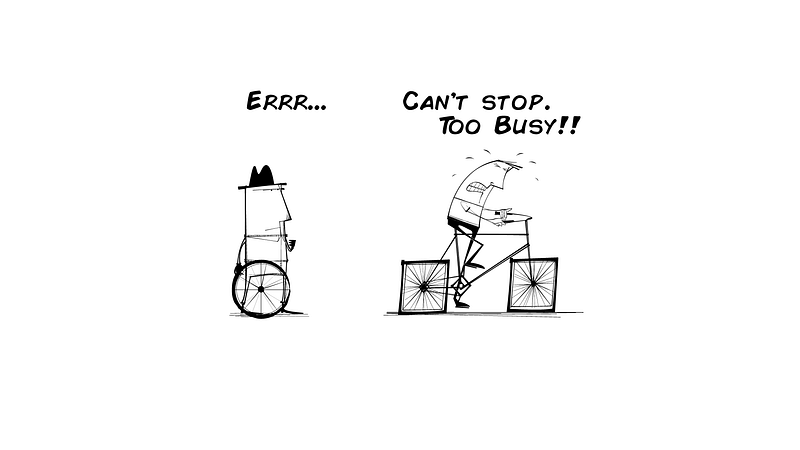
The glorification of being busy


While some of us might not like to admit it, we usually prefer to be busy than bored. When we’re bored or idling, we lack stimulation and yearn the feeling of being productive that lends itself to our self-esteem. It’s why many people struggle with depression during unemployment, without having other activities to channel their time and energy into. Being busy staves off boredom and contributes to our feeling of self-worth as rightly or wrongly we feel we have something to show for our time.

Being occupied therefore isn’t a bad thing and it’s necessary for good mental health. But the notion of being busy has changed. It’s become glorified as a measure of success or Stakhanovite-esque ideals and efforts that have skewed our perspective on what really matters. Being busy has come to falsely represent who works harder, whose job is more challenging and more important and ultimately who arbitrarily and meaninglessly gets bragging rights for the aforementioned.

By Alan O’Rourke and licensed under CC BY 2.0
Indeed, we all want to acknowledge our efforts to ourselves, and for others to do the same, as it returns to the validation we all crave from being productive. After a productive and long day at work, I might feel tired but I feel good for what I’ve achieved and that shouldn’t be a feeling we deny.Though that isn’t where said feeling stops in today’s society.

Working a long day is increasingly celebrated as a barometer for how hard we’ve worked yet it’s a Pyrrhic victory if the opportunity cost was any measure of success in our personal lives and our mental health. Many ‘successful’ people have regretted how they worked relentlessly for years, devoting themselves wholeheartedly to their work, only to later realise that they’d done so at the expense of what really mattered. Failing to spend time with family and friends that were no longer around, not pursuing personal passions or finding companionship, even in the platonic sense, had evaded them as years of a tunnel-vision approach to work passed them in the blink of an eye. At which point, they couldn’t make good on what they’d already lost in those years.

A friend and former colleague commented how they felt bad for not continuing to work into the night, on what was a day off, where they’d nevertheless already worked tirelessly for the day since the morning. We’ve now been wired to assume that we shouldn’t give ourselves a break and to do so is to be lazy. Even with the context of clearly putting in work, we don’t warrant ourselves worthy of breathing space because to pause has become synonymous with being indolent. If you consider that ideal in its crudest sense, we’ve basically been programmed to work and remain busy until burnout.

Naturally, there’s something to be said for one’s commitment to a task and we all find ourselves constantly tipping the scales of work-life balance in favour of work to meet work commitments (which doesn’t make it right either). However, we’ve now become conditioned to assume that if we aren’t busy with work, we’re slacking and should consequently feel guilty. It’s a ludicrous idea, and damaging to our mental health, that we actively deny ourselves any modicum of respite. I too have constantly been guilty of the same mindset where regardless of how long my day has been or how much I’ve managed to get achieve, I feel like I’ve let myself down by not doing more.

And it isn’t just a work where we succumb to that mindset. I’ve lamented that in the past I never really valued my time to an extent that I now do my utmost to make good on that attitude. As a consequence, rarely will I allow myself down time to just ‘be’; instead filling any free time I have in trying to reclaim those lost years. I maintain that I’m making good use of my time, particularly in the context of what I see as my previous errors. Nonetheless, there’s something to be said for allowing time to simply not be busy and providing our minds with an opportunity to unwind.

We all need to afford ourselves the mental capacity to manage our thoughts effectively and that’s only possible with an interruption in regularly scheduled programming. Although being in a constant state of preoccupation without any pause won’t facilitate that. So why are we denying such a crucial and easily attainable effort to achieve it?

The balance is there to be struck but society is causing us to fail miserably at achieving it. How often is being ‘busy’ used as an excuse for spending time with family and friends? Or a label for how fabulously ambitious one’s life is in contrast to their peers? Hard work and ambition shouldn’t be played down. On the contrary, they should be valued and celebrated but in the context of giving ourselves occasional and necessary respite. Otherwise, what are our endeavours for if we cannot enjoy them for ourselves and with others that matter?

When I die, I don’t want anyone attending my funeral who was too busy to make the effort to see me when I was alive. If your job was more important and too preoccupying then, don’t be taking the day off or finding an available evening to mourn me when we could have shared an evening together when I was actually here. Yet this is the stance we’ve adopted and it’s damaging our mental health, our perspective and our connections to people that matter.

Being idle is not the solution or the suggestion to counter the glorification of being busy. We need to achieve a balance and recalibrate our gauge on self-worth so that being busy isn’t erroneously interpreted as a contributory measure in allowing self-validation, or in receiving validation from others. It’s necessary to give ourselves respite; not only for ourselves but also for those around us.

Being busy has become a hollow trophy that society has designed to distract us from what really matters. We need to focus on ourselves, those around us and the things that matter to us rather than chasing a preoccupation that has become a distraction and a mistaken badge of honour for so many.
SHARE:

Saturday, 15 April 2017

Britain is in a housing crisis that's being exacerbated by aggressive gentrification

A few years ago, I moved from one area of London to another. There wasn't anything particularly remarkable about my move and admittedly, I hardly downgraded in my new living arrangement. However, I had moved from where I had spent most of my life to date and was effectively priced out due to gentrification.

The tale of my neighbourhood is one that mirrors the experience of many others like it. Once a largely working class and ethnically diverse community, good transport links and banks’ lenient lending criteria made it ripe as a property hotspot that owner-occupier, buy-to-let and commercial buyers eyed as a solid investment.

Like many inner city areas, it wasn't without some social challenges including a notorious estate, high unemployment and high levels of deprivation. Nevertheless, that made properties cheaper to buy for anyone enterprising enough and able to realise what was happening.

Gradually, the character began to change. Property prices rose to exorbitant levels and newer, middle class residents were happy to pay the asking price. Local amenities reflected their desires while established local businesses struggled. New builds appeared, again attracting similar residents with prices that were clearly telling established locals that this was no longer their community. A socio-economic hostile takeover had now been effected.

Some reading this may argue that considering my earlier description, the neighbourhood needed to undergo a change. I can hear some rhetorically asking ‘surely neighbourhoods with challenging circumstances plus free market principles equals warranted gentrification?’ Granted, the neighbourhood was in need of improvements but not at the expense of its character and pricing out its residents.

Just as in other neighbourhoods, many sensing the opportunity scooped up properties as buy-to-let investments when they were at bargain basement prices. This was largely thanks to the pre-property boom era and Margaret Thatcher’s policy of Right to Buy (a scheme allowing social housing to be bought at a discount by tenants but often abused by third parties using tenants and their discount eligibility as a front). Although these buyers don't have any intention of charging affordable rents to working class locals. One could say they don't have to as they’re in the property market to make a profit. Though that leaves the local authorities to provide affordable social housing and there's a lack of social housing available to do so.

The overarching legacy of Right to Buy means that most social housing has been sold off and it hasn't been replaced (the expensive apartments courting ‘young professionals’ as their buyers or tenants couldn't be further from the social housing that should have been built in their place). And as for buying, for many people on modest incomes, even schemes such as shared ownership or Help to Buy (which presents its own problems) can remain elusive due to the traditional routes of raising a deposit via savings, inheritance or parental support being largely exclusive to the middle classes.

When Conservative MP Garvin Barwell suggested that the housing crisis be eased by grandparents leaving an inheritance to grandchildren rather than their own children, it might have been well meaning but it was hugely ignorant and suggestive of how clueless he is of a life beyond his own circle. For many, it’s an option that just doesn't exist; something that isn't a reality for Barwell and his peers.

Consequently, you have a section of society that has nowhere to turn for affordable, decent accommodation and is increasingly denied the routes to accessing it.

This is the crux of the housing crisis we're faced with; with a paucity of affordable housing that successive governments have failed to address, we're now seeing a restricting of access to such housing in traditionally working class neighbourhoods and to those who need it the most. Housing is instead being offered up to the middle classes because they’re the only ones that can afford it. It means they can profit while residents on low or modest incomes are displaced away from their families and their communities or subject to unacceptable living standards.

When I moved from the part of London I'm originally from, I was essentially priced out but I was hardly displaced. I was fortunate that there was still an element of choice in my decision to move but many others are not. A lack of affordable housing limits their choices and increasingly foists an unwanted move upon them that they're in no position to oppose. Indeed, many tenants who can’t move are effectively trapped until the inevitability of eviction.

Speak to teachers working in many inner city communities and they’ll tell you of many of their students’ families being forced to move away from the school. As a result, students are made to leave their friends and the stability offered by schools that youths need and crave. In addition to the bedroom tax and the benefit cap having the same effect, gentrification has meant that private landlords are increasing rents to levels that modest incomes just can't service. And a barely regulated private rental sector and insecure tenancies encourage these landlords’ attitudes.

Most of these families are hardworking people in employment, not the ‘benefit scroungers’ or 'chavs’ that the Daily Mail, Brexiters and Tories would have you think. So now the message is even if you work hard, you still can't be guaranteed of affordable, quality housing. Clearly the Conservative vision of ‘work hard and you can get anything’ doesn't apply to the working class.

For those families who don't move away from their community, the result is overcrowding, and often in local accommodation that many would consider squalor, because it remains the only affordable and local option. I lived in overcrowded accommodation for over a decade and know first hand how it affects children during their formative years.

Beyond the perpetual struggle to find somewhere to do your homework with adequate space, that’s conducive to studying without the noise and activity from the rest of the household, where do younger children especially play? Your interpersonal skills are hampered because you can't invite friends over due to a lack of space and you’re denied the space to just 'be’, which is crucial in your formative years but taken for granted by so many.

You see, the housing crisis isn't just about having somewhere to live. It affects families, children and their social and emotional growth and the stability that we all, especially children, desire in our lives. Adequately addressing it is more about providing the basic standards of living that most expect yet many are denied and gentrification therefore just makes a serious problem even worse.

Just as Brixton has been transformed beyond recognition since the Brixton riots in 1981, Tottenham is experiencing the same fate since its own unrest in 2011. But the 'regeneration’ being pushed by Tottenham Hotspur in building their new stadium is intensifying it.

Walk through Tottenham today and you’ll see shiny new estate agents popping up, poised for what they know is on the verge of happening with the already rapid appreciation of property prices in the area. Many social housing tenants have already been moved by Haringey Council to make way for the stadium’s expansion and many private tenants have been forced to move or evicted because their landlords have hiked their rents to reflect property value in the area.

Tottenham, like Brixton and many others before it, is changing. The vibrancy of the community is being traded for Tottenham Hotspur’s ambitions, which Haringey Council is happy to encourage and provide tokenistic scrutiny and checks and balances to. The lack of provision of affordable housing in the process is more than collateral damage. It's part of the socio-economic engineering that can be seen in our communities.

Under the guise of regeneration and improving communities for everyone, gentrification is providing a vehicle for the 'them and us’ neoliberal narrative. Furthermore, it also serves to push the worsening housing crisis. Families are displaced, health and well-being are affected and affordable housing becomes harder to find. The message from rampant and unchecked gentrification is that the middle classes deserve quality accommodation and a decent standard of living because they can afford it. Yet for others, it’s a basic right that society is happy to deny.
SHARE:

Sunday, 22 January 2017

Is monogamy simply a social and emotional construct?

While having children is undoubtedly a person choice, anthropologically speaking, procreation is a perceived (and archaically assumed) feature of most relationships between the opposite sex. For those who seek to have children, and those that don’t, a monogamous relationship is usually deemed the most ideal unit from within which to procreate or simply to coexist with a partner. It represents stability, support and, bizarrely, social success of being in a relationship.

However, if we critique this approach, does monogamy really provide the aforementioned or have we been conditioned to believe it does to reinforce the very arguments that are made in its support? Furthermore, as emotional beings, is there an emotional attraction to monogamy that we crave in seeking an exclusive and reciprocated belonging, acceptance and love from a partner who is considered unique in fulfilling said role?

Firstly, I need to make a disclaimer that this isn’t about me expressing a desire or endorsement for polygamy or a proclamation that I am polyamorous (which would go against my own monogamous relationship). Had it been, I would likely have chosen a more personal forum to announce this to my partner. It’s also not something I’m seeking to explore, not to mention a practice I can’t envisage my wife embracing.

Nevertheless, the practice of monogamy has largely remained unquestioned in contemporary society. For even those of us that are more liberal-leaning, monogamy is still broadly considered sacrosanct. Polyamory is becoming more visible and accepted (Laurie Penny wrote an article on her own experience as a polyamorous woman) but there is still a stigma around it. For the conservative brigade, it’s probably just a synonym for liberal promiscuity that we blindly criticise. Why? Because it threatens the status quo of monogamy as the standard for relationships.

Our physical attraction to a partner is typically underpinned by a sexual attraction. And in anthropological terms (for a hetrosexual couple), an underlying desire to procreate. Although, society’s expectations when having children, and the pragmatism surrounding it, downgrades that underlying desire to sex for couples of all sexual orientation. Subsequently, that attraction forms the basis of compatibility for a relationship with personalities and shared values of course typically being granted similar status.

When it comes to a physical attraction, that initial spark is more primitive that we would care to admit. And it calls monogamy into question given its features are secondary, albeit valid, considerations for any relationship.

The stability of a monogamous relationship; having someone to confide in and receive reciprocated comfort, support and affection, makes perfect sense. And attributing that to one person perhaps makes it extra special. Throw in the mix exclusive intimacy and growing emotional attachment and you’ve just placed each other on a status of importance that places your partner above all others. Yet much of this is projected from the relationships of others in setting the standard that we’re told we should seek.

Most weddings feature speeches where the ‘special’ and ‘perfect’ love between the couple is waxed lyrical upon while guests are subject to regaling of how the couple are ‘made for each other’. Well, I’ve been to enough weddings (including those where I’ve known the feelings between the couple are far from mutual) to know that such rehearsed sentiments mean someone’s lying. Rather, they’re soundbites that we’re expected to attain in relationships and if we don’t project them in our own relationships, we risk the stigma-driven judgement of not attaining the social success of relationships.

If we want children, we are erroneously conditioned to feel that a two-parent, cohabiting relationship is better than one where parents may live separately (again, judgement raises its ugly head, particularly in relation to single mothers). Similarly, having two incomes is better than one and provides increased financial stability. And particularly as we age, existing in a unit where we can look after each other makes sense. But are these reasons suffice to drive the social conditioning of monogamy as the ‘right’ standard for relationships? Thinking objectively, and breaking away from my own social conditioning, perhaps not.

Conversely, wouldn’t more than one partner present all of the above but in abundance? Increased financial stability via further incomes, increased support in raising children and further companionship (assuming all of the relationships were able to coexist harmoniously alongside each other) all make a case for those of us sticking with monogamy missing a trick.

There are also the emotional ties that probably provide the strongest anchor to monogamy. As humans, we can be insecure creatures. The notion of sharing a partner, no matter how much of an understanding there might be, would be difficult for many. It’s why infidelity is deemed such a transgression - not just because one has gone against a promise to be monogamous but because their actions represent their willingness to share themselves with another and therefore serve as a trigger of insecurity.

Nonetheless, while not championing infidelity within a monogamous relationship, it comes back to the primal physical attraction that we experience. The attraction isn’t what causes a transgression (though those who experience much more insecurity in their relationship might argue otherwise), instead it’s acting upon it. That default opposition to doing so is based on the social conditioning we’ve been subject to. We’re wired to know that it represents wrongdoing but also empathy of how a partner would feel should that ever-present insecurity be provoked.

If I’m driving a Maybach and I see the Batmobile, I’m going to want to stop and look at it. And I’m probably going to want to drive it too. Nonetheless, getting out and risking not being able to drive my Maybach because I’ve forsaken it for the Batmobile (no matter how temporarily or meaninglessly) is an inherent temptation that is mitigated by the social conditioning that it would be wrong. Similarly to relationships, this makes us human but resistance to acting on an attraction is neutered by our perception and acceptance of monogamy. If we returned to experiencing and accepting those primal instincts, few people would bat an eyelid at getting in both cars.
"I like my Maybach... but it's the Batmobile..."
Monogamy represents stability and within contemporary society, a pragmatic approach to relationships that demonstrates how special a partner is. While I might not seek to adopt a different path, those that do are merely tapping into more primal sentiments that the rest of us have moved away from. Monogamy provides the safety and relationship goals that society has told us we desire and wards off the stigma that we’ve come to fear in not achieving the expectations placed upon us. It’s a social and emotional construct but one that most of us have seemingly brought into in making it the status quo.
SHARE:

Thursday, 27 October 2016

Slavery may have ended but its shadow remains over the black diaspora

When former British Prime Minister David Cameron visited Jamaica, he made the clearest statement that his government had little empathy for the black diaspora when considering the aftermath of slavery -
“That the Caribbean has emerged from the long shadow it cast is testament to the resilience and spirit of its people. I acknowledge that these wounds run very deep indeed. But I do hope that, as friends who have gone through so much together since those darkest of times, we can move on from this painful legacy and continue to build for the future.”
These weren’t surprising utterances from Cameron and they suggest much about him and those who share his stance. Although, with less unempathetic rhetoric, there are some (including some black people) who feel any dialogue around the subject of slavery is now redundant and that it should be consigned to history to avoid dwelling on a loathsome past.
While I don’t agree with this, I can see the rationale behind such an approach when considering how latching onto the past could further stymie the progress of black people. Nevertheless, while slavery has ended, its shadow remains like an unshakeable albatross. Many lamentable features of the black narrative can be traced back to our darkest period in history and over a century later, the existence of slavery has a lot to answer for.

The black diaspora is undoubtedly facing challenges and experiencing a rate of progress that is not commensurate with other communities. When I consider postwar emigration of non-black communities, later arrivals have generally experienced more prosperity than blacks who were one of the earliest groups of immigrants to Europe and North America subsequent to World War 2. The reasons for that are plentiful enough that it’d require a separate post. Needless to say, they cannot be wholly attributed to black people either but rather the institutionalised social attitudes we’re subject to.

These attitudes (and their manifestations in respective governments and legislation) are hangovers from slavery; a time when black people were marginalised and robbed of any notion of equality or progression while systematically being dehumanised. Yes, the tangible barriers to our progress, such as access to education and our freedom, have been lifted. But in practice, the vestiges of the prejudice, racial bias and a desire to preserve our inferior position in a centuries-old racial and social hierarchy that was once legal, can still be seen in modern views towards the black community.

For real change to be effected, wider society needs to unlearn centuries of institutionalised prejudice towards blacks that was par for the course during slavery and during the years that followed. Not doing so obviously preserves the position of blacks as beneath everyone else; a position that existed for centuries. Can we therefore really expect said unlearning to have occurred in less time than those ideals were actually entrenched?

Racial and cultural bias of standardised tests provide a further hurdle for our access to high quality education and the opportunities it can afford. And one only needs to look to America to see the influence of the slave owners’ ideals that black lives don’t matter having successfully permeated law enforcement. Slavery might have been abolished and equal rights legislation may have been passed, but it’s not so easy to abolish ideas that have been inherent in successive generations.

Conversely, the black diaspora is responsible for many of its own shortcomings. Though while not seeking to diminish this charge, these failings can be traced back to slavery in illustrating just how far its impact has spread since it was abolished.

Look at other immigrant groups and you’ll often notice they’re playing the long game. They’re happy to live in less than modest and often overcrowded accommodation for years while saving money for a better property and better opportunities for their future and that of their families. The long term thinking amongst these communities is what expedites their rapid social mobility. Meanwhile, black communities fail to experience the same trajectory or least with the same swiftness. Why? A warped mindset of short term thinking that has been engendered since slavery. It’s seemingly become inherent and frustratingly difficult to eradicate but it’s a flawed approach that we desperately need to address.

For the black slave, there was no need for long term thinking. Your life was a disposable commodity in the hands of a slave owner who viewed it as such. Alas, for many black people, the same mindset has seemingly continued.

It’s easy to say slavery has no bearing on this being the case today. But consider the nonchalance towards black lives held by the slave owner. In principle, is it much different to the nonchalance shown towards black lives now? The only difference is today, the ‘slave’ almost buys into those sentiments more than the ‘slave owner’ themselves to the extent that the slave owner needn’t push their agenda any longer as the slave will do that for him.

Similarly, governments have replaced slave owners with the undue power and influence some of the black community perceive them to have in being responsible for the direction of their lives. This is instead of acknowledging that there is more they can do for themselves that governments cannot interfere with. In turn, this has created a blame culture against legislatures and society. Sections of the diaspora are still unmotivated past the post slavery mentality when our fate was at the whim of the slave owner. Perhaps we were slaves for so long that we don’t know how to be free and how to grasp our freedom? Instead, we credit our failures to the nearest entity we can identify in the form of a slave owner rather than taking responsibility for the freedom that we now actually have.

The collective mental health of the black diaspora is arguably the most significant legacy of slavery. Centuries of being dehumanised and perceiving ourselves as inferior has permeated the black psyche. Our self esteem is incredibly damaged as we continue to perpetuate the notion of being secondary and almost actively allowing ourselves to be marginalised because for so long it was the status quo.

We struggle to value ourselves with our true worth because we have been programmed not to do so and others have been programmed to foist that notion onto us. Subconsciously, many black people equate being black to being negative to the extent that there’s a demand for skin bleaching products in a number of regions.

Vybz Kartel, once one of bashment’s biggest stars, launched his own range of ‘skin brightening’ products and presumably in pursuit of a caucasian look (which most opine went badly wrong), Lil’ Kim has transformed herself from a pin-up when she released her debut album Hardcore to a light-skinned barbie doll that didn’t meet quality control at the factory. And Beyonce, arguably one of the biggest celebrities period, has long been accused of appearing lighter. Are we literally trying to wash away our blackness? It shows how much undoing of centuries of damage to our self esteem is still required.
Psychologically, slavery has damaged the black psyche to so great an extent that we’re yet to wholly escape the conditioning it has seared into our identity. And we’ve failed to acknowledge and accordingly address the impact this has on us today.

It’s important to emphasise that slavery, a system that was abolished over a century ago, cannot be deemed a comprehensive excuse for any failings of a black person or indeed the wider black community. Yet it must be acknowledged as offering an explanation for the shadow of slavery continuing to pervade the black people today.

Other communities have seen persecution via colonialism and periods of brutality such as the experience of the Jewish Diaspora during the Holocaust. Though no group has seen such sustained physical abuse, psychological abuse and dehumanising as the black diaspora experienced throughout slavery and later periods of history. Furthermore, no group continues to be hindered by their experiences to the extent that can be seen in black communities worldwide.

Like a hat that has been worn for so long that even when removed it’s still felt to be on, the shackles once worn by black slaves during slavery may have been removed yet psychologically and socially they continue to be felt. After a while, the sensation of wearing the hat completely wears off but somehow the same can’t be said for slavery and the residual conditioning it has had on black people that can be traced back hundreds of years. However, we can’t overly lament or pontificate about it any longer unless we’re willing to take a meaningful approach to addressing it. Because if we don’t, no one else will and we’ll have wasted the freedom that black slaves would have once deemed unimaginable.
SHARE:

Sunday, 25 September 2016

The value of time

Time. It’s a commodity that we take for granted when it appears to be in abundance yet frantically despair when we realise it’s slipping through our fingers with no redress. And for all its value, once it’s gone, it’s gone. Sadly, many of us only realise this when it is indeed too late and we’re ruing over lost opportunities or experiences that we chose not to embrace.

We reflect on our naivety, how green we once were and often how plain ignorant our younger selves now appear in hindsight. But despite this inevitable regret, many people never really appreciate the value of time. Rather than making good on time lapsed, we soon consign our regret to a place of nonchalance; forsaking the chance to reflect and shape our subsequent approach to how we appraise the commodity of time.
I’m someone who is filled with regret at how I once valued time. In my youth, I arguably placed time on a pedestal to the extent that I wasn’t willing to take risks or explore new opportunities because I felt it might have represented a waste of time; time that I couldn’t get back. I was right. However, there is no reward without risk and rightly or wrongly, every risk we turn down represents a lost experience. I valued time but I didn’t appreciate the nature of how it escapes all of us.

That caution developed into complacency. I thought I was preserving time but I was allowing it to pass while I made little or poor use of it. Furthermore, my mindset had now turned to one where my stance remained due to an inability to act otherwise as a result of circumstance and anxiety.

Steve Harvey spoke of a similar experience of those who fritter their time away in their youth, just to try and play catch up once they’ve realised their mistake. I didn’t exactly waste my time out of overt recklessness. Nonetheless I was reckless in how I considered time and it had exactly the same result.

I lost years to this period of my life and who knows what else. Though this gave me the jolt I needed to view time in the way it should be. I realised I needed to make good on my folly and, almost predator-like, I did just that. If I had an interest in something, I was pursuing it. If an opportunity presented itself, I was seizing it. Good, bad or indifferent, I realised that every experience in life contributed to our being. And in ways we might not imagine or appreciate at the time but might actually serve us in the future. I had been denying myself this with my failure to see the worth of my time.

I’ve maintained said approach and it’s served me and my mental health well as I feel more confident that I’m making good use of a commodity that I can’t get back once it’s gone. Alas, I can’t make good on everything; ‘tis the nature of time. But wherever possible, I’m salvaging from the wreck of my earlier failure.

In doing so, I’ve also learned to value my time as mine. Not in a selfish way of not wanting to share my time and efforts with others but in perceiving my time and the journey I take via the path it represents, to be mine.

Years ago, I bumped into a friend in my old neighbourhood who I’d not seen for a while. We got to talking and it was around the period when I started to realise how my value of time hadn’t exactly been prudent. I was lamenting at what I hadn’t done based on what was ‘expected’ by society; not what I hadn’t done to my own detriment due to what was good for me. My friend responded with a deeply apt rebuttal and said “life’s not a race”. That’s stuck with me since and I pay little regard to what I should have done based on society’s expectations or what others are doing and instead focus on myself and those important to me.

We can’t care about using the lives of others as a gauge for where we should be in our own lives because our allocation of time is ours, not theirs. Although so many people are caught up in doing just that. They don’t see the worth in their time because they measure it against someone else's or society’s. And when they do realise their error, it’s often too late as they’ve used their time to create a life that isn’t necessarily for them and with little or no recourse. People chase the job, house, marital status, children, superficial notions of success and anything else they assume they’re ‘supposed’ to have based on a futile comparison. All the while they’re failing to appreciate their time as their own. Why chase a life that isn’t yours just to later realise you’re out of time to get to your own destination?

Our perception of time goes beyond recognising the worth of our own time but that of others too. So many of us have an inability to understand the finite nature of time, either in a discrete sense within a given period or as life itself. We make demands on others, totally indifferent to the impact it will have on their own time, and fail to see or appreciate this through our own blinkered perception.

How many times have we taken up the time of someone as we see their time as akin to ours? We see their x hours in the same regard as what we have prioritised for the same period. It’s the selfish nature of the human condition that even with a commodity as valuable and finite as time, we find ourselves unable to recognise the value of someone else’s time with their perception rather than our own.

Conversely, we need to learn to share our time. Spending excessively long days at a job to only neglect our partners, friends and families clearly doesn’t signal a true valuation of time. Nevertheless, it’s a common story for many as society has realigned our priorities to prevent us from recognising where our priorities should lie. We need to need to find the sensibility and balance to see our time for ourselves while apportioning it accordingly for others around us. This requires an altruistic approach that seems sparse when considered in tandem with the notion of our time.

Like good health, we appraise time with nonchalance when it is plentiful and desperately when it becomes scarce or reflects regret of past actions or lack of. Yet both commodities are rarely given the status we give wealth and material and tangible possessions that can come and go - with the proviso that we have the time and health to afford us the chance to do so. Clearly we need to reappraise the commodities in life that we should view as valuable with more esteem than those that we can always make good on should we mess up. Unfortunately, time isn’t so forgiving and once it’s gone, it’s gone.
SHARE:

Saturday, 3 September 2016

Channel 5’s Gangland wasn’t about uncovering gang culture, it merely perpetuated ignorant and negative stereotypes of black youths and the black diaspora

As part of a two-part documentary, Channel 5 recently aired the first episode of Gangland (at the time of writing, the second episode is yet to be aired). Gangland was advertised by Channel 5 in fairly broad terms as essentially an exposé into London’s gang culture. In fact, here’s exactly what Channel 5 said on its website:
Gangland is an original two-part documentary that gains unprecedented access to London’s most notorious young gangs, as they document what life is really like as part of a contemporary gang.
Like many people who decided to tune into Gangland, I expected balanced journalism that would explore the factors that led some youths to gang culture, the failures of society and the individuals in gangs that prefigured their involvement of said life and cautionary tales of those that have since renounced being in a gang through their own expectedly dire experiences or indeed lucky escapes.

Given it was set in London, I also expected the programme to cover gangs of all ethnicities in reflecting London’s ethnic diversity. All of this I thought would be presented against a backdrop of life in a gang that would reflect Channel 5’s social responsibility as a mainstream broadcaster, but also with an approach that showed the seriousness of gang culture in the city.

Alas, perhaps I asked for too much as all Channel 5 delivered with this show was an epic failure that perpetuated ignorant and negative stereotypes of black youths. That’s right, only black youths. Aside from the white girlfriend of one of the protagonists (who felt he was going to beat a case due to no evidence - yet Channel 5 have hours of footage of him incriminating himself), every person interviewed was black.
Gangland’s producer, Paul Blake, spoke of his motivation in making the documentary in the Guardian. The Guardian wrote ‘Blake spent over a decade trying to get a documentary made which would give voice to the thoughts and motivations of gang members’. Blake added “this documentary was born from the fact that I am a black man, born in this country, and I was just pissed off that no one cared about these young black kids who are dying”.

Perhaps that was his motivation and maybe even what he presented to Channel 5 before they requested he amend it to what we saw on our screens. Unfortunately, it isn’t what was achieved with Gangland.

For anyone aware of gang culture, the majority of what was aired on Gangland would not have tallied up with that perception. As a friend said to me, it was like watching a parody for the most part. If you’re in a ‘notorious’ gang and willing to come on a terrestrial channel, barely, if at all, disguising your appearance, and never disguising your voice while talking unimaginably recklessly in incriminating yourself and your peers, you really aren’t about that life. And if you really are in that lifestyle yet still talking like that, then as DJ Khaled would say, “you played yourself” and everyone else around you.

The black youths (because just to remind you, Channel 5 either couldn’t find any non-black gangs or gang members because they seemingly don’t exist in London) who were willing to brandish guns while talking about what they were willing to do, started off as uber cringeworthy. It was akin to many of the American rappers we’ve seen in the UK doing their very best to convince us they’re “from the hood” or a bad caricature of World Star Hip Hop. Attack the Block (and I don’t say that with any kudos for that film either) had more credibility than their utterances and I couldn’t take them seriously. But I quickly went from cringing to being flabbergasted at what I was watching.

One alleged gang member, safe in the knowledge that Channel 5 would never betray his location or any other personal information by which he could be located and identified, spoke about how he’d save a bullet for the police. All the while, they brazenly exposed operations as they spoke more and more with zero caution for themselves and anyone connected to them. Section Boyz might have said ‘trapping ain’t dead’ but those that appeared on Gangland appeared to be trying to bring it to death’s door via Channel 5 along with lengthy prison sentences supported by copious amounts of evidence. The lifestyle they purported clearly isn’t one to be glamourised but their incautiousness beggars belief.

The documentary portrayed the black community as idiots and individuals for whom the price of life is cheap. The reason I don’t caveat that as ‘black gang members’ rather than the black community is because if you aren’t acquainted with black people and perhaps live in a largely ethnically homogenous part of the UK, you might think all black people were like the image shown on the documentary as every person on the show was black.

It’s not as if the mainstream media don’t already drive a racist narrative to the extent that the black diaspora is still faced with prejudice based on such portrayals that we spend our lives refuting. Just look at the media’s annual reporting on the Notting Hill Carnival in contrast to the class A drug-fests that are many festivals yet the latter rarely gets bad press. I commented to a friend that I hoped my in-laws weren’t watching Gangland as they might think whenever I said I was cooking hard food for dinner I might have actually meant drugs rather than breadfruit and green banana.

Gangland left me angry and confused at those who agreed to be on the show but also at Channel 5. I don’t expect Channel 5 to do any favours for the black diaspora but I do expect a broadcaster to show some social responsibility and they have failed in achieving that with Gangland. The documentary wouldn’t actually be amiss on Fox News in a UK special presented by the vile Katie Hopkins.

Of the participants of the show, they were young and presumably eager for a platform to portray themselves in a way that they felt was credible. That in itself is incredibly sad that they’ve mistaken a life of violence and reckless talk as something to pursue and perhaps had no mentors, elders or voices of reason and experience in their lives to show them otherwise and more so so advise that featuring on this documentary was a terrible idea. Any ‘serious’ members in a gang, past or present, would have promptly advised them of that. Nonetheless, I should add that I’m not excusing those that appeared on the show.

The only credible individual of the documentary was Quincy, a former gang member who sought to be a cautionary tale for the life he once lived. Yet even the final edit of the programme seemingly tried to suppress that message. Furthermore, the ignorance that filled the remainder of the broadcast was what Channel 5 deemed more appropriate to air.

Gangland was an opportunity to raise awareness of real problems in London on a platform of balanced, investigative and analytical journalism that explored causes, motivations and solutions. Instead it became a showcase for 60 minutes that lacked credibility and furthered the media’s often racist narrative of negative stereotypes of black people.
SHARE:

Sunday, 26 June 2016

The EU referendum result was deeper than how the UK perceives the EU

During the EU referendum campaign, and in the aftermath of the result, it’s clear that the referendum was deeper than just views on our relationship with the EU. It was about the attitudes of the UK electorate and just how divided we are as a country. The leave vote wasn’t driven by a well articulated campaign that promoted awareness of the EU as a supranational body and how it might not benefit us. Nor was it driven by a plan for how life outside of the EU would look, particularly when juxtaposed with the status quo. Instead, it was driven by ignorance, insularity, xenophobia and undertones of prejudice. That is the crux of how we ended with the electorate voting to leave the EU.

The EU isn’t a perfect institution and it’s a fairly convoluted and bureaucratic one at that. Moreover, many people can’t claim to fully understand it and I would include myself in that statement. Though headline arguments in favour of EU membership such as economic benefits, cultural and historic ties to Europe (the EU was formed in an effort to foster stronger ties post world war 2 in a bid to prevent Europe going to war again), freedom of movement, free movement of labour and EU laws that protect human rights, employment rights and quality of life (which I would struggle to trust a Tory government to preserve) were solid arguments in favour of remaining in the EU. In opposition, the leave campaign’s objective arguments to refute the above were predicated on.... well, nothing. Casual racism doesn’t count.


What exactly did you win? A gloomy economic outlook for the UK and the promotion of xenophobia? Huzzah!

It is important to remember that not everyone who voted to leave is racist. But anyone who’s racist certainly voted to leave. Furthermore, many people who voted leave had reasons that despite not shared by me, had rationale that was void of any prejudice and what they felt, rightly or wrongly, was best for the country. Nevertheless, such views were in a minority, even within the leave campaign and the utterances of politicians who supported a Brexit.

I'm not holding a grudge against anyone who voted differently from me and decided to vote to leave the EU because they felt it was genuinely the best option for the country and based on a well reasoned argument. I am, however, holding a grudge against anyone who voted leave based on xenophobia, selfishness and any opinion they based on something they read in The Sun.

Immigration has been a major driver toward Euroscepticism as an enlarged EU inevitably means further non-British EU citizens in the UK. The UK has traditionally been seen as an attractive location to live and work and many EU citizens come here to do just that. In doing so, they contribute to the economy and work in sectors where there’s a clear demand. Otherwise, there wouldn’t be a job for them. They assimilate British culture and contribute economically, culturally and socially to the UK.

Conversely, while we can’t pretend that there aren’t some EU citizens who are attracted to the UK due to it having a more generous and accessible welfare system than their own, they are not in the majority. Yet the right wing media and politicians have fed us with this via racist and politically motivated drivel that many people lap up as the manna for their prejudice. These are British people. Though prior to the referendum, and in contemporary history, they had not made their sentiments so clear and on such a prominent platform that would show how divided the UK is.


Oh wait, is Boris Johnson not part of the establishment you wanted to give a kicking?

Many voting leave saw the EU referendum as a vote on immigration. Think immigrants (regardless of if they’re from within the EU) are taking our jobs, welfare and social housing whilst showing our country no respect? Then vote leave! This is what many perceived the referendum to be asking them and what the leave campaign peddled. In an age of the internet, where one can research essentially anything, I doubt many people sought to find out what the pros and cons of EU membership actually were. Rather they relied on propaganda that even a day after the result has been shown to be a lie. Furthermore, they wanted to give the establishment a kicking (forgetting that Boris Johnson et al are part of the establishment), say no to immigrants and ‘regain control of our country’. All utterly stupid and unfounded reasons, particularly when made with such consequences.

On the issue of immigration, it will remain a contentious subject whether in or out of the EU. Nonetheless, the fact is economic migrants make a huge and necessary contribution to our economy and workforce. Nor will our borders now close as the UK gradually becomes a homogenous white nation again. That’s something ethnic minorities campaigning to leave the EU like Tory MP Preeti Patel (whose parents are Gujarati Ugandans) were blind to as the desire of many leave voters. When they say they want immigrants out Preeti, even though we were born here they mean you and I too.


"What have I done?..."
Politicians have failed to generate a sensible and pragmatic debate on immigration, preferring to use it as a political hot potato. No wonder a section of the electorate felt this was their way to add their voice and frustrations to a dialogue that hasn’t really started. The problem is, they chose to do it at the least practical time. Immigration was the leave campaign’s trump card and they knew it. Dress it with some propaganda and spurious arguments, while targeting ignorant and largely uneducated people, and they probably won’t even question why they should do anything but vote leave. And 51.9% of them didn’t. Not to mention, not once did the leave campaign include a plan before or after the referendum to set out life after a potential Brexit. Indeed, Boris Johnson’s rhetoric encouraging an unhurried exit, and his demeanor during the post result press conference, was that of a man not only without a plan but also with the realisation of ‘what the ---- have I done?’ As Del Boy would say, what a plonker.


"What a plonker!"

For the first time in my adult life, I am ashamed to be British; a significant statement as a British born, second generation West Indian, who nonetheless encapsulates Britishness as part of my identity. I am ashamed to share an identity with cretins who hold the views that prompted them to vote leave. Idiots who see right wing tabloids like The Sun and the likes of Nigel Farage, Michael Gove and Boris Johnson, who have all resorted to undertones of racism throughout this campaign, as credible sources of information upon which to base their decisions. I’m ashamed to live in and be born in a country where such feelings exist to such an extent.

Like many non-Americans around the world, I’ve long perceived America as a nation comprising some superb ignorance and insularity. Their abysmal and disheartening lack of gun control against a backdrop of a countless horrific gun related tragedies and Donald Trump becoming a presidential candidate supports that view of American society and the American people. Britain hasn’t quite experienced such levels of poor judgement (although we have allowed Boris Johnson to position himself as the potential next Prime Minister so perhaps we have after all) but with the referendum vote to leave the EU, we now have our own watershed moment in contemporary British history that illustrates the obtuseness and stupidity in our society. Indeed, Britain isn’t far behind in sharing some of the attitudes that the rest of world mocks America for. As an American friend rightly commented, this is truly a case of ‘like father like son’.

The divisions that long existed in the UK are now more conspicuous than they have been in recent time. Those who voted to leave voted on the sentiments that UKIP, a racist party, have campaigned on since their creation. Let it sink in that half the electorate share UKIP’s views. Just as progressive Americans and progressive states such as New York and New Jersey, live alongside those who get their information from Fox News, we have become a nation so polarised that we are a country of two narratives.

I am angry, sickened and disillusioned with the result and those who voted to leave with little regard for the consequence but more so what their decision represented. In a hilarious but on point video (NSFW) that captures the sentiments of most people who voted to remain in the EU, Rants N Bants articulates what most of us are thinking; we don’t want to be associated with a nation that possesses such attitudes. Albeit in some jest, many are even calling for London to breakaway from the rest of the UK. Scotland and Northern Ireland (who both largely voted to remain), have also already highlighted the tensions the referendum result has raised for their respective inclusion in the UK. The leave vote was also heavily supported by older electors with little regard for subsequent generations’ futures. Selfishness and insularity has played a big part in this referendum.


"I went one referendum too far..."

For now, we are still in the EU. No amount of celebrations from Nigel Farage can change that. It’s also not likely to be a hurried exit for the UK as there isn’t a plan and the government will need and want to stall as long as possible. David Cameron announcing his decision to step down in the wake of the referendum result adds a leadership battle in the Conservative party that will further divert attention from a hasty Brexit. Good, bad or indifferent, no one knows what happens next. What we do know is sterling has taken a kicking after the result, Moody’s has cut the UK’s credit outlook to negative and the EU is not looking for an amicable separation. The leave campaign wanted isolation and to move away from the status quo and now it seems like they’ve got it.

However, while somewhat fanciful, I’m not entirely convinced that an exit from the EU will happen, at least not with the separation envisaged by the leave campaign.

Firstly, the referendum result is not legally binding. It’s essentially a gauge of public support for an issue. And despite the support being in favour of leaving the EU, it was with 51.9% of the vote. Support, yes, overwhelming, no. Secondly, to put the wheels of a Brexit in motion, article 50 of the Lisbon Treaty will need to be invoked which Cameron intends to leave for his successor. Some would argue that setting that in motion would also warrant agreement from the UK Parliament rather than merely going on the referendum result for such a significant issue. Yet most MPs support remaining in the EU. Therefore particularly given the narrow margin for the vote to leave, they may decide to go against the referendum result in any vote in Parliament and not vote in favour of doing so.

For the UK Parliament to go against the referendum result, it’d set a huge and dangerous precedent and undermine the referendum as a democratic process. Although amidst the referendum result having an immediate and adverse impact on the British economy, and a tangible sense of regret amongst many leave voters who either voted to leave as a protest or were taken in by propaganda that’s since been found to be a lie, it would give MPs voting against leaving some credence as being in the public interest.

A petition calling for a further referendum already has in excess of 2 million signatures at the time of writing and David Lammy MP has called for Parliament to ignore the referendum. People are rightly not ready or willing to accept the result and Parliament may not either given how quickly it’s become apparent what a bad decision it actually is. That could result in legal action via judicial review from the leave campaign and it would all get quite messy which is one thing that seems fairly likely regardless of what happens.

The referendum result has exposed how divided the UK is and how much ignorance, xenophobia and selfishness there is within the country alongside the inclusivity that it must be stressed does exist throughout the UK. With my London-centric perspective, perhaps it’s just less than I previously gave the country credit for. Attitudes that have perhaps been suppressed since the first wave of post war immigration apparently never really disappeared and generations later, it has to be questioned if these attitudes are simply inherent to some sections of British society.

Whether or not we proceed with a Brexit, our relationship with the EU is altered forever. We have rejected strong relations with the EU, and all that it brought us, as the UK has cut off its nose to spite its face. Posturing via the ballot box might have seemed a good idea for the leave voters at the time. But they’ve created a mess that no matter to what extent it can be resolved, has damaged our relationship with the EU and each other and created a perception of the UK as a country that comprises many of the attitudes we’ve long criticised other nations for holding.
SHARE:

Sunday, 5 June 2016

Alicia Keys’ and the no makeup movement

Alicia Keys’ recent essay on Lenny provides a narrative that is surely familiar to most women. It articulates the struggle and pressures of being a woman in feeling the need to meet accepted and expected images of beauty that conform to traditional notions of being a woman. In a brave move that should be praised, Keys’ decision to shun this in rejecting the need to constantly wear makeup equally opposes and challenges the social anxieties it presents for many women. Indeed, her attempt to spread a #NoMakeup movement is arguably inspiring many women but it’s the tip of the iceberg when considering the notions of beauty and femininity that women have long been subject to.


As a man, much of the the experience outlined by Alicia Keys, and shared with many women, is admittedly alien to me. Although as an aside, men are increasingly subject to further social pressures in body image and perceptions of masculinity. This is prompting many men to take dangerous steps to meet these perceptions which are rapidly damaging men’s mental and physical health at perilous levels. Sadly, as a relatively new phenomenon, these aren’t widely recognised. Nevertheless, for women this is something that has existed as far back as patriarchal stereotypes can be traced throughout history.

Personally, I like to look good as much as the next person does. But the driver for that stems from my personal contentment and less so from the perception of others. During the winter months, I often grow my hair into a sometimes untamed but periodically shaped afro and shave less frequently than usual. There are occasions that I probably look at least a tad unkempt but on the whole, I don’t care and broadly speaking I’m not judged for it. It’s something I embrace with a nonchalance that is born out of incremental improvements to my own self-esteem and mental health whereby I feel more comfortable with myself, my actions and my appearance than I might once have been. Though for women, this represents a challenge that involves undoing centuries of expected conformity in one's appearance and indeed traditional notions of femininity which are increasingly foisted in the face of women.


Social media has provided a further and damaging projection of what many women feel they need to meet with Instagram posts displaying what is brushed off as casual and effortless perfection of women. Subjects such as the Kardashians are photographed leaving the gym, looking as if they’re yet to break a sweat with not a hair out of place. Because that’s exactly how we all look after a workout, right? Then there are the voyeuristic photos (often posted under the guise of something that seems more principled than the superficial notion of merely getting your attention) that get posted to an audience of young women who naively seek to attain an image that’s manufactured by those who devote their lives to maintaining a plastic, paparazzi-ready facade.

Makeup, hair, clothes, shoes and conforming to expectations of ideal body image present a rigmarole that women have to contend with on a daily basis. And rarely does society suggest it’s acceptable to dispense with any of the aforementioned. For younger women and girls especially, the message is damaging - if you don’t look like this, you’re slacking as a woman. It comes from the media but also wider society and even some men who fail to accept women with a natural demeanour that ignores the above. Similarly and lamentably, and in a further example of gender roles being dangerously reinforced, some women will admit to feeling naked or exposed without wearing makeup as it provides a shield that they literally feel unable to leave home without.

In a brilliantly honest but hilarious social critique of the expectations of beauty placed upon women, one of YouTuber Jenna Marbles’ early videos highlights the extent to which women go in their daily routines. It’s frighteningly accurate for many women and her satirical commentary provides the subconscious narrative for what many women feel compelled to do on a daily basis. Nonetheless, there isn’t anything wrong with wearing makeup. But there is a troubling issue with the extent to which it becomes a decision based on social conditioning and pressures and less about a personal choice, not to mention the effect it has on female mental health.

I’m in no way criticising women who wear makeup or makeup per se. It can enhance, accentuate or refine features and conceal what might personally be deemed a minor imperfection. And most importantly, it can provide a source of confidence that should never be rejected. No different to how I might get a haircut or have a shave when attending an event, makeup can be part of the effort women make to feel good about themselves. After all, we should all do what makes us comfortable and supports our self-esteem and no one should feel the need to apologise for doing so. However, that shouldn't be confused with attempting to meet a gauge of beauty that isn’t our own.

As a celebrity, Alicia Keys is able to use her status as a vehicle for the #NoMakeup movement but her essay also shows the emotional growth she’s undergone to arrive at a point where she is able to embrace her new stance. Furthermore, let’s not pretend that even without makeup, Alicia Keys hardly falls short of the accepted notion of beauty. It’s just a more natural, and some might say less refined, version of what we’re accustomed to seeing. It’s also worth noting that Alicia Keys is an artist who has a huge talent that doesn’t require compensation based on her looks and therefore has further attributes upon which to pin her own self-confidence. Although this shouldn’t detract from the stance that she and many other women have taken in rejecting these social pressures.

It’s questionable if women have been so long subject to these expectations that the status quo can never be overturned. A natural look can be met with raised (and sometimes unnaturally shaped) eyebrows as if to suggest “didn’t you get the memo? We don’t do that as women” which is a sad reality. Many women even experience discomfort in showing themselves without makeup to their partner, family or friends let alone to strangers.

I’m sure #NoMakeup will get some welcome traction on social media. It’ll also likely result in many #NoMakeup selfies celebrating the rejection of having to constantly wear makeup out of obligation rather than choice which is the crux of the argument. More significantly, hopefully it can provide the seed for the wider debate on the social conditioning woman are subject to and the damaging impact it has on successive generations of females.
SHARE:

Monday, 2 May 2016

Are ethnic minority Tories a paradox or a representation of progress within the Conservative party?

When most people think of British politicians and the British political class, they think of white, middle-aged, middle-class men with a stronghold of support from Middle England. And broadly speaking, they’d be right. Although within contemporary history, there has been a shift and albeit limitedly, progress has been made in bringing further diversity to politics. Women have become a feature of British politics with a female former British Prime Minister in Margaret Thatcher and a female First Minister of Scotland in Nicola Sturgeon. In 1997 when Labour were elected to power, 101 of their MPs were female which prompted the Daily Mail to coin the somewhat misogynistic label of ‘Blair’s Babes’.

For ethnic minority politicians in the UK, their increase has been less prolific but still visible. Where ethnic minority politicians have been most noticeable has been within the Labour Party, which is hardly surprising given their track record on promoting and legislating equality for all minority groups. That’s in contrast with the Conservative Party’s historically hostile reception towards immigrants and its resistance to equality for any minority group other than the ‘1%’ who comprise many within the party and bankroll them. As a result, and unsurprisingly, minorities have typically aligned themselves with the Labour Party or the left.

Firstly, let’s not pretend that the Labour Party and the broader left is, or always has been, void of prejudice or always promoted equality. The female sewing machinists at Ford’s Dagenham plant were initially not supported by their trade union in their 1968 strike for equal pay. Furthermore, while Labour and the trade unions have a long and proud history of supporting ethnic minorities, many post-war immigrants were met with hostility by many within the trade union movement. Factions echoing the irrational and unfounded fears of some of their members claimed that immigrants were taking the jobs of the indigenous white British. This was despite an acute labour shortage following the war. Such undertones could also be be felt within the Labour Party at a time when broader British society and politics was arguably subject to much institutional racism.

Nevertheless, it was Barbara Castle, a Labour MP and the then Secretary of State for Employment, who intervened in the the Ford machinists’ strike and a Labour government that was responsible for the Equal Pay Act 1970 that the strike action helped to bring about. It was also a Labour government that was responsible for the Race Relations Act 1965 which many Labour backbenchers actually argued didn’t go far enough. Indeed, while it hasn’t been without blemish, the Labour Party and the left has a long and celebrated history of promoting equality for all minorities, which can’t be said for the Conservative Party. Even as recently as 2013, the Conservative Party was split over same-sex marriage with 136 voting against it while only 127 were in favour. Historically, equality hasn’t really been their forte.

During the 1964 general election campaign, Conservative parliamentary candidate Peter Griffiths used the slogan “If you want a nigger for a neighbour, vote Labour.” He was subsequently elected. In 1968, Conservative MP Enoch Powell gave his infamous and inflammatory Rivers of Blood speech, harshly criticising immigration from the Commonwealth and race relations legislation. Despite not openly to the extent of Powell’s utterances, the Conservative Party retained undertones of prejudice that merely fanned rather than quelled the flames of institutional racism within British society at the time.


Conservative MP Oliver Letwin’s remarks and attitudes on the black community, recently released in a 1985 memo discussing the Broadwater Farm riots in Tottenham, show that racism within the Conservative Party was enduring. The lack of proportionate censure from today’s Conservative Party suggest that such comments might not go amiss now either, an assertion that Zac Goldsmith’s casual Islamophobia and dog whistling in his smear campaign against Sadiq Khan actually supports. And juxtaposed with the recent suspensions of Ken Livingstone and Naz Shah from the Labour Party, which David Cameron also called for, where was David Cameron’s reproach for Boris Johnson's racist and colonialist rhetoric on Barack Obama or much of Zac Goldsmith’s Islamophobic and divisive mayoral campaign?


The modern Conservative Party has sought to lose the tag of ‘the nasty party’ and reject the racist elements of its history. It can also boast a number of ethnic minority MPs such as frontbenchers Sajid Javid, Priti Patel and and Sam Gyimah. The Tories have undoubtedly progressed from the days when even an ethnic minority backbencher would be unthinkable and that should be lauded regardless of one’s political persuasion.

It’s also important to emphasise that not all Tories, regardless of ethnicity, are racist. Many are committed to equality and positive race relations even if their party’s history may suggest otherwise. Nonetheless, for many ethnic minorities, including me, the party’s still-raw history of racism towards our immigrant grandparents and parents and those of us that were born in the UK, along with its poor track record on race relations and equality in general, make it difficult to support them as a party. After all, some of those sentiments are apparent in today’s Conservative Party. Yet oddly, this isn’t the perception amongst all ethnic minorities.

For many immigrants, there is an experience and a narrative of arriving in a new country with very little but a can-do attitude and working hard to make a better life for yourself and your family. That narrative is fulfilled to varying extents but there are many diaspora communities who have shown admirable and impressive graft and business acumen that has resulted in successive generations steadily climbing the often greasy pole of social mobility.

Ugandan Indians refugees arriving in the UK
Take the Gujarati community, many of whom were forced to leave East Africa to rebuild their lives in Britain. Many become proprietors of newsagents and convenience stores in the UK, working long hours with a stakhanovite work ethic while family would often comprise their staff. Though subsequent generations have moved away from small business retailers and into roles such as finance, medicine and dentistry. They aren’t the only ethnic minority group with a similarly story either. Regardless of race, it’s the very narrative that is celebrated and encouraged by the Conservative Party - work hard, create jobs, don’t rely on the state and you’ll be successful.

Many second and third generation ethnic minorities from immigrant families share less of the experiences of the generations before them. Racism is less overt than it once was and class has superseded race as a social determinant of how we identify ourselves and with whom we identify with. Take a British doctor of Gujarati descent. His parents may have faced racism upon coming to Britain in the 1960s where they may have worked in an unskilled sector. As working class ethnic minorities, they would have been typical Labour supporters. Whereas his experiences are acutely different to that of his parents with less required graft and subtle and less barriers to social mobility, he will likely see himself as middle class with a life that is more aligned to the Tories.

Capitalism and social mobility often has a way of making an ethnic minority metaphorically lighten the hue of their skin tone in how they perceive themselves. That’s reflected in how they might vote too. I’ve seen ethnic minorities deem a decent job and a good socio-economic status to equate to needing to vote Conservative because it’s who they feel the type of person they now identify with should vote. They no longer feel aligned to the tales of the parents but instead that of Middle England and the political class. Perhaps such perception is valid. After all, I can’t dictate how someone identifies themselves. What I can be sure of, is that Middle England certainly don’t identify with them and they’re barking up the wrong tree if they think differently. No amount of money and well-spoken delivery will change that either.

Ignorance too has played a role in the growth of ethnic minority support for the Tories. During the previous general election campaign, a middle class Asian female Tory voter that I know foolishly claimed that they were voting Conservative because “Labour had ruined the economy” and proceeded to attribute the global financial crisis to Labour. Was that the same Labour Party that hadn’t been in power for five whole years? The Conservative Party’s ploy of blaming everything under the sun on the previous Labour government must have had some effect as some voters were clearly stupid enough to recycle the same trite argument for the coalition government’s failures. Said individual also works in finance which compounds her ignorance. Even sadder is that as a woman and an ethnic minority, she would have personally benefited throughout her life from legislation introduced under previous Labour governments.

It’s lamentable that some ethnic minorities have such short memories when it comes to the Conservative Party, their values and how they treated our grandparents and parents when they arrived in the UK. A generation later and with a bit of money and a decent job, some ethnic minorities are voting Conservative but can’t even articulate why other than an underlying belief that Conservative policies might make them a bit more cash while trodding on the less fortunate in society - the same people their parents may once have been only a few generations ago.

The Conservative Party might be deemed the party of business and enterprise which ties into the immigrant narrative for many. But we need to ask ourselves, are they the party of ethnic minorities? Alas, while those features needn’t and shouldn't be mutually exclusive, for some factions within the Conservative Party they probably are and would-be ethnic minority Conservative voters need to remember that.

I need to emphasis that I’m not suggesting ethnic minorities can’t or shouldn’t vote for the Conservatives if that’s where their values lie. Democracy affords us the opportunity to support and vote for whoever we desire and that can’t ever be criticised or restricted. Moreover, it isn’t right to hold today’s Tories to the ills of their history and it would be unfair to imply that as a party they haven’t made any progress in representing the ethnic minority electorate. Though we need to ask ourselves how far and how meaningful that progress has been. We also need to consider how representative ethnic minority Tory MPs are of the broader ethnic minority experience and the party’s failure to robustly tackle the institutionally racism that is still present in today’s Conservative Party. Consequently, while ethnic minority Tory voters represent some progress for the party, there is still something quite paradoxical about them. Fortunately for the Conservative Party, they don’t seem to see it for themselves.
SHARE:
© iamalaw

This site uses cookies from Google to deliver its services - Click here for information.

Blogger Template Created by pipdig