Wednesday, 15 November 2017

Difficult conversations in the black community


When you compare black people to other ethnicities, we’re arguably one of the more open communities. Black culture is always apparent in the places that the diaspora finds itself within and we generally integrate better than other ethnic minority groups. By that token, both our successes and challenges are more visible and the latter is therefore viewable for those even outside of the community. Where other communities are very adept at keeping their problems in-house, our experience has meant the contrary.

Being from London, one of the world’s most ethnically diverse cities, I feel qualified to say with confidence that I know we aren’t the only community with challenges. I’ve seen institutionalised misogyny, racism, drug use, domestic abuse and much more as stereotypical, albeit not consistent, features of other communities that never seem to get the spotlight on them due to their insularity.

But for the black community, we aren’t afforded the luxury of keeping our problems to ourselves. Consequently, the issues some sections of our community are faced with are exploited by the media and society and used to besmirch the majority of us, even within our own eyes. The latter is significant. We can’t perceive ourselves in such a negative way, let alone allow others to do the same, without realising it’s something we need to talk about. So why is this a conversation we aren’t having?
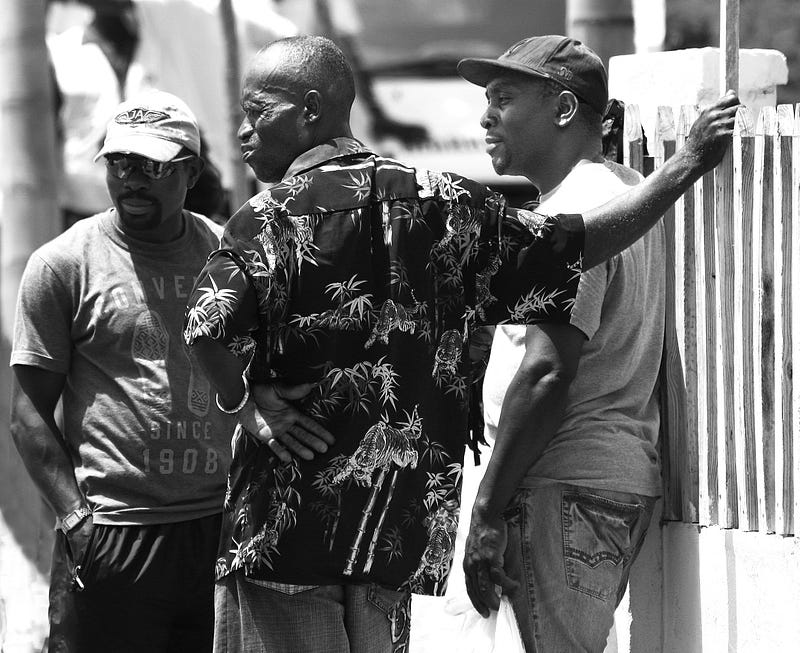
Three Men by Rennett Stowe is licensed under CC BY-NC-ND 2.0
The sad reality is that even as a black man, who’s been around black people my entire life, I will be more likely to be suspicious of a large group of black youths congregating than I would with a group of white youths. That’s only for me to have to check myself for what is essentially racial profiling of my own people. Rapper and activist Akala said the same of his initial thought of suspicion when seeing a fellow black male paying in a large amount of cash at the bank, again, only to have to check himself for succumbing to racial assumptions.

Despite both being black men, society’s successful racist conditioning has caused us and others to identify with a negative perception of those in our own image. What a win for racism and a failure on our part to recognise and stem it from happening.

It could be argued that the openness of the black community places us in a better position to address this and to have the conversations that other communities instead ignore. Though we aren’t taking advantage of that and we’re suffering in our denial that this is necessary dialogue for the community.

In a controversial but incredibly hilarious sketch from his Bring the Pain HBO special, Chris Rock spoke of the distinction between most black people and the minority that feed the stereotypes we face -
“Now we’ve got a lot of things, a lot of racism in the world right now, Who’s more racist? Black people or white people? Black people! You know why? Because we hate black people too! Everything white people don’t like about black people, black people REALLY don’t like about black people. There’s some shit going on with black people right now. There’s like a civil war going on with black people, and there’s two sides. There’s black people and there’s n******. The n****** have got to go”.

Putting aside subjective views on use of the n-word, amidst my uncontrollable laughter I immediately identified with such a brilliant articulation of the frustrations I had as a black person with a few within my own community. There was us, the majority of black people who made being black a privilege and something to be celebrated. And then there was them; the minority whose foolishness and ignorance the rest of us have to suffer the stereotype for.

The sketch divided black people. Rather than being owned as an experience of most black people in distancing ourselves from negative stereotypes, some viewed it as airing our dirty laundry in public. Did those people not think it was bit late to be concerned with that given those stereotypes were already in the mainstream?

The fact is, every ethnicity has those bad-minded few that don’t reflect the masses but do push negative stereotypes. Yet rather than acknowledge the very home truths that we need to face and address in order to progress, we’re failing to reflect and act.

In countries where the black diaspora can be found, we make up a shockingly disproportionate amount of the prison population and are subject to disproportionate racial profiling by police. The US is another kettle of fish with not only institutionally racist police forces but that being accompanied by well documented police brutality that’s encouraged by the douchebag-in-chief. In the UK, the racial profiling similarly exists against a history of tension between the police and the black community.

Racial profiling by police in the UK can’t be denied. Like most black males, I’ve been stopped by the police (something many non-blacks have never experienced). Furthermore, if they’re looking for a suspect, surely we don’t all look the same. Yet what we also can’t deny is that violent crime occurring within the black community seemingly isn’t going away. And if the police wanted an excuse for their racial profiling, that’s given it right to them.

Again, it’s a minority of black people responsible. Nevertheless, it’s enough to warrant acknowledgement and urgent addressing when black youths killing other black youths happens to the extent that it is. White youths kill each other too in the same sad circumstances that are also against a backdrop of deprivation and a lack of education. But when you make up around 3% of the population, as black people in the UK do, it becomes a much alarming reality.

I’ve previously written about the legacy of slavery on the black diaspora and the aforementioned can clearly be traced back to this. Centuries of being dehumanised and perceiving ourselves as inferior has permeated the black psyche to an extent that even today, we’ve been programmed to see the price of our own black lives as cheap (while the establishment continues to push that narrative for us and everyone else). This isn’t said to justify crime within the black community but rather to explore its deep rooted causes that have worsened with deprivation. Nonetheless, this is a problem that exists now and needs to be addressed.

Sky Sports boxing pundit and boxing historian, Spencer Fearon, tweeted his support for stop and search as a tool to address the rising gun and knife crime within the black community. That’s despite black people being eight times more likely to be targeted than white people. However, his comments came following him attending two funerals of black youths in the past month, both due to gun crime.

The disproportionate targeting of black people being stopped and searched is a clear indicator of racial profiling by the police. Although in the context of violent crime in sections of the black community, Spencer Fearon acknowledges a pressing issue that can’t be ignored. Whether or not you agree with him, it’s a necessary conversation that we aren’t having and to the detriment of our community. Meanwhile, black youths are succumbing to our inactivity on the matter while bad apples are allowed to have such an adverse effect on the community.

The experience of the black diaspora around the world is similar. We aren’t having the difficult conversations necessary to progress as a community. We have successes to celebrate which we need to build upon but we also have to address the challenges that we face. Unlike other communities, our difficulties are already in the public domain which exacerbates how negative we look to others when we fail to address them.

Acknowledgment, dialogue, cooperation and action need to be forthcoming within the diaspora. Otherwise, we’ll remain stagnant as a people and continue to succumb to the actions of the minority. Every community has them, ours are just out in the open making it that bit worse for the rest of us.
SHARE:

Saturday, 3 September 2016

Channel 5’s Gangland wasn’t about uncovering gang culture, it merely perpetuated ignorant and negative stereotypes of black youths and the black diaspora

As part of a two-part documentary, Channel 5 recently aired the first episode of Gangland (at the time of writing, the second episode is yet to be aired). Gangland was advertised by Channel 5 in fairly broad terms as essentially an exposé into London’s gang culture. In fact, here’s exactly what Channel 5 said on its website:
Gangland is an original two-part documentary that gains unprecedented access to London’s most notorious young gangs, as they document what life is really like as part of a contemporary gang.
Like many people who decided to tune into Gangland, I expected balanced journalism that would explore the factors that led some youths to gang culture, the failures of society and the individuals in gangs that prefigured their involvement of said life and cautionary tales of those that have since renounced being in a gang through their own expectedly dire experiences or indeed lucky escapes.

Given it was set in London, I also expected the programme to cover gangs of all ethnicities in reflecting London’s ethnic diversity. All of this I thought would be presented against a backdrop of life in a gang that would reflect Channel 5’s social responsibility as a mainstream broadcaster, but also with an approach that showed the seriousness of gang culture in the city.

Alas, perhaps I asked for too much as all Channel 5 delivered with this show was an epic failure that perpetuated ignorant and negative stereotypes of black youths. That’s right, only black youths. Aside from the white girlfriend of one of the protagonists (who felt he was going to beat a case due to no evidence - yet Channel 5 have hours of footage of him incriminating himself), every person interviewed was black.
Gangland’s producer, Paul Blake, spoke of his motivation in making the documentary in the Guardian. The Guardian wrote ‘Blake spent over a decade trying to get a documentary made which would give voice to the thoughts and motivations of gang members’. Blake added “this documentary was born from the fact that I am a black man, born in this country, and I was just pissed off that no one cared about these young black kids who are dying”.

Perhaps that was his motivation and maybe even what he presented to Channel 5 before they requested he amend it to what we saw on our screens. Unfortunately, it isn’t what was achieved with Gangland.

For anyone aware of gang culture, the majority of what was aired on Gangland would not have tallied up with that perception. As a friend said to me, it was like watching a parody for the most part. If you’re in a ‘notorious’ gang and willing to come on a terrestrial channel, barely, if at all, disguising your appearance, and never disguising your voice while talking unimaginably recklessly in incriminating yourself and your peers, you really aren’t about that life. And if you really are in that lifestyle yet still talking like that, then as DJ Khaled would say, “you played yourself” and everyone else around you.

The black youths (because just to remind you, Channel 5 either couldn’t find any non-black gangs or gang members because they seemingly don’t exist in London) who were willing to brandish guns while talking about what they were willing to do, started off as uber cringeworthy. It was akin to many of the American rappers we’ve seen in the UK doing their very best to convince us they’re “from the hood” or a bad caricature of World Star Hip Hop. Attack the Block (and I don’t say that with any kudos for that film either) had more credibility than their utterances and I couldn’t take them seriously. But I quickly went from cringing to being flabbergasted at what I was watching.

One alleged gang member, safe in the knowledge that Channel 5 would never betray his location or any other personal information by which he could be located and identified, spoke about how he’d save a bullet for the police. All the while, they brazenly exposed operations as they spoke more and more with zero caution for themselves and anyone connected to them. Section Boyz might have said ‘trapping ain’t dead’ but those that appeared on Gangland appeared to be trying to bring it to death’s door via Channel 5 along with lengthy prison sentences supported by copious amounts of evidence. The lifestyle they purported clearly isn’t one to be glamourised but their incautiousness beggars belief.

The documentary portrayed the black community as idiots and individuals for whom the price of life is cheap. The reason I don’t caveat that as ‘black gang members’ rather than the black community is because if you aren’t acquainted with black people and perhaps live in a largely ethnically homogenous part of the UK, you might think all black people were like the image shown on the documentary as every person on the show was black.

It’s not as if the mainstream media don’t already drive a racist narrative to the extent that the black diaspora is still faced with prejudice based on such portrayals that we spend our lives refuting. Just look at the media’s annual reporting on the Notting Hill Carnival in contrast to the class A drug-fests that are many festivals yet the latter rarely gets bad press. I commented to a friend that I hoped my in-laws weren’t watching Gangland as they might think whenever I said I was cooking hard food for dinner I might have actually meant drugs rather than breadfruit and green banana.

Gangland left me angry and confused at those who agreed to be on the show but also at Channel 5. I don’t expect Channel 5 to do any favours for the black diaspora but I do expect a broadcaster to show some social responsibility and they have failed in achieving that with Gangland. The documentary wouldn’t actually be amiss on Fox News in a UK special presented by the vile Katie Hopkins.

Of the participants of the show, they were young and presumably eager for a platform to portray themselves in a way that they felt was credible. That in itself is incredibly sad that they’ve mistaken a life of violence and reckless talk as something to pursue and perhaps had no mentors, elders or voices of reason and experience in their lives to show them otherwise and more so so advise that featuring on this documentary was a terrible idea. Any ‘serious’ members in a gang, past or present, would have promptly advised them of that. Nonetheless, I should add that I’m not excusing those that appeared on the show.

The only credible individual of the documentary was Quincy, a former gang member who sought to be a cautionary tale for the life he once lived. Yet even the final edit of the programme seemingly tried to suppress that message. Furthermore, the ignorance that filled the remainder of the broadcast was what Channel 5 deemed more appropriate to air.

Gangland was an opportunity to raise awareness of real problems in London on a platform of balanced, investigative and analytical journalism that explored causes, motivations and solutions. Instead it became a showcase for 60 minutes that lacked credibility and furthered the media’s often racist narrative of negative stereotypes of black people.
SHARE:

Monday, 2 May 2016

Are ethnic minority Tories a paradox or a representation of progress within the Conservative party?

When most people think of British politicians and the British political class, they think of white, middle-aged, middle-class men with a stronghold of support from Middle England. And broadly speaking, they’d be right. Although within contemporary history, there has been a shift and albeit limitedly, progress has been made in bringing further diversity to politics. Women have become a feature of British politics with a female former British Prime Minister in Margaret Thatcher and a female First Minister of Scotland in Nicola Sturgeon. In 1997 when Labour were elected to power, 101 of their MPs were female which prompted the Daily Mail to coin the somewhat misogynistic label of ‘Blair’s Babes’.

For ethnic minority politicians in the UK, their increase has been less prolific but still visible. Where ethnic minority politicians have been most noticeable has been within the Labour Party, which is hardly surprising given their track record on promoting and legislating equality for all minority groups. That’s in contrast with the Conservative Party’s historically hostile reception towards immigrants and its resistance to equality for any minority group other than the ‘1%’ who comprise many within the party and bankroll them. As a result, and unsurprisingly, minorities have typically aligned themselves with the Labour Party or the left.

Firstly, let’s not pretend that the Labour Party and the broader left is, or always has been, void of prejudice or always promoted equality. The female sewing machinists at Ford’s Dagenham plant were initially not supported by their trade union in their 1968 strike for equal pay. Furthermore, while Labour and the trade unions have a long and proud history of supporting ethnic minorities, many post-war immigrants were met with hostility by many within the trade union movement. Factions echoing the irrational and unfounded fears of some of their members claimed that immigrants were taking the jobs of the indigenous white British. This was despite an acute labour shortage following the war. Such undertones could also be be felt within the Labour Party at a time when broader British society and politics was arguably subject to much institutional racism.

Nevertheless, it was Barbara Castle, a Labour MP and the then Secretary of State for Employment, who intervened in the the Ford machinists’ strike and a Labour government that was responsible for the Equal Pay Act 1970 that the strike action helped to bring about. It was also a Labour government that was responsible for the Race Relations Act 1965 which many Labour backbenchers actually argued didn’t go far enough. Indeed, while it hasn’t been without blemish, the Labour Party and the left has a long and celebrated history of promoting equality for all minorities, which can’t be said for the Conservative Party. Even as recently as 2013, the Conservative Party was split over same-sex marriage with 136 voting against it while only 127 were in favour. Historically, equality hasn’t really been their forte.

During the 1964 general election campaign, Conservative parliamentary candidate Peter Griffiths used the slogan “If you want a nigger for a neighbour, vote Labour.” He was subsequently elected. In 1968, Conservative MP Enoch Powell gave his infamous and inflammatory Rivers of Blood speech, harshly criticising immigration from the Commonwealth and race relations legislation. Despite not openly to the extent of Powell’s utterances, the Conservative Party retained undertones of prejudice that merely fanned rather than quelled the flames of institutional racism within British society at the time.


Conservative MP Oliver Letwin’s remarks and attitudes on the black community, recently released in a 1985 memo discussing the Broadwater Farm riots in Tottenham, show that racism within the Conservative Party was enduring. The lack of proportionate censure from today’s Conservative Party suggest that such comments might not go amiss now either, an assertion that Zac Goldsmith’s casual Islamophobia and dog whistling in his smear campaign against Sadiq Khan actually supports. And juxtaposed with the recent suspensions of Ken Livingstone and Naz Shah from the Labour Party, which David Cameron also called for, where was David Cameron’s reproach for Boris Johnson's racist and colonialist rhetoric on Barack Obama or much of Zac Goldsmith’s Islamophobic and divisive mayoral campaign?


The modern Conservative Party has sought to lose the tag of ‘the nasty party’ and reject the racist elements of its history. It can also boast a number of ethnic minority MPs such as frontbenchers Sajid Javid, Priti Patel and and Sam Gyimah. The Tories have undoubtedly progressed from the days when even an ethnic minority backbencher would be unthinkable and that should be lauded regardless of one’s political persuasion.

It’s also important to emphasise that not all Tories, regardless of ethnicity, are racist. Many are committed to equality and positive race relations even if their party’s history may suggest otherwise. Nonetheless, for many ethnic minorities, including me, the party’s still-raw history of racism towards our immigrant grandparents and parents and those of us that were born in the UK, along with its poor track record on race relations and equality in general, make it difficult to support them as a party. After all, some of those sentiments are apparent in today’s Conservative Party. Yet oddly, this isn’t the perception amongst all ethnic minorities.

For many immigrants, there is an experience and a narrative of arriving in a new country with very little but a can-do attitude and working hard to make a better life for yourself and your family. That narrative is fulfilled to varying extents but there are many diaspora communities who have shown admirable and impressive graft and business acumen that has resulted in successive generations steadily climbing the often greasy pole of social mobility.

Ugandan Indians refugees arriving in the UK
Take the Gujarati community, many of whom were forced to leave East Africa to rebuild their lives in Britain. Many become proprietors of newsagents and convenience stores in the UK, working long hours with a stakhanovite work ethic while family would often comprise their staff. Though subsequent generations have moved away from small business retailers and into roles such as finance, medicine and dentistry. They aren’t the only ethnic minority group with a similarly story either. Regardless of race, it’s the very narrative that is celebrated and encouraged by the Conservative Party - work hard, create jobs, don’t rely on the state and you’ll be successful.

Many second and third generation ethnic minorities from immigrant families share less of the experiences of the generations before them. Racism is less overt than it once was and class has superseded race as a social determinant of how we identify ourselves and with whom we identify with. Take a British doctor of Gujarati descent. His parents may have faced racism upon coming to Britain in the 1960s where they may have worked in an unskilled sector. As working class ethnic minorities, they would have been typical Labour supporters. Whereas his experiences are acutely different to that of his parents with less required graft and subtle and less barriers to social mobility, he will likely see himself as middle class with a life that is more aligned to the Tories.

Capitalism and social mobility often has a way of making an ethnic minority metaphorically lighten the hue of their skin tone in how they perceive themselves. That’s reflected in how they might vote too. I’ve seen ethnic minorities deem a decent job and a good socio-economic status to equate to needing to vote Conservative because it’s who they feel the type of person they now identify with should vote. They no longer feel aligned to the tales of the parents but instead that of Middle England and the political class. Perhaps such perception is valid. After all, I can’t dictate how someone identifies themselves. What I can be sure of, is that Middle England certainly don’t identify with them and they’re barking up the wrong tree if they think differently. No amount of money and well-spoken delivery will change that either.

Ignorance too has played a role in the growth of ethnic minority support for the Tories. During the previous general election campaign, a middle class Asian female Tory voter that I know foolishly claimed that they were voting Conservative because “Labour had ruined the economy” and proceeded to attribute the global financial crisis to Labour. Was that the same Labour Party that hadn’t been in power for five whole years? The Conservative Party’s ploy of blaming everything under the sun on the previous Labour government must have had some effect as some voters were clearly stupid enough to recycle the same trite argument for the coalition government’s failures. Said individual also works in finance which compounds her ignorance. Even sadder is that as a woman and an ethnic minority, she would have personally benefited throughout her life from legislation introduced under previous Labour governments.

It’s lamentable that some ethnic minorities have such short memories when it comes to the Conservative Party, their values and how they treated our grandparents and parents when they arrived in the UK. A generation later and with a bit of money and a decent job, some ethnic minorities are voting Conservative but can’t even articulate why other than an underlying belief that Conservative policies might make them a bit more cash while trodding on the less fortunate in society - the same people their parents may once have been only a few generations ago.

The Conservative Party might be deemed the party of business and enterprise which ties into the immigrant narrative for many. But we need to ask ourselves, are they the party of ethnic minorities? Alas, while those features needn’t and shouldn't be mutually exclusive, for some factions within the Conservative Party they probably are and would-be ethnic minority Conservative voters need to remember that.

I need to emphasis that I’m not suggesting ethnic minorities can’t or shouldn’t vote for the Conservatives if that’s where their values lie. Democracy affords us the opportunity to support and vote for whoever we desire and that can’t ever be criticised or restricted. Moreover, it isn’t right to hold today’s Tories to the ills of their history and it would be unfair to imply that as a party they haven’t made any progress in representing the ethnic minority electorate. Though we need to ask ourselves how far and how meaningful that progress has been. We also need to consider how representative ethnic minority Tory MPs are of the broader ethnic minority experience and the party’s failure to robustly tackle the institutionally racism that is still present in today’s Conservative Party. Consequently, while ethnic minority Tory voters represent some progress for the party, there is still something quite paradoxical about them. Fortunately for the Conservative Party, they don’t seem to see it for themselves.
SHARE:

Thursday, 31 December 2015

Oliver Letwin’s remarks aren’t just a product of their time, they’re a product of the Conservative Party

The recently released memo revealing Conservative MP Oliver Letwin’s remarks and attitudes on the black community are not a good reflection of the Conservative Party. And certainly of Letwin himself. Although while they may have been made thirty years ago, how much can we assume has actually changed about the views of Letwin and many within the Conservative Party? Well, relatively speaking, thirty years isn’t that long and given the old boys club that is the Conservative Party, probably not very much.

Letwin’s views aren’t just racist, they show the class prejudice that is at the centre of the Conservative Party. Thus, they characterise the party and its attitudes. In response to the memo, Trevor Philips said “I don’t think these remarks would have raised a single eyebrow at the time” and amongst all the mainstream parties, perhaps they wouldn’t have. What stands out though is how they could easily be the content of Conservative Party policy discussions today.

Just consider what was put forward by Letwin (along with Hartley Booth, another Tory MP at the time) regarding the Broadwater Farm riots and others that occurred at the time. It wouldn’t be amiss today from the same party it emanated from thirty years ago ­­–

"The root of social malaise is not poor housing, or youth 'alienation' or the lack of a middle class....Lower-class, unemployed white people lived for years in appalling slums without a breakdown of public order on anything like the present scale; in the midst of the depression, people in Brixton went out, leaving their grocery money in a bag at the front door, and expecting to see groceries there when they got back...Riots, criminality and social disintegration are caused solely by individual characters and attitudes. So long as bad moral attitudes remain, all efforts to improve the inner cities will founder...Riots, criminality and social disintegration are caused solely by individual characters and attitudes. So long as bad moral attitudes remain, all efforts to improve the inner cities will founder...[Lord] Young’s new entrepreneurs will set up in the disco and drug trade; Kenneth Baker’s refurbished council blocks will decay through vandalism combined with neglect; and people will graduate from temporary training or employment programmes into unemployment or crime."

If in years to come released papers showing policy discussions around the England riots in 2011 (which started in Tottenham, the location of Broadwater Farm) have the same sentiments, I wouldn’t be surprised. Furthermore, it would show just how little attitudes in the Conservative Party haven’t changed within contemporary history.

The undertones of racism have long been present in mainstream British politics but especially within the Conservative Party. During post-war immigration to the UK, all British political parties exhibited xenophobia but none more so than the Tories. Indeed, I’m often flummoxed by the short memories of many ethnic minority supporters of the Tory Party, who feel that the Tories will protect and further their social mobility, when they fail to reflect on the party’s history of policies and attitudes that smack of racism. After all, Margaret Thatcher, subsequent leader of the Conservative Party, referred to Enoch Powell’s 1968 Rivers of Blood speech as “strong meat”; not merely highly inflammatory racism. I doubt the many East African Asians and other immigrants arriving in the UK in the same year would have considered it in the same terms. Yet some subsequent generations of said communities are today Tories who ignorantly feel the party reflects their middle class status.

To be clear, I don’t think all Tories are racist. While I’m clearly not a Tory myself, I know many people who are and they’re undoubtedly committed to equality and positive race relations. Ideologically we just don’t agree on everything while somethings we do. I do, however, think that the party machinery of the Conservative Party hasn’t rid itself of racism, nor do I think it’s made much effort to either.

The image of the ‘nasty party’ is one that publically, the Tories have seemed to want to dispel. But returning to Letwin’s remarks, they pretty much support that perception. Letwin may have apologised, albeit with no real contrition. At the time of writing, David Cameron, as Prime Minister and leader of the Conservative Party, has made no comment let alone shown reproach in reference to the utterances of a senior and influential member of the party. And he certainly hasn’t condemned Letwin, retrospectively or otherwise. Unsurprisingly really from a man who shows little understanding of the racist and prejudiced rhetoric that has long existed within his party and indeed British history.

The right-wing media too has had little vitriol for Letwin and his remarks and there is a disheartening lack of public outcry with the same effect. Though as a figure of public life, I feel Letwin should resign. If Cameron sincerely wanted to rid his party of the tag of the nasty party, and show his commitment to leading a government where racist views had no place whatsoever, he would have requested Letwin’s resignation himself. Alas, the ‘nasty party’ image probably appeals to the section of the electorate, British society and business whose favour Cameron is keen to court.

The Letwin story should be huge news. A senior, high profile and influential member of the Conservative Party who’s made these remarks, and who is currently serving in the Cabinet, should be met with widespread censure. But as he’s a Tory, perhaps it doesn’t seem so out of place. That and his comments are directed at black and ‘lower class’ communities, groups who are seen by many as inferior to others within British society. Indeed, had comments been revealed with such prejudice toward other communities and minority groups such as the Jewish Diaspora, women or the disabled, would the response have been so lukewarm, even after thirty years? I doubt it and rightly so. Similarly, I doubt Letwin and other high profile Tories have completely rid themselves of such views either.

The Conservative Party may have tried to modernise and appeal to a broader section of British society. Nonetheless for many, they’ll continue to be the nasty party that Cameron et al have at times sought to refute. The lack of distance between Letwin’s thirty-year old remarks and many of the attitudes that are still present in the Conservative Party and some of its supporters today, proves just that.
SHARE:

Saturday, 31 August 2013

The unlikely taboo of interracial relationships


Despite improved race relations and the progress of multiculturalism, for some, one area that should remain sacrosanct to such progression is interracial relationships. Consequently, and as an undeniable feature of modern society, interracial relationships have remained an unlikely taboo for some.

Being in an interracial relationship, I’ve been fortunate to not have experienced tangible resistance from either family and certainly not with any hostility. There have been undertones of cautiousness on both sides but that’s been largely based on ignorance of the other’s culture and how to respond to it. And with my partner’s community being fairly insular, initially, I literally represented the unknown for her family.

With some people, and behind a smokescreen of disingenuousness, we’ve both observed unspoken sentiments of disapproval toward our relationship. It’s a minority view but not one held by individuals who we have any real relationship with or respect for. Nor is it a view that has ever been articulated – which is just as well as said individuals’ opinions are of no value to us. Though admittedly, knowing that you are the source of any disapproval from even the smallest factions of your partner’s family or community is not a pleasant feeling.

Particularly if any opposition stems more from your partner’s side than yours, it’s easy to see yourself as the indirect source of any potential anguish for them or the reason for them needing to become more resolute in their convictions. It can also lead to a feeling of helplessness and regret; not of your relationship but of what you feel you represent on some level in causing an issue. Conversely, for the other person, an unwarranted feeling of resentment toward their family and community, and a sense of guilt that they come from a background that exhibits prejudice wrapped in backwards ideals, is an unescapable emotion.

Nonetheless, neither of us will ever lament the fact that we aren’t of the same ethnicity simply because it doesn’t meet blanket approval. Both of us are proud of our respective heritage and nothing will change that or cause us to suppress either culture within the relationship. We embrace each other’s culture which is something both our families appreciate and has arguably mitigated any challenges we may have faced.

Thankfully, we haven’t experienced the problems encountered by some interracial couples. I know of interracial and interreligious couples whose families and wider communities have not been receptive to their relationship whatsoever. For some, that’s meant having to choose between their relationship and their family – with the ultimatum being directly or indirectly made by the latter. In response, some couples have shown great courage that I have the utmost admiration for and they’ve pursued their relationship at the risk of being ostracised by either family. Whereas for some, their family was too great a sacrifice to make. Especially against a backdrop of prejudice from a family, many would argue that pursuing the relationship is the right thing to do in such instances. Although, regardless of the decision, it's undoubtedly an emotionally charged predicament.

Interracial relationships and people of mixed race have become commonplace in modern society and the prejudice they were once met with has certainly receded in recent years. The Melting Pot Generation – How Britain Became More Relaxed About Race, a report published by think tank British Future, also found that in contrast to 50% and 40% of the British public admitting to being opposed to interracial relationships in the 80s and 90s respectively, that figure was 15% in 2012. That’s a huge improvement. But with a population that exceeds 60 million, 15% can’t be discounted as merely a handful of people with archaic attitudes.

The 2001 UK census reported that 2% of all marriages were “inter-ethnic”, a figure that will surely be shown to be growing once the respective data is released for the 2011 census. In the interim, and as a measure of the increasing number of interracial relationships in the UK, the 2011 census data shows that the mixed race population is amongst the fastest growing and forecast to become the largest ethnic minority group in the country. In America, the 2010 census also reported that “interracial or interethnic” cohabiting married couples grew by 28% between 2000 and 2010. With such a trend, how have interracial relationships therefore managed to remain taboo for some?

It may not always be overt, and in many cases is culturally or even generationally institutionalised, but prejudice is what underpins opposition to interracial relationships. Yet many who hold said opinions would probably argue to the contrary. Some would claim that their opposition is based on their perception of the lack of viability of an interracial relationship and a fear of their culture becoming diluted. They’d allege that’s in contrast to a relationship where the couple at least share their heritage if nothing else. Many would also pledge their commitment to multiculturalism, citing their indifference to colleagues, neighbours and even friends of a different background. However, for them, the intimate sphere of a relationship is a line that that indifference cannot and should not cross.

Granted, and potentially coming to the fore in raising children, some interracial couples may experience challenges of different cultural expectations or different cultural values within the relationship. Where applicable, language barriers with each other’s families, not to mention a possible frosty reception to the relationship, can also present problems. Although in a multicultural society, aren’t these problems mitigated by multiculturalism itself? And when taken outside the context of race or indeed religion, aren’t differing views challenges that all couples may be faced with, regardless of their respective backgrounds?

The assertion that interracial relationships signal the end of a culture’s identity is unfounded. Multiculturalism shapes new identities and, as a frequent by-product of interracial relationships, the mixed race population provides a growing ethnic group that with it brings new hybrid identities and cultures. Though that needn’t cause a culture to become extinct. In a diverse society, cultural identities can just as easily become eroded within a couple of the same ethnicity and heritage. Therefore to pin that on interracial couples is a charge that is tinged by ignorance, prejudice and irrational fear.

Beyond their prejudice, those who maintain an opposition to interracial relationships may see it as a gradual attack on their own race, culture and accompanying values and identity. But in maintaining their view, they’re unwittingly or otherwise resisting the virtues of multiculturalism and holding a belief that has little reasoning behind it. Furthermore, ironically, the very values and identities they unnecessarily seek to protect and preserve will likely outlive their own backwards and narrow-minded ideals.

For interracial relationships to remain taboo for some is a sad reality that goes against the grain of a racially diverse society. Fortunately, it is a view that is becoming increasingly rare and typically met with disgust and disdain. Yet despite the progress made in race relations, the prejudice that fuels this opposition hasn’t been completely eroded; until it is, there will always be individuals who simply don’t agree with interracial relationships.
SHARE:

Saturday, 16 March 2013

Can cultural values and identities survive within second generation diasporas?

My parents, and the parents of many of my peers, came to the UK as part of the wave of emigration from former British colonies to “the mother country”. They had spent up to their formative years in the Caribbean and fully assimilated the culture of their respective nations before arriving in the UK. Their story is typical of the time, especially for those emigrating from the Caribbean, South Asia and Africa where colonial ties, labour shortages in the UK and rising unemployment in former colonies were just some of the contributors to the UK becoming a new home for many. This was also the case for America, Canada and several countries in Europe throughout the twentieth century. Consequently, immigrant communities have since seen second generations born in states other than those of their origin.

As a by-product of immigration, ‘hybrid’ cultural identities have developed. These reflect cultural heritage while embracing the values and identities of the countries in which these communities currently reside. But what of these diasporas’ ‘original’ cultural identities? Have these become diluted as second generations form their own identities that may supersede what their parents and grandparents knew? And if so, is it only a matter of time before said cultures become diminished?

Being born to West Indian parents, I share an affinity with the respective nations of my parents and of course the land of my birth. On the former, I’m familiar with the culture, I understand the dialect of my parents’ respective nations and I’m aware of the region’s history and current affairs. And while my cooking might not be anywhere as extensive of a culinary repertoire of West Indian food as my parents, it’s to an extent that can reflect my heritage within my diet.

On the other hand, there are some of my generation that aren’t well-versed with the culture and heritage of their family background. This begs the question whether or not they will be able to pass on their parents’ culture to their own children. And with the increase of interracial relationships, preserving one’s culture can be perceived as an even bigger, but not insurmountable, challenge when it comes to subsequent generations.

As a young child, learning of your parents’ culture is often embraced. Tales of rich experiences that differ from those of your peers provide something tangible that also offers an explanation for your own identity. Going to a Saturday school or similar to learn the language and culture of your family is a common experience for many ethnic minority children – and one that often isn’t questioned. That’s until adolescence when it then becomes the reason why you can’t go to the park or the cinema with your friends whose weekends don’t include such activities. As a result, what was once enthusiasm for learning about your culture can sometimes turn to resentment and apathy, at least until you gain the maturity to appreciate it. Of course, this isn’t the case for everyone but it’s an experience I expect many can relate to. It can also be a turning point in observing any diminishing of cultural roots within the second generation of a diaspora.

For many, multiculturalism rightly shapes new identities and a compromise has to be made between the culture experienced at home and outside. This isn’t negative and often the two can complement each other. Furthermore, it needn’t signal the extinction of identities and values experienced in the home and amongst family.

The size and insularity of a diaspora can add to the strength and longevity of a culture. While the latter might not contribute to healthy multiculturalism, it does however, help to preserve culture. A sizeable community too can help to retain links with the country from which it migrated, often forging cultural and economic links that create a reciprocal relationship. After all, if a community seeks access to authentic cultural experiences, the country from which it migrated is happy to serve thriving and profitable markets overseas.

The availability of Bollywood and Nollywood films catering for the large audiences outside of India and Nigeria respectively, illustrate this. Similarly, the south Asian wedding market outside of the Indian subcontinent is a huge industry that south Asians worldwide heavily contribute to.

As long as a diaspora exists as a profitable market, the more likely the country it migrated from will continue to provide it with the cultural ties it yearns. And in an age of the internet and e-commerce, the barriers that may have once restricted this are increasingly disappearing.

Language too provides a preservation of culture. It’s a binding feature of shared identity, even for those that have never set foot in the land from which it originated. Indeed, I have many British born friends whose first language was actually the language of their parents instead of English. While I have mixed views on this (I think it’s more appropriate that both languages are learnt alongside each other, rather than the learning of English being secondary or not until school, to enable a child to fully communicate and integrate into British society and in the home), I do consider it important for second and subsequent generations to learn the language of their family. Language is an enduring feature of any community’s identity. Moreover, no doubt as a legacy of colonialism, it’s something that regrettably doesn’t exist to the same extent within my own culture where local dialects and patios are spoken alongside English.

There are precedents for cultural identities surviving within second generations and beyond. As a nation with a history of immigration, America has Irish, Jewish, Italian and latterly Hispanic communities to name a few, that have retained their cultural identity several generations after they first emigrated. They’ve also experienced a strong presence that has maintained their culture while contributing to American society.

A sense of pride and awareness of one’s culture shouldn’t be lost in subsequent generations, nor should it be at the expense of embracing the identity of one’s place of birth and residence. The key is achieving the balancing act that is the cornerstone of successful multiculturalism and with it, remembering the identities and values of the communities that contribute to it.
SHARE:

Sunday, 2 December 2012

British born and bred, but not British

Being asked “where are you from?” is something most British born ethnic minorities have been asked at some point. It’s a common feature of small talk but there was a time that this could have equally been a loaded question (and a prelude to being subject to some casual or candid racism) as it could be out of genuine interest. But as race relations have improved, most would argue it’s now more likely to be the latter.

For many, the generic response to that question is a caveated reply of “I was born here” or “I’m British”, followed by “but my parents are from…”. There’s a sense of having to fully account for your identity in being British but also reflecting the culture of your heritage. It’s not a rejection of either culture but more an attempt to balance them, illustrating the difficulty sometimes presented in being born of a diaspora that isn’t the land of your birth.

Growing up, this was a common response from my peers and I as we struggled to articulate that in essence we were from more than one place. As an adult, I’m able to better articulate those sentiments but I have found myself sometimes calling upon variations of “I’m British but my parents are from...”. Nonetheless, I have found that stopping at “I’m British”, or even claiming my parents’ nationalities as my own, is something I’m more comfortable with unless I’m prompted for more information. That isn’t because I feel any less black, Caribbean or British. If anything it’s the opposite. I don’t feel I need to justify my identity because I am sufficiently assured of it, regardless of what my response is.

However, for some, their experiences are seemingly not the same. Being British born and bred is something they reject. The UK is the place they merely live rather than a source of their identity. Stating that they were born in the UK is done so reluctantly and the emphasis is hurriedly placed upon the place they truly identify with. But why would someone born in the UK reject being British and in some cases do so with perceptible disdain?

Not to evoke Norman Tebbit’s “cricket test” but support for a national team can sometimes be a gauge of how people identify themselves. During the London Olympics, there was an apparent and uncontrived patriotism for the British athletes. People associated with them and wanted them to do well. Like many born in the UK, but with different a cultural background, this was no different for me. Though in addition, I supported the athletes of Jamaica and Barbados as the nations of my parents and places I equally identify with.

Conversely, not all British born ethnic minorities shared my support for Team GB. I found it difficult to understand why some people, born, educated, living and working in the UK all their lives, would openly wish failure upon British athletes and want the games, as a representation of the UK, to fail. Of course, someone choosing to not support a national team may have no bearing on their patriotism whatsoever. Yet when that stance is tinged with contempt and extended to broader British society, it suggests something more telling.

For the generations of ethnic minority communities that experienced racism at its peak in the UK, an aversion towards some aspects of British society can be deep rooted. As I wrote in a previous post, the attitudes of said generation, while not endorsed, can therefore be understood. Though for younger generations, who admittedly are still faced with institutionalised racism, what’s their excuse?

Some ethnic minority communities in the UK have a degree of insularity. As a result, this creates a bubble around them, preventing any other cultural influences from permeating their lives. Language, attitudes, exposure to cultural media and other cultural manifestations, all provide tangible factors to reinforce the influence of their culture and in some cases rejecting that of British culture in doing so. This almost creates a cultural microcosm that exclusively represents the ideals of the diaspora.

For many, despite not being born there themselves, there’s an inherent connection with the land of their heritage. That bond can be strong enough that it supersedes the more tangible link with one’s place of birth. Although unlike how I feel the connection to my Caribbean heritage is balanced with British culture, for others that balance either isn’t desired or is rejected.

For others, there’s an external or internal pressure to reflect the culture of their family and wider community. Externally, an attempt to fully assimilate this may take priority over a desire to achieve a culturally balanced identity. Similarly, and particularly for those within the second generation of a diaspora, there can be an internal conflict in seeking to ensure their ‘original’ culture doesn’t become diluted by that of another. In the process, any sense of being British might be rejected as it’s perceived as a threat to avoiding just that.

An argument can be made that place of birth and residence is circumstantial and has no correlation with identity. And as experiences can shape identity, a sense of ‘Britishness’ isn’t guaranteed merely by virtue of living in the UK. However, that argument undermines the notion of national identity and there are certainly precedents to refute it.

In a diverse society such as the UK, there will be always be people who rightly or wrongly don’t feel any connection to the county of their birth. Yet in critiquing multiculturalism as a social experiment, it cannot guarantee the cohesiveness it promotes and aims to achieve.

The culture of someone’s ethnic background needn’t be and shouldn’t be secondary to that of British culture, nor should it be vice versa. It is possible for both to coexist but some clearly choose for that not to be the case.
SHARE:

Sunday, 19 August 2012

Reverse racism? Sideways racism? No, it’s just racism

Prejudice directed against ethnic minorities by individuals of the majority indigenous (and typically white in a western context) race is the commonly accepted notion of racism. Although when this notion takes a different format such as a role reversal or the prejudice of one ethnic minority group directed against another, this often evokes a different reaction. Indeed, in such instances, often the label of racism isn’t used with the same acerbity that would otherwise be expected. In fact, sometimes the label of racism isn’t used at all. Yet surely all racism is fundamentally the same, even if by another name or no name at all? Moreover, why is racism from those within minority groups not met as it would be in the more familiar context of such prejudice?

In the communities of some ethnic minorities, undertones of racism appear to be inherent and consequently accepted. This is even apparent in some communities where in theory, multiculturalism should successfully challenge such views.

Race relations in western society have generally improved. Racism is generally challenged and largely considered unethical behaviour. However, largely due to political correctness, it has also become somewhat taboo to candidly discuss.

Arguably, this taboo is what hinders any effective challenge to such attitudes existing within some communities. To suggest that an ethnic minority might be racist is less likely to be received with the same abhorrence as suggesting a white person might be racist. A white person making this suggestion could even be accused by others (including other white people) that in saying so they aren’t culturally or racially sensitive.

The difficulty in challenging these attitudes is also compounded by the insularity of such communities. This further limits the scope for such views to be challenged by experience and wider interaction. Even where second and third generations of ethnic minority groups acknowledge these attitudes to be wrong (often by virtue of their increased interaction within a multicultural society), they nonetheless tacitly accept them, rarely deciding to instead become outspoken of what they know is unethical behaviour.

Some might counter that the reason for insularity within some communities is due to the prejudice they may have experienced. This is particularly in instances where immigration has been met with racism and a frosty reception by governments and the wider public. No minority group can be blamed for such a knee-jerk reaction and a disinclination to integrate within a wider society that once appeared so hostile. Nonetheless, this approach has meant any existing prejudices within such communities remain unchecked as individuals are not subject to positive experiences that would otherwise refute these attitudes. Unwittingly, it also supports wider racist views.

Take the sentiments of the BNP. While being interviewed on the BBC’s Newsnight, Nick Griffin, leader of the BNP, was questioned on his view of “mixing races” and if he opposed this. Rather than attempt to gloss over or deny this, he candidly admitted that this was his opinion (and presumably that of his party) but added that this was a view shared by other ethnic minority groups.

Unfortunately, while in a minority, there are sections of some minority groups that would share these views. In doing so, this gives credence to an ideal of a far-right party that doesn’t even support their presence in Britain. It also illustrates the inconsistency of how racism is perceived based on who it comes from.

In his Bigger and Blacker show, Chris Rock examines modern day racism – Black people yelling "racism!" White people yelling "reverse racism!" Chinese people yelling "sideways racism!" Like much of Chris Rock’s material, a lot of truth is astutely said in jest. And while not the central theme of his sketch on race, the notion of varying labels to describe racism is certainly accurate. The idea of reverse racism is often perceived as a form of positive discrimination or positive action but has also been used more simplistically to refer to racism that doesn’t conform to the more familiar notion.

Racism by another name doesn’t change the fact that someone is racist. Yet giving it a different label makes the flawed suggestion of there being some nuance that supports just that. It also perpetuates an irrational and inexcusable rationale that essentially encourages such attitudes.

It’s fair to say that a degree of prejudice exists within everyone and therefore within every racial group. Yet when it remains unchecked, it leads to attitudes that are simply unethical and should not be tolerated by those that choose to accept and ignore them.
SHARE:
© iamalaw

This site uses cookies from Google to deliver its services - Click here for information.

Blogger Template Created by pipdig